







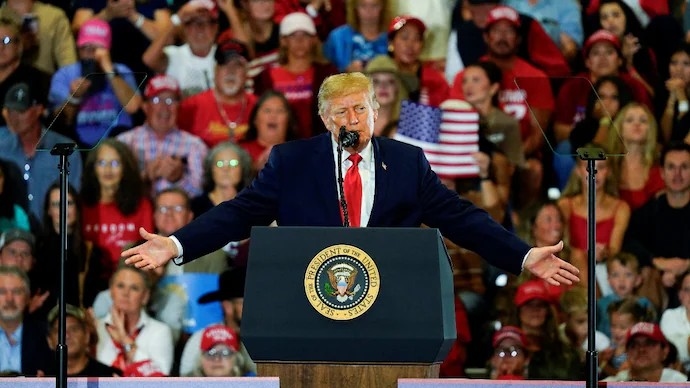


Washington: US President Donald Trump on Friday announced an $8.4 billion enhanced oil recovery project involving South Korea, presenting it as another addition to a broader trade and investment arrangement between Washington and Seoul.
Trump said the project would help increase oil and gas production in the United States and contribute to what he described as American energy security. However, South Korean officials later indicated that the oil recovery project was not included in the strategic investment commitments agreed between the two countries, creating uncertainty over the status of the announcement.
The announcement came shortly after Trump unveiled a package of South Korean investment plans involving a gas-fired power plant in Texas, eight nuclear reactors and a proposed Alaska liquefied natural gas (LNG) project.
Together, the projects form part of a broader $350 billion investment commitment South Korea made under last year’s trade agreement with the United States. The package includes $150 billion for shipbuilding and up to $200 billion for strategic investments in the US.
Trump announces $8.4 billion EOR project
Trump announced the oil project in a post on Truth Social on Friday.
“The Republic of Korea Deal keeps getting BETTER! 8.4 Billion Dollars for an enhanced Oil Recovery Project,” Trump wrote, adding that increased oil and gas production would support American energy dominance and future energy security.
Trump did not provide details about the location, companies involved, financing structure or timeline for the project.
Enhanced oil recovery, or EOR, refers to techniques used to extract additional crude oil from existing fields after conventional production has declined. One method involves injecting substances such as carbon dioxide into an oil reservoir to push additional crude towards production wells.
The technology has long been used by the oil industry to increase recovery from mature fields.
Trump’s announcement, however, was not immediately matched by the South Korean government’s description of its investment commitments.
Seoul says project is not part of agreed package
South Korea’s industry ministry said it was surprised by the announcement and indicated that the EOR project was not among the strategic investments covered by the bilateral agreement.
A ministry official told Yonhap that the strategic investment commitments were limited to projects specified in the joint fact sheet and press release issued by the two governments.
The official also said Seoul had contacted the US side through trade channels to seek clarification about Trump’s announcement.
The disagreement is significant because South Korea has been emphasising commercial viability and legal safeguards while deciding where to deploy the investment committed under the trade agreement.
Seoul’s industry ministry has said that taxpayer funds would be involved in the investment initiative and that profitability, investment recovery and risks would therefore be assessed before projects move forward.
This means Trump’s announcement of the $8.4 billion EOR project does not, by itself, establish that South Korea has formally committed that amount to the project.
$350 billion investment deal forms wider backdrop
The EOR announcement comes against the backdrop of last year’s US-South Korea trade agreement.
Under the arrangement, South Korea committed to invest $350 billion in the United States in exchange for lower US tariffs on Korean goods.
Of that amount, $150 billion was earmarked for cooperation in shipbuilding, while the remaining $200 billion was allocated to strategic investments in sectors including energy and infrastructure.
Washington and Seoul have since been negotiating individual projects that could form part of the strategic investment component.
On Thursday, South Korea and the US formally selected a gas-fired power plant in Texas as the first project under the $350 billion commitment.
Known as Project Star, the facility is planned as a 6,472-megawatt power plant designed in part to supply electricity to artificial intelligence data centres. The project is estimated to cost $22.3 billion, with the first phase of commercial operations targeted for 2029 and full operations for 2032.
Texas power plant gets formal backing
The Texas project has a clearer status than some of the other investments Trump announced.
South Korea’s industry ministry said the two governments had formally selected the project as the first investment under the strategic package.
The project is being developed with participation from companies including Related Companies and NextEra Energy, according to Seoul.
South Korea has said the investment is intended to create a new model of cooperation around energy infrastructure and the rapidly growing electricity requirements of AI data centres.
The project also illustrates the structure Seoul is seeking for investments under the wider agreement: projects must have a reasonable prospect of commercial returns while protecting South Korean investors from excessive risks.
Eight nuclear reactors also proposed
Another major component announced by Trump is a plan for South Korean participation in the construction of eight nuclear reactors in the US.
South Korea’s industry ministry has referred to the initiative as Project Power, with up to $120 billion allocated for the construction programme.
The framework includes $100 billion in construction costs and a $20 billion contingency fund.
The proposal could also involve South Korean companies acquiring a minority stake in Westinghouse, allowing them to participate in the US nuclear market and potentially expand their international business.
However, Seoul has stressed that the broad framework does not mean that specific reactor projects have already been finalised.
Detailed arrangements are still expected to be negotiated between the governments and participating companies.
Alaska LNG project remains uncertain
The Alaska LNG project is another major element of Trump’s recent announcements, but its status has also been subject to differences between Washington and Seoul.
Trump presented South Korea’s investment in the project as part of the broader package and put the value at around $54 billion.
The proposed project would involve a roughly 1,298-kilometre pipeline carrying natural gas from Alaska’s North Slope to the southern part of the state, where the gas could be liquefied and exported to Asian markets.
South Korea, however, has said the project remains subject to a review of its commercial viability and compliance with domestic legal requirements.
The industry ministry has stressed that the two sides agreed to begin work on the project subject to those conditions rather than approving an unconditional investment.
Seoul’s cautious position reflects its broader approach to the $200 billion strategic investment programme, under which projects are being assessed for profitability and risk before funds are committed.
EOR project adds another point of uncertainty
The $8.4 billion oil recovery announcement therefore introduces another potential difference between the way Washington and Seoul describe the investment programme.
Trump presented the EOR project as part of the Korea deal and linked it directly to increased American oil and gas production.
South Korea, meanwhile, has said the agreed strategic investment is limited to projects contained in the bilateral documents and has sought clarification from Washington.
At present, there are therefore different levels of certainty surrounding the projects associated with the $200 billion strategic investment component.
The Texas power plant has been formally selected, while the nuclear programme still requires further project-level discussions. The Alaska LNG project is subject to commercial and legal review, and the newly announced EOR project has not been identified by Seoul as part of the agreed strategic investment package.
Energy production and climate debate
EOR projects can increase the amount of crude extracted from existing oilfields, but the technology has also attracted criticism from environmental groups.
Some EOR operations use captured or naturally sourced carbon dioxide to increase oil recovery. Critics argue that using the technology can extend the economic life of oilfields and prolong dependence on fossil fuels, while questions remain over the overall climate impact of carbon capture and storage associated with such projects.
Trump has instead framed the proposed project around increased domestic energy production and energy security.
The competing views reflect a broader debate in the US over whether technologies that improve fossil-fuel production can be reconciled with efforts to reduce greenhouse gas emissions.
Investment announcements come before US midterms
Trump’s latest announcement also comes as his administration places increasing emphasis on major investment projects ahead of the November US midterm elections.
The President has been highlighting large industrial and energy projects as evidence of economic activity and investment under his administration.
The South Korea package has provided a particularly large platform for that message, with the $350 billion commitment covering shipbuilding and strategic investments across energy and infrastructure.
The announcements have also carried political significance because several of the proposed projects are located in states where economic investment and energy development are important political issues.
However, several projects remain at the planning, negotiation or review stage, meaning the value announced for a project does not necessarily represent money already invested or facilities already under construction.
What happens next
The immediate question following Trump’s $8.4 billion announcement is whether Washington and Seoul will formally add the EOR project to the strategic investment programme.
South Korea’s industry ministry has already indicated that it does not regard the project as part of the investment package agreed in the existing bilateral documents.
Further discussions between the two governments will therefore be needed to establish whether the project becomes part of the deal or remains a separate proposal.
For the broader US-South Korea economic relationship, the disagreement also highlights the challenge of turning a headline $350 billion investment commitment into specific projects that meet both countries’ commercial, legal and strategic requirements.