







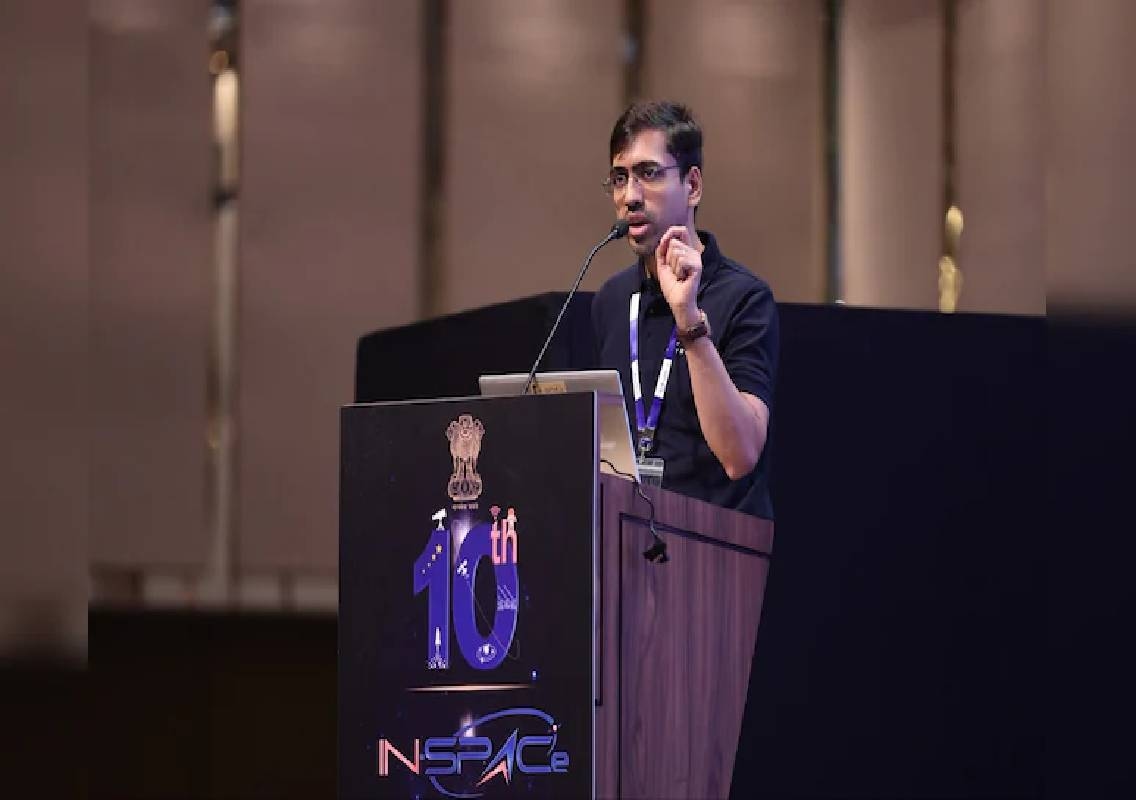


Hyderabad: Skyroot Aerospace has entered India’s space history after its Vikram-1 rocket successfully reached orbit, making it the first Indian private company to achieve an orbital launch. Following the landmark mission on Saturday, an earlier statement by Skyroot Aerospace Chief Executive Officer Pawan Kumar Chandana has resurfaced, in which he described the company’s long-term ambition as becoming the “Uber for space”.
The successful launch marks a significant milestone for India’s private space sector and positions the country among a select group of nations with privately developed orbital launch capability. The achievement is expected to boost confidence in India’s growing commercial space industry while strengthening the country’s ambitions to become a global space technology hub.
Vikram-1 creates history for India’s private space sector
Skyroot Aerospace’s Vikram-1 mission represents a breakthrough for India’s rapidly expanding private space ecosystem. The successful orbital launch demonstrates the capability of Indian private companies to design, manufacture and launch orbital-class rockets, an achievement previously limited to government space agencies and a handful of private firms globally.
The mission comes at a time when India’s space sector is witnessing increased private participation following policy reforms that opened up opportunities for startups and commercial players. Vikram-1’s success highlights the growing maturity of India’s indigenous aerospace technology and private innovation.
The achievement also places India alongside the United States and China as countries with private companies capable of launching payloads into orbit, underlining the country’s expanding presence in the global commercial space market.
Pawan Chandana explains the ‘Uber for space’ vision
Speaking during an earlier appearance on NDTV Profit’s The Disruptors, Pawan Kumar Chandana explained the philosophy behind Skyroot’s business model by comparing it with SpaceX.
When asked about his comparison between the two companies, Chandana said SpaceX could be viewed as a “bus” or a “train” that transports multiple satellites, whereas Skyroot aims to function more like a “cab” that offers customised transportation to specific destinations in space.
According to Chandana, the analogy reflects Skyroot’s objective of providing flexible and dedicated launch services tailored to individual customer requirements.
He explained that satellite operators would be able to book a rocket in the same way people book a cab through a ride-hailing platform. Instead of waiting for a shared launch, customers could send their satellites directly to their preferred orbital location.
To illustrate the concept further, Chandana compared it to everyday travel. Just as people book a cab to reach a specific destination rather than taking a train, satellite companies may require dedicated launches to precise orbital positions. Skyroot aims to fulfil that need by providing customised launch services.
Competing through flexibility rather than size
Chandana’s comments indicate that Skyroot is not attempting to directly replicate the large-scale launch model adopted by companies such as SpaceX. Instead, the Hyderabad-based startup is focusing on dedicated launches for customers seeking greater flexibility and faster deployment schedules.
The growing number of small satellites being developed for communication, Earth observation, scientific research and defence applications has increased demand for launch providers capable of offering customised missions.
Dedicated launch vehicles can reduce waiting periods and allow satellite operators to choose their preferred orbital parameters rather than adjusting to a rideshare mission. This approach has become an increasingly attractive segment within the global commercial launch market.
Beyond satellite launches
Chandana believes the successful development of an orbital rocket opens opportunities well beyond launching satellites.
According to him, rockets remain the only practical means of accessing space today. Once a reliable launch vehicle has been developed, companies can participate in a much broader space economy that could eventually include human spaceflight, in-space manufacturing, orbital factories and even space-based data centres.
He suggested that the commercial space industry is still in its early stages and that reliable launch capability serves as the foundation for numerous future businesses.
As governments and private companies invest more heavily in space infrastructure, reusable technologies and orbital services are expected to become increasingly important over the coming decades.
Focus on reducing launch costs
A key element of Skyroot’s long-term strategy is making space access more affordable and frequent.
Chandana said the company’s primary objective is to develop low-cost rockets capable of flying regularly. He believes reducing launch costs while increasing launch frequency will be essential for expanding commercial activity in space.
His broader vision is to make spaceflight as accessible and routine as air travel is today. Achieving that goal would require advances in rocket technology, manufacturing efficiency and operational reliability.
Industry experts have consistently identified launch affordability as one of the biggest factors determining the future growth of the global space economy.
A milestone for India’s commercial space ambitions
The successful Vikram-1 mission is expected to strengthen India’s position in the international commercial launch market. It also demonstrates the growing capabilities of Indian private aerospace startups following regulatory reforms that encouraged greater private participation in the country’s space programme.
For Skyroot Aerospace, the achievement validates years of research, engineering and testing while providing momentum for future commercial missions.
As demand for satellite launches continues to increase worldwide, dedicated launch providers like Skyroot are expected to play an increasingly important role in serving customers seeking faster, more flexible and cost-effective access to space.
The company’s “Uber for space” vision reflects its ambition to simplify space transportation by offering customised launch services, while the success of Vikram-1 marks a significant step towards making that vision a reality.