










New Delhi: Sridhar Vembu, co-founder of Zoho Corporation, has sparked a nationwide debate after urging Indians living in the United States to consider returning to India, saying the country needs their talent to shape its future.
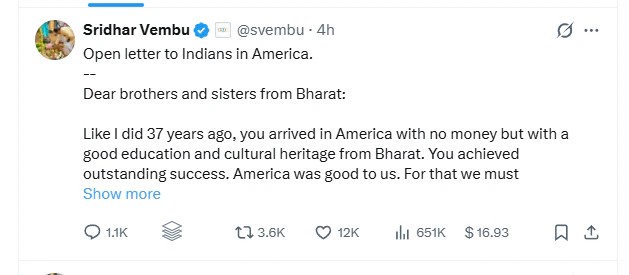
In an open letter shared on the social media platform X, Vembu called on the Indian diaspora to look beyond career growth and financial gains, and instead reflect on their role in contributing to India’s long-term development.
Call for talent to return home
Vembu began his message by acknowledging the journey of many Indians who moved to the United States in search of better opportunities. He expressed gratitude towards America for providing a platform for growth and success.
“America was good to us. For that, we must remain grateful — gratitude is our Bharatiya way,” he wrote.
However, he also highlighted what he described as a growing sense of unease among sections of American society. According to Vembu, some people in the US believe that Indian professionals have taken away jobs or succeeded unfairly, pointing to rising tensions around immigration and employment.
He further suggested that Indians living in the US are caught in a larger ideological divide, stating that they are often bystanders in a conflict shaped by competing worldviews. Without directly naming political groups, he remarked that the situation offers limited long-term stability or respect for Indian professionals abroad.
Linking global respect to India’s progress
At the core of Vembu’s argument is the idea that global respect for Indians is closely tied to India’s own economic and technological progress.
“If India remains poor, the woke left will give us moral lectures with pity and the hard right with scorn,” he noted, adding that neither form of attention translates into genuine respect.
Instead, he argued that true global standing comes from building strong domestic capabilities in technology, manufacturing, and innovation. He stressed that India already has the human capital required to achieve this, but much of it has been utilised abroad.
“Bharat Mata needs your talent”
Making a direct appeal, Vembu urged Indians in the US to consider returning to India and contributing to nation-building.
“As difficult as it is for many of you to contemplate this, please come back home. Bharat Mata needs your talent,” he wrote.
He encouraged professionals to bring back their global experience and mentor India’s younger generation, calling for what he described as a “missionary zeal” to accelerate the country’s development.
His remarks come at a time when India is actively positioning itself as a global hub for technology, startups, and manufacturing, with increasing focus on self-reliance and innovation.
Mixed reactions on social media
Vembu’s message quickly went viral on social media, triggering a wide range of responses from Indians both in India and abroad.
Supporters of his view described the message as a timely reminder of the importance of contributing directly to India’s growth. Some users agreed that respect on the global stage is earned through economic strength and technological leadership rather than perception.
One user commented that India does not just need remittances but the active participation of its skilled workforce. Others echoed similar sentiments, calling the appeal inspiring and aligned with national priorities.
Practical challenges highlighted
At the same time, several users pointed out the practical challenges involved in returning to India. Concerns were raised about comparatively lower salaries, longer working hours, and higher tax burdens without matching improvements in public infrastructure and services.
Some responses also emphasised the need for policy changes to make India more attractive for returning professionals. Suggestions included improving ease of doing business, reducing tax complexities, and strengthening urban infrastructure.
The debate highlighted a clear divide between emotional motivation and practical realities. While many resonate with the idea of contributing to India’s growth, others remain cautious due to quality-of-life considerations and career prospects.
A larger debate on migration and identity
Vembu’s remarks have brought renewed attention to broader questions around migration, identity, and the global role of Indian talent.
As India continues to expand its footprint in key sectors such as information technology and manufacturing, the question of where its skilled workforce chooses to live and work has gained increasing importance.
The discussion also reflects a shift in narrative — from viewing migration purely as an economic opportunity to considering its long-term implications for national development.
Conclusion
While there is no single answer to whether Indians abroad should return home, Vembu’s appeal has undeniably reignited an important conversation. His message blends national pride with economic reasoning, urging a rethink of how talent can best contribute to India’s future.
Whether or not large numbers of professionals choose to return, the debate underscores a key reality — India’s growth story will depend significantly on how it attracts, retains, and utilises its vast pool of talent across the world.