







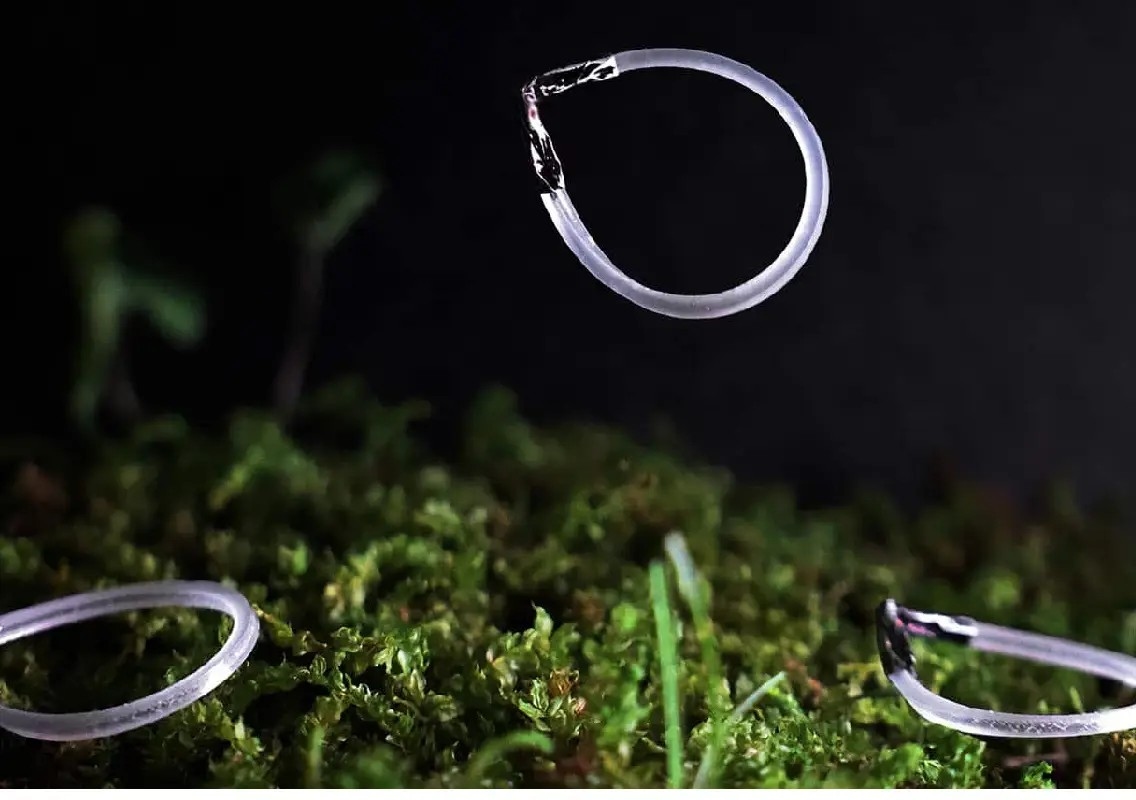


What if a tiny robot could keep jumping without batteries, motors or someone resetting it after every move? Researchers have developed soft robots that can repeatedly leap when exposed to infrared light, opening up an intriguing new possibility in robotics.
A little light sets the robot moving
The tiny robots are made from a flexible material called liquid crystal elastomer, shaped into a teardrop-like ribbon. A thin V-shaped aluminium tube is attached to one end.
When infrared light shines on the robot, the ribbon contracts and starts rotating. The unusual V-shaped structure prevents it from simply rolling. Instead, the movement twists the ribbon and stores elastic energy.
Once enough energy builds up, it is released suddenly, causing the robot to strike the surface and jump. Remarkably, the robot then returns to its original shape, allowing the cycle to begin again as long as the light continues.
Change the shape, change the jump
Researchers discovered that even a small change in the V-shaped structure can dramatically alter the robot’s movement.
With a 120-degree angle, the robot crawls forward. At 90 degrees, it can jump forward, while a 50-degree angle makes it leap vertically.
A small weight can also be added to the rounded end to improve forward movement and stability.
From grass to sand, the robots keep going
The light-powered robots were tested on different surfaces, including grass, sand, rocks and mulch. They were also able to cross slopes and overcome small obstacles.
The intensity of the infrared light needs to be carefully controlled. Too little light cannot trigger sufficient movement, while excessive intensity can make the robot jump unpredictably.
Could these tiny jumpers have a bigger future?
The technology is still at the research stage and does not yet have an immediate practical application. However, researchers believe the self-resetting movement could eventually prove useful for navigating challenging environments and developing swarm robots.
The work demonstrates how simple materials, clever shapes and light can work together to create surprisingly complex robotic movement.