










In today’s fast-paced world, change is the new constant. Therefore, if this change means moving away from the tech stack and IT infrastructure used for decades, then that’s what it should be.
After the acquisition of VMware by Broadcom, enterprises are under severe pressure to find a VMware replacement. VMware’s U-turn with their licensing and switching to a subscription-based model led to an enterprise cost hike.
That’s not all; moreover, clients started to lose flexibility and control. As a result, most VMware users started to scout for reliable VMware replacement options. However, there are plenty of replacements in the market, making it often difficult for enterprises to choose the right VMware alternative platforms.
This guide examines key decision parameters, cost, performance, and features, to help organizations select optimal alternatives. Sangfor HCI emerges as a leading solution across these criteria.
Cost Considerations: Total Ownership Analysis
VMware’s transition to per-core subscriptions has significantly impacted enterprise budgets. vSphere Foundation bundles now include 250 GiB/core of vSAN capacity, regardless of usage, with annual costs ranging from $250–$400 per core plus mandatory support. On the other side, mid-market organizations report 20–50% renewal increases, while large enterprises face 2–3x escalations due to eliminated socket discounts.
True cost evaluation requires a three-year TCO analysis, incorporating licensing, hardware refresh cycles, operational overhead, and migration expenses. Also, hidden factors include support mandates, scaling penalties, and vendor lock-in premiums.
Sangfor HCI solves VMware licensing issues through flexible “one-edition” pricing and perpetual license options. This eliminates bundle bloat, delivering at least 30–40% TCO reductions. Customers avoid capacity surcharges and subscription escalations, maintaining budget predictability.
Cost Evaluation Framework
- Licensing Model: Perpetual vs. subscription commitments
- Scaling Economics: Per-core vs. capacity pricing
- Support Structure: Optional vs. mandatory inclusions
- Migration Investment: Tool automation vs. manual processes
Performance Requirements: Workload Validation
Performance parity remains critical for VMware replacements. vSphere established benchmarks in IOPS throughput (500K+ 4K random reads), latency (<1ms), and high availability clustering. Therefore, enterprises must validate alternatives across VDI, databases, ERP systems, and emerging AI workloads.
Hyper-converged infrastructure (HCI) platforms excel by integrating compute, storage, and networking, eliminating silos that degrade performance. Moreover, independent benchmarks reveal variability; some KVM-based solutions lag 15–25% in mixed workloads.
Sangfor HCI is a VMware Alternative with aSV hypervisor achieving vSphere-equivalent performance. Furthermore, aSAN distributed storage delivers 1M+ IOPS, while aNET networking maintains sub-millisecond latency under load.
Performance Testing Protocol
- Benchmark Standardized Workloads: SQL Server, VDI, Oracle databases
- Measure Scale-Out Efficiency: 100–1000 VM clusters
- Validate Resiliency: HA failover, live migration times
- Assess Resource Utilization: CPU/memory efficiency ratios
Feature Set Evaluation for VMware Replacement
VMware’s comprehensive stack (vSphere hypervisor, vSAN storage, NSX networking, and Aria management) sets a high bar. Replacements must deliver equivalent or superior functionality without excessive add-ons.
Security integration represents a key differentiator. VMware requires third-party solutions for zero-trust, micro-segmentation, and endpoint protection. Sangfor HCI is one of the best VMware alternatives because it provides integrated security across the full stack, including traffic-pattern micro-segmentation.
Essential Feature Requirements
- Full HCI Stack: Integrated compute/storage/networking
- Management Console: Single-pane operations
- Backup/DR: Native replication and snapshot capabilities
- Multi-Workload Support: VMs, containers, AI inference
- Cloud Integration: Hybrid bursting capabilities
Decision Framework: Weighted Scoring Matrix
Organizations should prioritize parameters based on strategic needs:
| Parameter | High Priority Criteria | VMware Baseline | Sangfor HCI Score |
| Cost (40%) | Perpetual licensing, TCO <3 years | Subscription-only | 95/100 |
| Performance (30%) | IOPS >500K, latency <1ms | Industry standard | 92/100 |
| Features (20%) | Native security, HCI completeness | Comprehensive | 96/100 |
| Migration (10%) | Automated tools, <8 week timeline | N/A | 94/100 |
Competitive Landscape: VMware Alternatives Comparison
| Platform | Licensing Model | Performance (IOPS) | Security Model | HCI Completeness | Migration Ease |
| Sangfor HCI | Perpetual/one-edition | 1M+ | Athena native (aSEC Virtualization Security) | Full (aSV/aSAN/aNET/aSEC) | Automated |
| Nutanix AHV | Subscription | 800K | Add-on required | Full | Good |
| Microsoft Hyper-V | Windows-included | 300K | Azure add-ons | Basic | Fair |
| Red Hat Virtualization | Subscription | 600K | Add-ons | Partial | Good |
| Proxmox VE | Free | 400K | Basic | Limited | Manual |
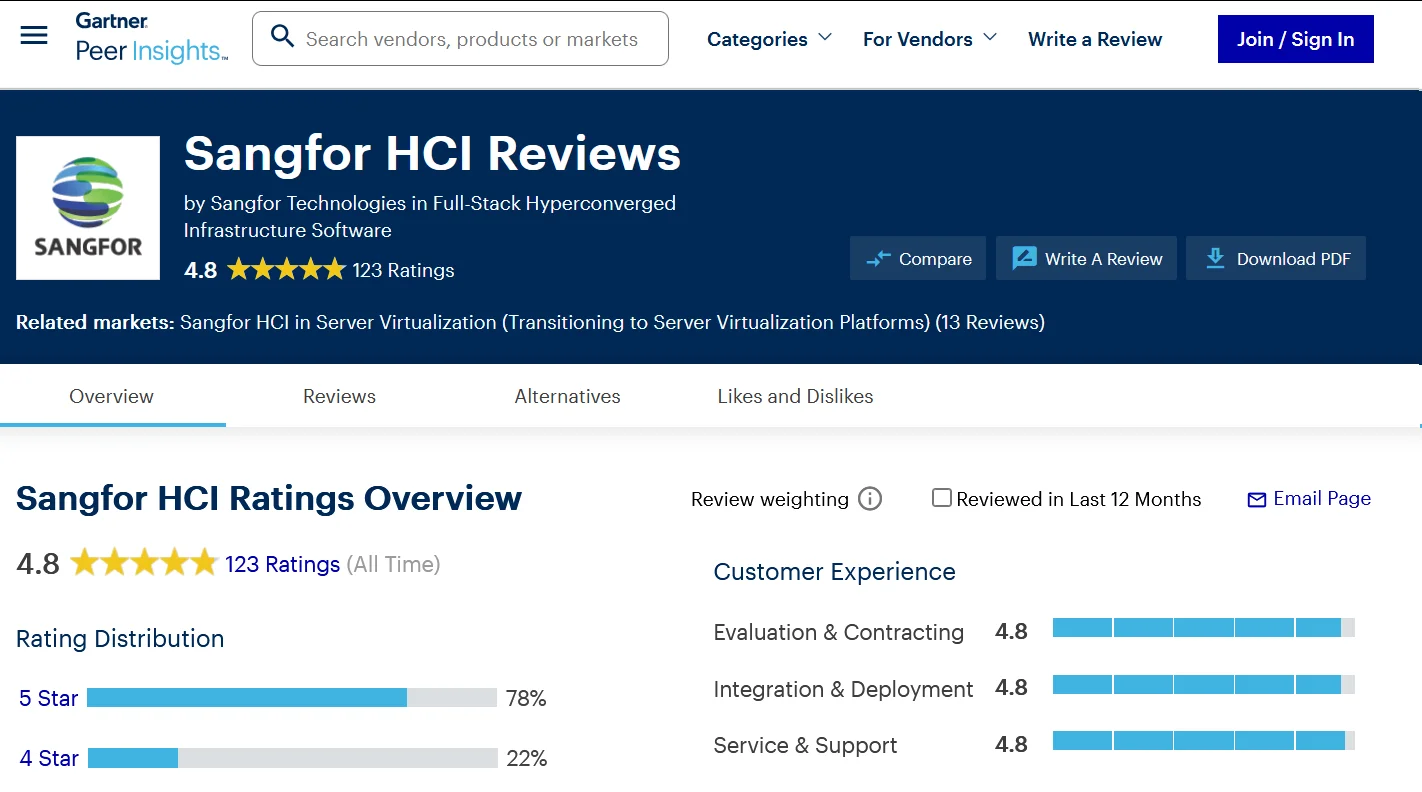
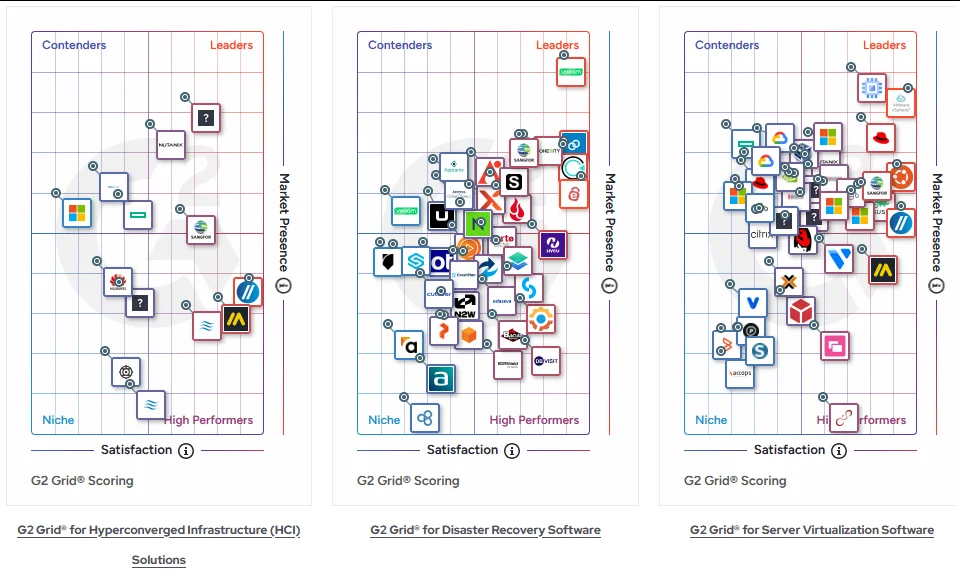
Sangfor HCI leads across enterprise-grade deployments, recognized by Gartner as a 2025 Server Virtualization Representative Vendor. And it’s also recognized as a G2 Leader across core categories in Cloud Computing
Sangfor HCI: Optimal Solution Across All Parameters
Looking for a VMware vSphere alternative? Then Sangfor HCI is the best solution. If you are planning a VMware migration and shift to a new platform, then Sangfor HCI is a reliable alternative to consider.
First of all, Sangfor HCI excels in cost leadership with perpetual licensing, avoiding Broadcom’s subscription escalations. In addition, performance validation confirms aSV hypervisor parity with vSphere across VDI (500+ concurrent sessions), databases (1M+ IOPS), and mixed workloads. Furthermore, the full HCI stack (aSV compute, aSAN storage, and aNET networking) eliminates performance silos.
Similarly, security integration sets Sangfor apart. As a Managed IT Security Services provider (MSSP), Sangfor delivers comprehensive Athena protection natively. Consequently, Sangfor HCI is the best VMware Competitor for enterprises requiring zero-trust architectures without vendor proliferation.
Finally, migration simplicity completes the value proposition. Specifically, automated tools convert vCenter configurations, preserving networks, policies, and storage layouts. Therefore, enterprises achieve 60% faster transitions (4–8 weeks average) with zero production downtime. Additionally, APAC-localized support ensures rapid issue resolution.
Real-world deployments validate these capabilities: a 500-VM financial services migration reported identical performance metrics, 38% TCO reduction, and unified security operations within 6 weeks.
Which VMware replacement offers the best regional support for global teams?
Microsoft Hyper-V provides broad support across the Windows ecosystem, while Red Hat delivers strong enterprise Linux coverage. Proxmox relies on community forums, which have variable response times.
However, Sangfor HCI offers unmatched regional support by far through its robust APAC infrastructure, ensuring rapid issue resolution for enterprises expanding across Asia-Pacific markets.
Which VMware replacement best supports AI workloads in 2026?
Microsoft Hyper-V handles emerging AI through Windows optimization, while Red Hat Virtualization supports containerized ML workloads. Proxmox manages basic AI but lacks enterprise GPU acceleration. However, Sangfor HCI excels for AI workloads by far with native GPU passthrough, 1M+ IOPS aSAN storage, and seamless container integration for machine learning deployment.
Implementation Roadmap for 2026
Phase 1: TCO Assessment (Weeks 1-2): Export VMware entitlements, calculate 3-year costs vs. Sangfor HCI perpetual licensing (30-40% savings). Secure budget approval.
Phase 2: Proof of Concept (Weeks 3-6): Deploy Sangfor lab, migrate 10-20% workloads. Benchmark aSV performance (1M+ IOPS), validate Athena security.
Phase 3: Phased Migration (Weeks 7-12): Wave 1 (dev/test), Wave 2 (Tier 2), Wave 3 (critical). Automated converter ensures zero downtime.
Phase 4: Optimization (Ongoing): Tune aSAN/aNET, deploy full Athena suite, reallocate savings. Sangfor’s free tools/training accelerate every step.
Sangfor provides free migration assessment tools and certification programs to accelerate adoption.
| What platform eliminates VMware’s capacity-based surcharges completely?Hyper-V leverages existing Windows licensing to avoid hypervisor costs, while Proxmox offers free core virtualization with no capacity fees. However, Sangfor HCI completely eliminates capacity surcharges through perpetual one-edition licensing, which never mandates vSAN storage purchases regardless of usage patterns. |
What platform future-proofs enterprises for edge computing growth?
A: Hyper-V supports basic edge through Azure Arc, while Proxmox handles small remote sites adequately. Red Hat offers containerized edge but requires Kubernetes expertise.
However, Sangfor HCI future-proofs edge deployments by far with stretched cluster capabilities (aSC), 1M+ IOPS distributed storage, and zero-trust security that scales seamlessly from data center to remote branches.
Strategic Advantages Beyond Replacement!
Sangfor HCI positions enterprises for 2026 priorities: AI workload acceleration, edge computing expansion, and regulatory compliance. Native container support and GPU passthrough enable machine learning inference without architectural changes.
VMware replacement decisions in 2026 hinge on balancing cost, performance, and feature completeness. Whether you’re running an enterprise or an SMB, choosing the right evaluation parameters is crucial. However, if you were looking for a reliable VMware Alternative, Sangfor HCI is worth considering, as it delivers superior value across the board.