







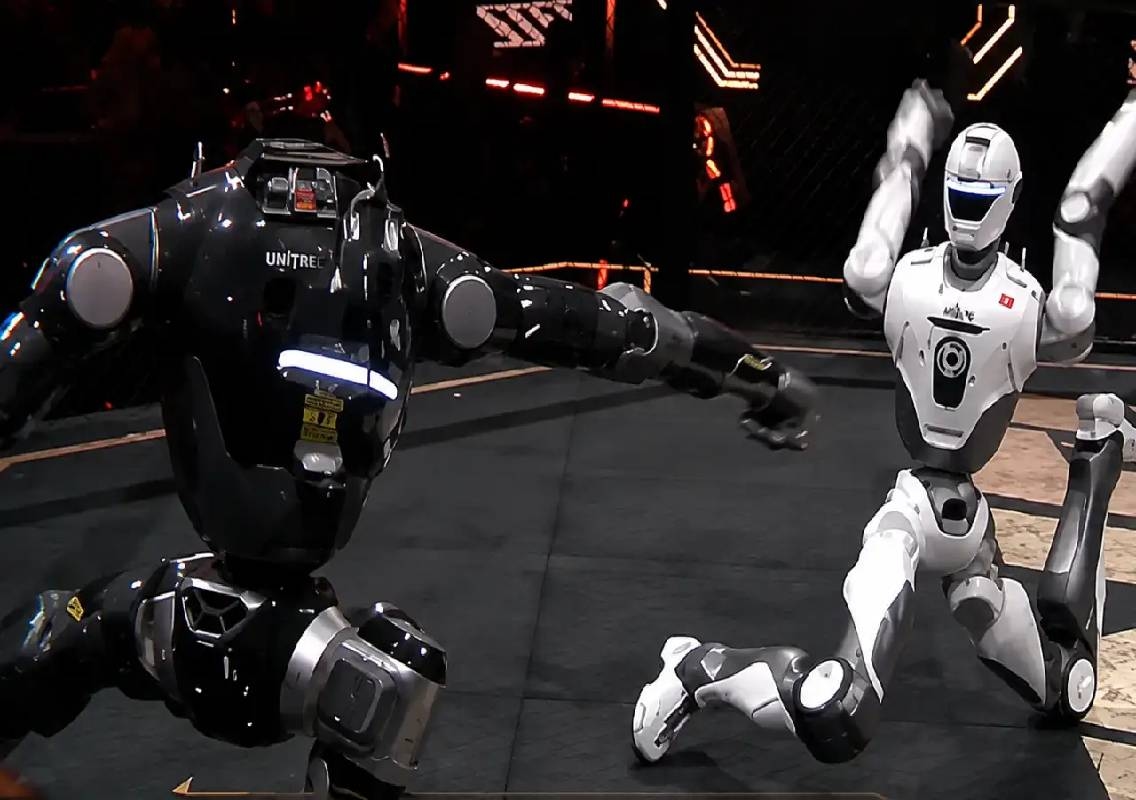


Shenzhen: A dramatic moment at China’s Ultimate Robot Knock-out Legend (URKL) tournament has captured global attention after a humanoid robot continued fighting even as its head became detached during a bout. The unusual incident took place during the opening rounds of the competition, highlighting both the entertainment value and engineering ambitions behind one of the world’s most unique robot combat events.
Organised by Shenzhen-based robotics company EngineAI, the URKL tournament brings together teams using advanced humanoid robots designed to test movement, balance and durability under real combat conditions. While the contest resembles a futuristic boxing tournament, organisers say the real objective is to collect valuable data that can improve the next generation of humanoid robots.
Head detaches but robot keeps fighting
One of the tournament’s most talked-about contests featured White Eagle taking on Matador in a high-intensity bout.
During the fight, White Eagle landed a powerful high kick to Matador’s head. The impact caused the black-coloured robot’s head to loosen and swing awkwardly from its neck.
Despite the severe damage, Matador continued throwing punches and attempting kicks while its head remained barely attached.
Footage shared by Chinese media outlet Shenzhen Story showed the damaged robot continuing to attack before eventually collapsing to the floor.
Dramatic finish to the contest
After falling, Matador attempted to regain its footing.
However, as the robot tried to stand, its body landed on the already damaged head, causing it to detach completely.
The humanoid collapsed once again, bringing the contest to an end.
Following the victory, White Eagle celebrated by dancing inside the ring and striking a muscle-flexing pose while officials removed the defeated robot from the arena, creating scenes reminiscent of a professional combat sports event.
The dramatic footage has since attracted widespread attention across social media platforms.
Global teams competing
According to organisers, 32 teams from around the world were selected earlier this year to participate in the inaugural URKL competition.
Each team competes using EngineAI’s T800 humanoid robot platform, allowing engineers to focus on software, movement strategies and combat programming rather than designing entirely different hardware.
The standardised platform enables organisers to compare performance across different control systems and artificial intelligence models.
More than entertainment
Although the fights resemble scenes from a science fiction film, organisers say the tournament serves a serious technological purpose.
Every punch, kick, fall and recovery provides engineers with valuable information about a robot’s ability to maintain balance, absorb impacts and continue operating after sustaining damage.
The data collected during the competition can help improve future humanoid robots intended for industrial work, emergency response, logistics, healthcare and other real-world applications.
Researchers are particularly interested in how robots recover from unexpected impacts and adapt to rapidly changing situations.
Growing focus on humanoid robotics
China has significantly increased investment in humanoid robotics in recent years as companies compete to develop machines capable of performing increasingly complex tasks.
Advances in artificial intelligence, sensors, motion control and battery technology have accelerated progress, enabling humanoid robots to walk, climb stairs, carry objects and perform intricate movements with greater stability.
Events such as the URKL tournament provide developers with an opportunity to stress-test their machines in highly demanding environments while showcasing technological capabilities to investors and the public.
A glimpse into the future
The viral images of White Eagle and Matador have reinforced growing public fascination with humanoid robotics.
While spectators were captivated by the spectacle of two machines exchanging punches and kicks, engineers viewed the contest as an opportunity to improve robotic intelligence and mechanical resilience.
The tournament demonstrates how competitive environments can accelerate innovation by exposing robots to unpredictable conditions that are difficult to recreate in laboratories.
As humanoid technology continues to evolve, competitions like URKL could play an increasingly important role in developing robots that are stronger, smarter and better equipped for practical use beyond the arena.