







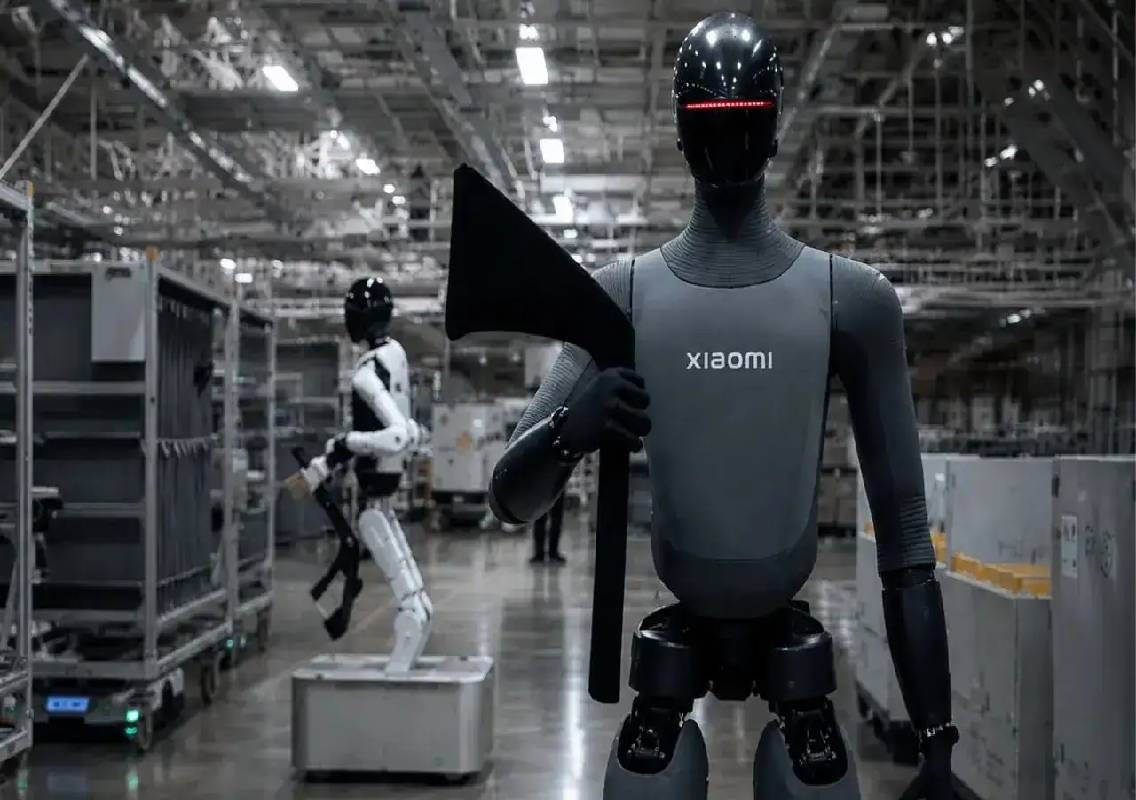


Beijing: Chinese technology giant Xiaomi has offered its clearest demonstration yet of its humanoid robotics programme, with Chief Executive Officer Lei Jun sharing footage of AI-powered robots performing manufacturing tasks inside one of the company’s electric vehicle (EV) factories.
The video highlights Xiaomi’s growing ambitions beyond smartphones and electric vehicles as it accelerates development of industrial humanoid robots capable of handling repetitive factory operations with minimal human intervention.
The latest showcase suggests Xiaomi’s robotics project is moving from research and development into real-world manufacturing applications.
Robot performs repetitive factory tasks autonomously
In a video shared by Lei Jun on social media platform X, Xiaomi’s humanoid robot is seen repeatedly picking up centre console side covers from a production line and placing them into designated containers without assistance.
Sharing the footage, Lei Jun wrote:
“One of the toughest challenges for robots in factories is handling large, irregular, flexible parts reliably over long periods.”
The company described the clip as an unedited demonstration of the robot carrying out continuous sorting operations, highlighting its ability to work autonomously in an industrial environment.
The footage also features another robotic platform equipped with a humanoid upper body mounted on a wheeled base, indicating Xiaomi is testing multiple robotic systems simultaneously.
From CyberOne to factory automation
Xiaomi entered the humanoid robotics space in 2022 with the unveiling of CyberOne, a full-sized humanoid robot capable of recognising people, perceiving its surroundings and performing simple interactions.
At the time, the company positioned CyberOne primarily as a research project rather than a commercial product.
Since then, Xiaomi has increasingly focused on industrial automation instead of consumer robotics.
Earlier this year, the company revealed that its self-developed humanoid robots had successfully completed three consecutive hours of autonomous work inside its EV manufacturing facility.
Robots handling multiple manufacturing operations
According to Xiaomi, the robots have already demonstrated the ability to perform several production-line activities, including:
- Tightening screws
- Installing vehicle badges
- Removing protective films
- Transporting material boxes
- Sorting automotive components
These tasks were reportedly completed without direct human intervention, showcasing advances in artificial intelligence, computer vision and robotic manipulation.
The demonstrations indicate Xiaomi is developing robots capable of supporting modern smart manufacturing facilities.
Long-term automation strategy
Lei Jun has previously stated that Xiaomi intends to deploy a large number of self-developed humanoid robots across its manufacturing facilities over the next five years.
Although the company has not announced commercial launch plans or pricing, the latest factory demonstrations suggest the robotics programme is progressing beyond laboratory prototypes.
Industry observers believe humanoid robots could eventually help manufacturers address labour shortages, improve production efficiency and automate repetitive or physically demanding tasks.
Xiaomi expands beyond consumer electronics
The robotics initiative reflects Xiaomi’s broader transformation from a smartphone maker into a diversified technology company.
In recent years, the company has expanded into several sectors, including:
- Electric vehicles
- Smart home devices
- Artificial intelligence
- Internet of Things (IoT) products
- Wearable technology
- Robotics
Its electric vehicle business has become one of the company’s biggest growth drivers, with robotics now emerging as another strategic area of investment.
AI race extends to physical robotics
Technology companies worldwide are increasingly investing in humanoid robots as advances in generative AI, machine learning and computer vision improve robots’ ability to understand and interact with complex environments.
Manufacturers see AI-powered robots as a potential solution for improving productivity, reducing repetitive manual work and increasing factory automation.
Xiaomi joins a growing list of global companies investing heavily in intelligent robotics for industrial applications.
Conclusion
Xiaomi’s latest factory footage marks another milestone in its robotics journey, demonstrating that its humanoid AI systems are progressing beyond experimental prototypes into practical manufacturing roles. While commercial deployment remains some distance away, the company’s long-term strategy suggests humanoid robots could become an increasingly common feature across Xiaomi’s factories in the years ahead.