







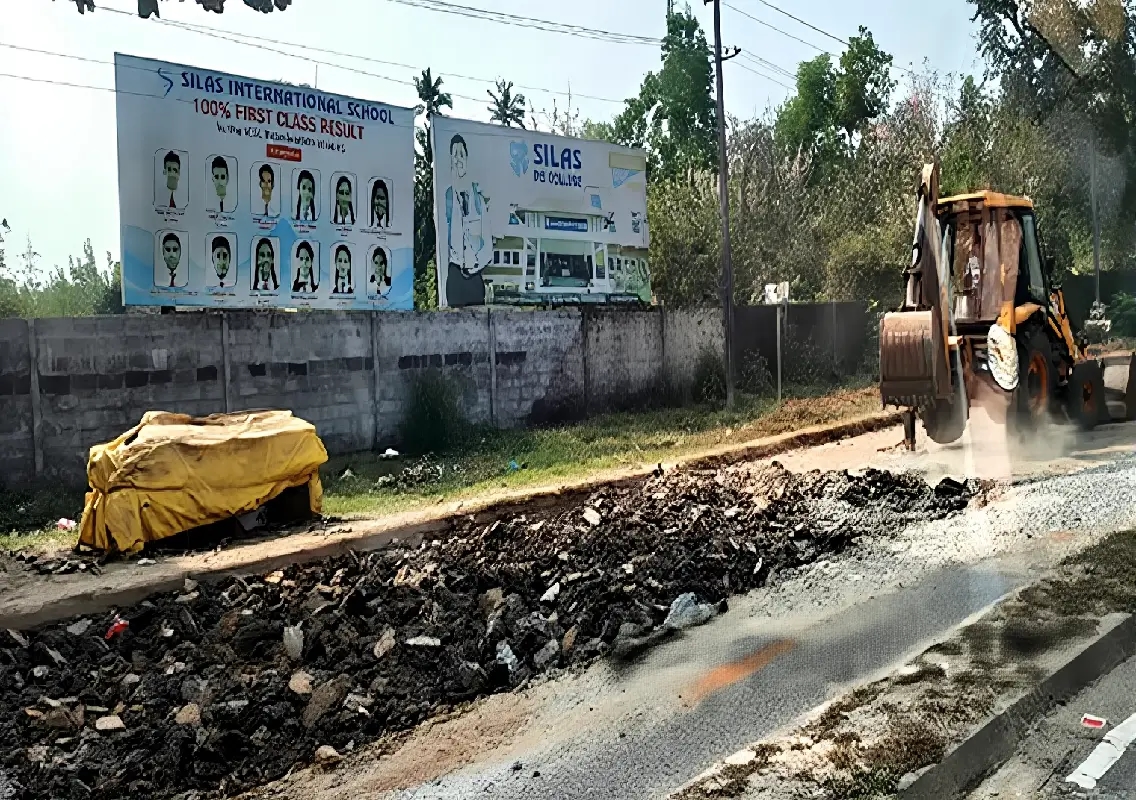


Udupi: In yet another instance of administrative apathy causing inconvenience and safety risks to the public, authorities took nearly a month to restore a stretch of road that had been dug up for manhole repair on the busy Kalsanka–Ambagilu Road near Silas School. The prolonged delay, despite completion of the actual repair work, drew sharp criticism from residents and commuters who were forced to navigate hazardous conditions daily.
The issue came to light following a series of reports highlighting damaged and sunken manholes along the stretch, which had resulted in severe traffic congestion and posed a danger to motorists. Responding to these reports, the concerned department finally undertook manhole repair work in the last week of December 2025. While the repair of the manhole itself was completed within a short period, the road that was excavated for the work was left unattended for more than 20 days.
Loose gravel left behind posed serious risk
Instead of restoring the road surface properly after completing the underground work, the excavated portion was merely filled with loose gravel. This temporary and inadequate measure created extremely unsafe driving conditions, especially for two-wheeler riders.
Motorists reported that the loose stones caused frequent skidding, forcing riders to slow down abruptly or swerve to avoid accidents. Several commuters spoke of near-miss incidents, particularly during peak traffic hours when the road witnesses heavy movement of vehicles. The situation became even more dangerous at night, as poor visibility made it difficult for drivers to spot the uneven surface in time.
Residents pointed out that while repairing a damaged manhole was essential, leaving the road in such a condition defeated the very purpose of the work. “The manhole may have been fixed, but the loose gravel on the road was equally dangerous. It felt like we were trading one hazard for another,” said a local resident.
Busy arterial road affected
The Kalsanka–Ambagilu Road is a key arterial route that connects several residential areas and sees constant traffic throughout the day. It is frequently used by school buses, private vehicles, public transport buses, pedestrians and emergency vehicles.
With Silas School located close to the affected stretch, parents and school authorities also expressed concern over the safety of children. School buses and parents dropping off students had to slow down considerably or take detours, leading to traffic bottlenecks and delays.
Pedestrians, too, were affected, as the uneven road surface forced vehicles to move unpredictably, increasing the risk of accidents near the roadside.
Delay despite repeated complaints
Public frustration mounted as days passed without any effort to restore the road to its original condition. Residents and regular commuters repeatedly raised complaints with the authorities, urging them to complete the resurfacing work without further delay.
Despite these complaints, no immediate action was taken. The situation continued for over 20 days after the manhole repair had been completed, raising questions about the lack of coordination between departments responsible for underground utilities and road restoration.
It was only after sustained pressure from local residents and continued highlighting of the issue that the authorities finally initiated road restoration work. The delayed response, however, left many questioning why such a basic follow-up task took nearly a month to execute.
Questions over accountability and coordination
The incident has once again brought the spotlight on the lack of accountability and poor inter-departmental coordination in public infrastructure projects. Residents alleged that while departments are quick to dig up roads for repairs or new installations, there is little urgency when it comes to restoring the road surface.
Civic activists pointed out that such delays are not isolated incidents but part of a recurring pattern seen across the city. “Roads are dug up in the name of development, but restoring them properly is often treated as an afterthought. This results in prolonged inconvenience and avoidable accidents,” said an activist.
They also noted that the absence of strict timelines and penalties allows contractors and departments to delay restoration work without facing consequences.
Demand for strict timelines
Residents have demanded that road restoration be carried out immediately after any underground work is completed. They urged the authorities to ensure that proper tarring or levelling is done on the same day or within a clearly defined timeframe.
Many also called for stricter monitoring of such works and the imposition of penalties on agencies that fail to restore roads promptly. “Public safety should not be compromised due to bureaucratic delays. There must be accountability,” a resident said.
Conclusion
The delayed restoration of the Kalsanka–Ambagilu Road stretch has underscored the need for better planning, coordination and accountability in civic works. While repairing underground infrastructure is essential, authorities must recognise that incomplete surface restoration poses serious risks to the public. Residents hope that lessons will be learnt from this incident and that future works will be executed with greater responsibility to prevent prolonged inconvenience and danger to commuters.