







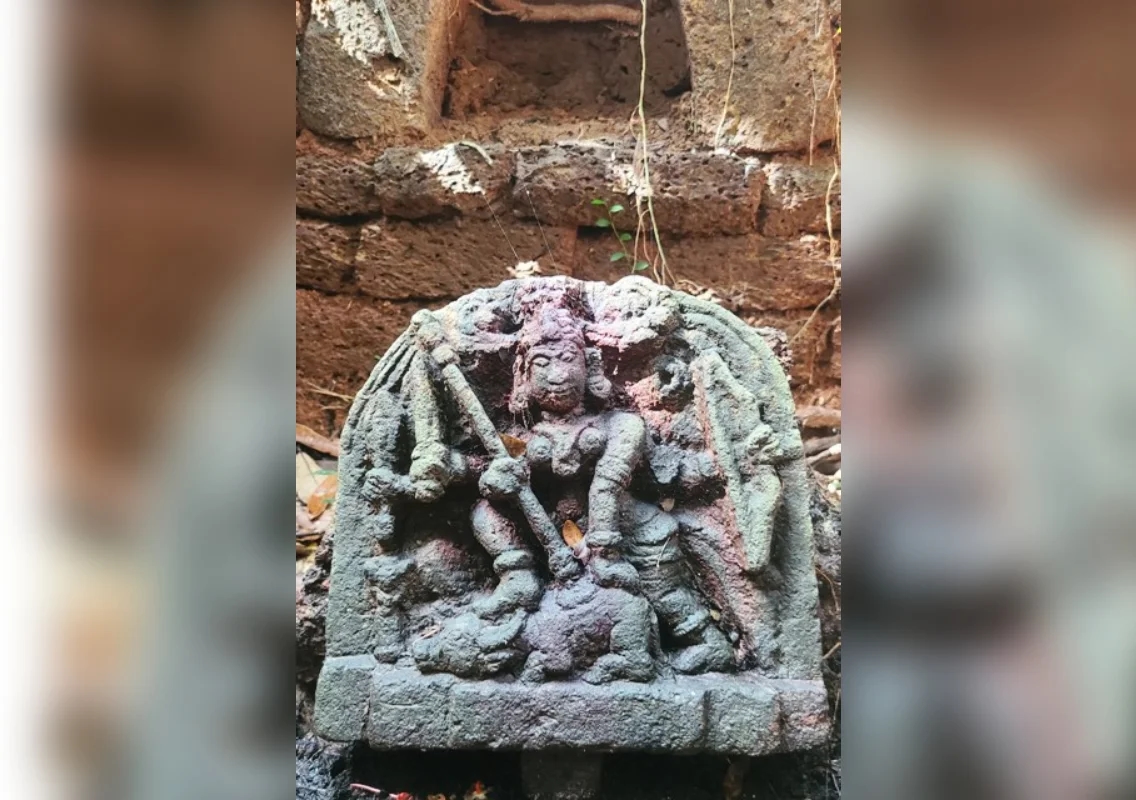


Udupi: The Mother Cult, regarded as one of the oldest belief systems in the world, has deep historical roots in coastal Karnataka, with Udupi emerging as an important centre of early mother goddess worship. Archaeological evidence from the region traces mother figure rock art back to the prehistoric period, highlighting the antiquity of this tradition. A rare and stylistically unique representation of Mahishamardhini, discovered in a ruined temple at Melmutt in Kundabarandadi village of Kundapura taluk, has now drawn scholarly attention for its artistic and historical significance.
Sharing details in a press release, noted archaeologist Murugeshi T., founder trustee of Adima Kala Trust, said the sculpture reflects a strong local artistic tradition and provides valuable insights into the evolution of the Mahishamardhini cult in the region.
Udupi as a centre of Mahishamardhini worship
According to Prof Murugeshi, the Mahishamardhini cult emerged in the early centuries of the present era in north-western India and rapidly spread to the Deep South. Udupi became one of its most prominent abodes. The Belman Mahishamardhini Temple, dated to the 7th century AD, is considered the oldest Mahishamardhini temple in the district.
The famous Belman Copper Plate Inscription of Aluvarasa II, the earliest known Kannada copper plate inscription, refers to the goddess as Vindhyagirivasini and Mahamunisevite, underscoring her revered status during the early medieval period.
Unique iconography of the Kundabarandadi image
The Mahishamardhini image discovered at Kundabarandadi displays rare and distinctive iconographic features. The goddess is depicted with six arms. In her right hands, she holds a trident, sword, and an upright gadha (mace). Her left hands show varied gestures: one rests on the back of the demon Mahisha, another is mutilated, while the third holds a bow.
The goddess is shown forcefully placing her right leg on the head of Mahisha, with the trident piercing deep into the demon’s body, symbolising the triumph of divine power over evil.
Dravidian features and local art tradition
One of the most striking aspects of the sculpture, Prof Murugeshi noted, is the facial expression of the goddess. She has a flat and thick nose, prominent lips, and protruding eyes, and wears a karanda mukuta as her headgear. These features strongly resemble Dravidian physiognomy, making the sculpture an outstanding example of local artistic tradition, rather than a classical pan-Indian style.
Below the gadha on the right side of the sculpture is a small female figure, believed to possibly represent the wife of Mahisha, a rare narrative element seldom seen in Mahishamardhini iconography.
Panchadurga tradition and cosmic symbolism
The Mahishamardhini temple at Kundabarandadi holds immense historical importance due to its association with the Panchadurga tradition. Prof Murugeshi explained that four Mahishamardhini temples are located in the four cardinal directions around the region. The Kundabarandadi temple, situated in the south, symbolically represents the demonic or fierce aspect of the goddess.
Together, these temples are believed to represent the five elements of nature, with the fifth element embodied by male power, identified with Shiva. This spatial and symbolic arrangement highlights a sophisticated theological and cosmological understanding embedded within regional temple planning.
Dating and historical significance
Based on stylistic analysis, the Mahishamardhini image from Kundabarandadi is dated to the 15th century, placing it in the late medieval period. Despite its relatively later date, the sculpture preserves archaic features and local stylistic elements, making it an invaluable artifact for understanding the continuity and regional adaptations of goddess worship in coastal Karnataka.
Acknowledgements for the study
Prof Murugeshi expressed gratitude to members of the temple renovation committee, including Nagendra Poojary, Raghuram Poojary, Sitarama Poojary, and Sanjeeva Billava, for their cooperation and support during the study. He also acknowledged the dedicated efforts of the Adima Kala research team — Murulidhara Hegade, Shreyas, Gowtham, and Bhanumati — for their tireless assistance.
Preserving heritage through research
The discovery and documentation of the Kundabarandadi Mahishamardhini sculpture add another important chapter to Udupi district’s rich archaeological and cultural heritage. Scholars emphasise that such studies not only deepen understanding of regional religious traditions but also strengthen the case for conservation of ruined and lesser-known temples that continue to hold immense historical value.
The find reaffirms Udupi’s position as a living landscape of ancient beliefs, where art, faith, and local identity intersect across centuries.