







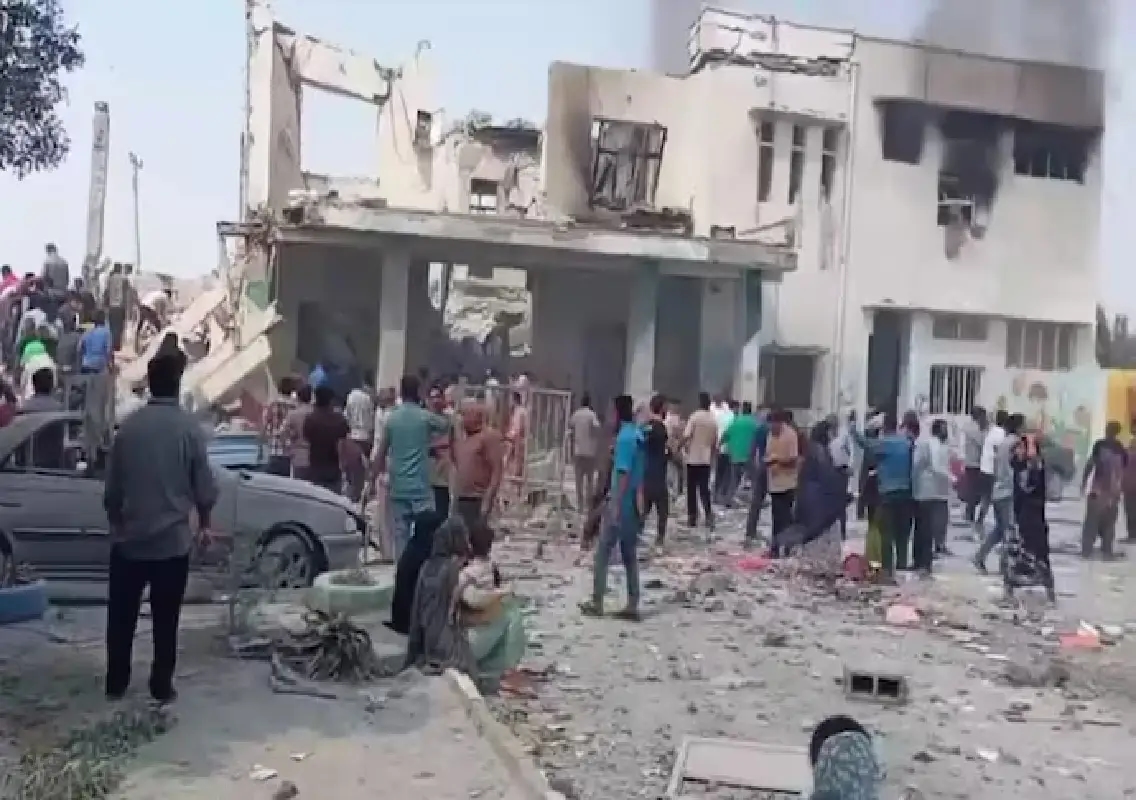


Tehran: At least 40 students were killed and 45 others injured after a coordinated strike by Israel and the United States reportedly hit a girls’ school in Minab city in Iran’s Hormozgan province on Saturday, Iranian authorities said. The attack occurred amid a widening military confrontation between Tehran on one side and Washington and Tel Aviv on the other.
Visuals circulating from the site showed collapsed structures, scattered debris and rescue teams working through the rubble. Local emergency services rushed the injured to nearby hospitals, with officials warning that the death toll could rise as some students remain in critical condition.
Strike hits Minab amid wider military campaign
Minab, located in southern Iran, is known to host facilities linked to the Islamic Revolutionary Guard Corps (IRGC). Iranian authorities alleged that the school was struck during a broader operation targeting government and military infrastructure in the region.
The coordinated military action was part of the United States’ “Operation Epic Fury” and Israel’s “Operation Roaring Lion”, which reportedly targeted strategic sites across Iran, including locations in Tehran. Loud explosions were heard across multiple cities, and plumes of smoke were seen rising over parts of the capital.
While Israeli and US officials have maintained that their operations were aimed at neutralising security threats and strategic installations, Iranian state media condemned the school strike as a violation of international humanitarian law, calling it an attack on civilians.
Leaders reportedly targeted, Iran denies harm
Among the high-profile targets reportedly included in the broader strike plan were Iran’s Supreme Leader Ayatollah Ali Khamenei and President Masoud Pezeshkian. News agency reports indicated that multiple missile strikes were aimed at sites associated with the two leaders.
Iranian officials later stated that Ayatollah Khamenei had been moved to a secure location prior to the strikes and was safe. The presidency also confirmed that Pezeshkian was unharmed.
The strikes came as nuclear negotiations between Washington and Tehran had stalled earlier in the week, with both delegations initially expected to reconvene in Vienna, Austria. Diplomatic channels now appear severely strained following the escalation.
Iran retaliates across Gulf
In retaliation, Iran launched missile and drone strikes targeting US military bases across several Gulf states, including Kuwait, Qatar, Bahrain and the United Arab Emirates. Jordan said it intercepted projectiles that entered its airspace.
The escalation prompted widespread disruption across the Middle East. Several countries temporarily closed their airspace, and numerous global airlines suspended or cancelled flights transiting the region due to security concerns.
The rapid chain of attacks and counterattacks has pushed the region into what analysts describe as one of the most serious crises in recent years, with fears of a prolonged conflict.
Strong reactions from Washington and Tel Aviv
US President Donald Trump warned Iran to abandon its nuclear ambitions, cautioning that it would “face death” if it did not lay down its arms. Israeli Prime Minister Benjamin Netanyahu stated that the strikes were intended to eliminate what he termed an “existential threat” posed by Iran.
Tehran, however, described the attacks as “criminal military aggression” and called upon the United Nations and the international community to condemn the strikes. Iranian officials emphasised that targeting civilian institutions such as schools crossed a dangerous line and could amount to a war crime if confirmed.
Humanitarian concerns grow
The reported strike on the girls’ school has intensified humanitarian concerns. International organisations have expressed alarm over civilian casualties, particularly involving children. Rescue operations continued late into the evening, with families gathered outside hospitals in Minab awaiting updates on missing students.
Medical authorities in Hormozgan province said that many of the injured suffered blast-related trauma and burns. Emergency wards were placed on high alert, and additional medical teams were deployed from neighbouring districts.
As tensions remain high and retaliatory actions continue, the situation across the Middle East is fluid and unpredictable. The attack on the school marks a tragic development in an already volatile conflict, underscoring the severe civilian toll that could follow if hostilities intensify further.
With missile alerts, military deployments and diplomatic tensions mounting, global attention is now focused on whether international mediation can de-escalate the crisis or if the region is headed towards a deeper and more prolonged confrontation.