







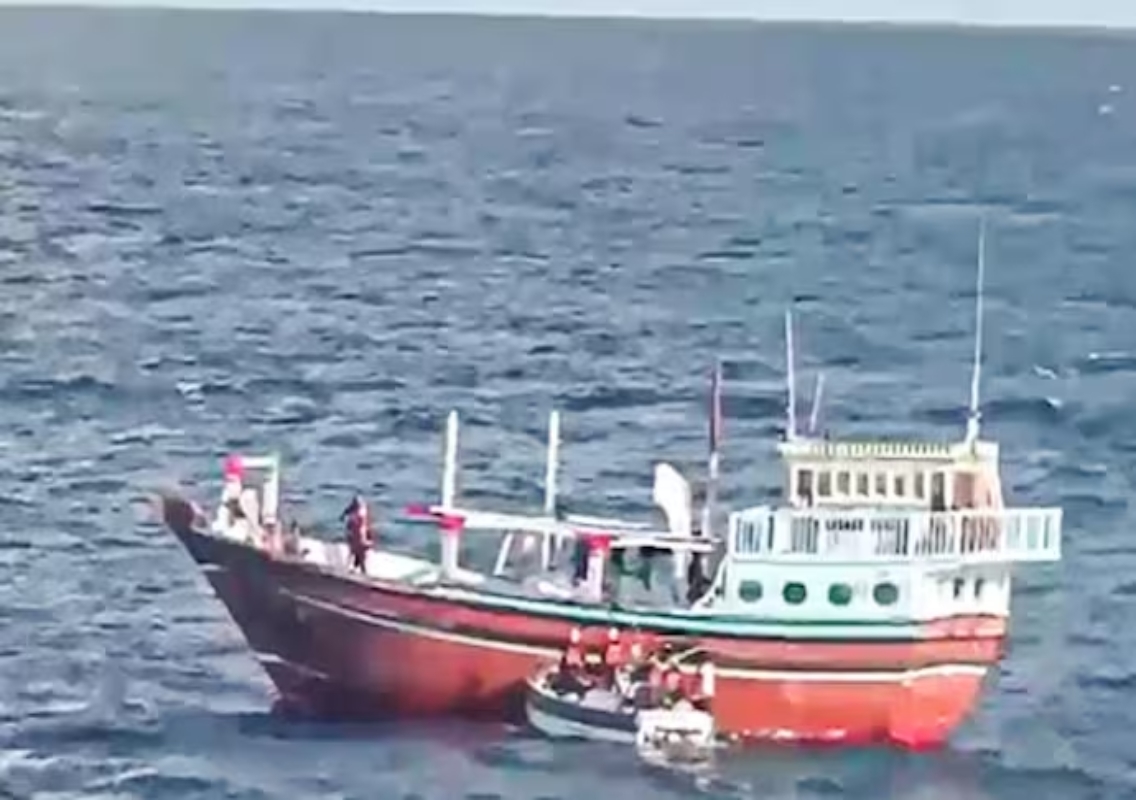


Lakshadweep: The Indian Coast Guard, in coordination with the Gujarat Anti-Terrorism Squad (ATS), has intercepted an Iranian-flagged boat carrying 526 kg of heroin and methamphetamine in the Arabian Sea, west of Lakshadweep. Five Pakistani nationals aboard the vessel were arrested in connection with the seizure, with the drugs estimated to be worth more than ₹3,000 crore.
The operation was carried out on September 25 following intelligence inputs about a suspicious vessel operating in the Arabian Sea. The Coast Guard used sea and air surveillance to track the boat before intercepting and boarding it.
The seizure is among the major recent maritime narcotics interceptions involving Indian enforcement agencies and highlights the use of sea routes for transporting high-value drugs into the region.
Iranian boat intercepted west of Lakshadweep
According to the report, the Coast Guard received intelligence regarding the suspected movement of a vessel carrying narcotics. Surveillance assets were deployed to monitor the boat as it travelled through the Arabian Sea.
The vessel was subsequently intercepted west of Lakshadweep. Coast Guard personnel boarded the boat and carried out a search, during which large quantities of suspected narcotics were recovered.
The operation involved coordination between the Indian Coast Guard and the Gujarat ATS, with the agencies working together on the intelligence-led interception.
The Indian Coast Guard has a designated anti-smuggling and narcotics-control role and coordinates with Customs and other central and state law-enforcement and intelligence agencies to prevent contraband from entering the country through maritime routes.
526 kg of heroin and methamphetamine seized
The intercepted vessel was found carrying a combined 526 kg of heroin and methamphetamine, according to the authorities cited in the report.
The seized narcotics have been valued at more than ₹3,000 crore in the illicit market. The recovery included two high-value synthetic and opioid drugs that are frequently targeted by Indian anti-narcotics agencies.
Heroin is an opioid derived from morphine, while methamphetamine is a powerful synthetic stimulant. Both are controlled narcotic or psychotropic substances under Indian law, and trafficking them can attract severe criminal penalties.
The size and estimated value of the consignment indicate that the seizure involved a large-scale trafficking operation rather than a small quantity intended for personal use.
Five Pakistani nationals arrested
Five Pakistani nationals who were aboard the intercepted vessel were taken into custody by the authorities.
Their alleged roles in the transportation of the narcotics will be examined as part of the investigation. The arrests do not by themselves establish guilt, and further investigation will be required to determine the origin of the drugs, their intended destination and the wider network involved.
Investigators are also expected to examine the vessel’s movements and communications to establish how the consignment entered the maritime route and where it was ultimately intended to be delivered.
The nationality of those arrested and the use of an Iranian boat are among the aspects likely to be examined during the probe.
Intelligence-led maritime operation
The interception was carried out after a specific intelligence input, with the Coast Guard maintaining surveillance before moving to stop the vessel.
The operation demonstrates the importance of maritime surveillance in tackling narcotics trafficking. India’s extensive coastline and surrounding waters are vulnerable to the movement of contraband through fishing vessels, speedboats and other maritime platforms.
The Coast Guard says combating smuggling through sea routes is part of its responsibilities and that it works with Customs and other enforcement agencies to disrupt trafficking networks. Its official data records the seizure of narcotics and other contraband worth thousands of crores through anti-smuggling operations since the force’s inception.
Investigation into wider drug network
The seizure is expected to be followed by a detailed investigation into the wider trafficking network behind the consignment.
Investigators will seek to establish where the drugs were sourced, who financed the shipment, who arranged the vessel and who was supposed to receive the consignment after it reached its destination.
The agencies may also examine whether the intercepted shipment was connected to other narcotics cases or networks operating along India’s western coastline.
The recovery of such a large quantity of drugs in international waters or near India’s maritime zone can involve multiple jurisdictions, making intelligence-sharing and coordination between enforcement agencies important to tracing the complete supply chain.
Major setback to maritime drug trafficking
The seizure of 526 kg of narcotics and the arrest of five Pakistani nationals represent a major enforcement action against an alleged maritime drug-smuggling operation.
While the investigation will determine the precise origin, destination and network associated with the consignment, the interception prevents a large quantity of heroin and methamphetamine from reaching the illicit market.
The case also underlines the continuing focus of Indian agencies on maritime routes as part of efforts to disrupt international narcotics trafficking. Further details about the arrested individuals, the vessel and the wider network are expected to emerge as the investigation progresses.