







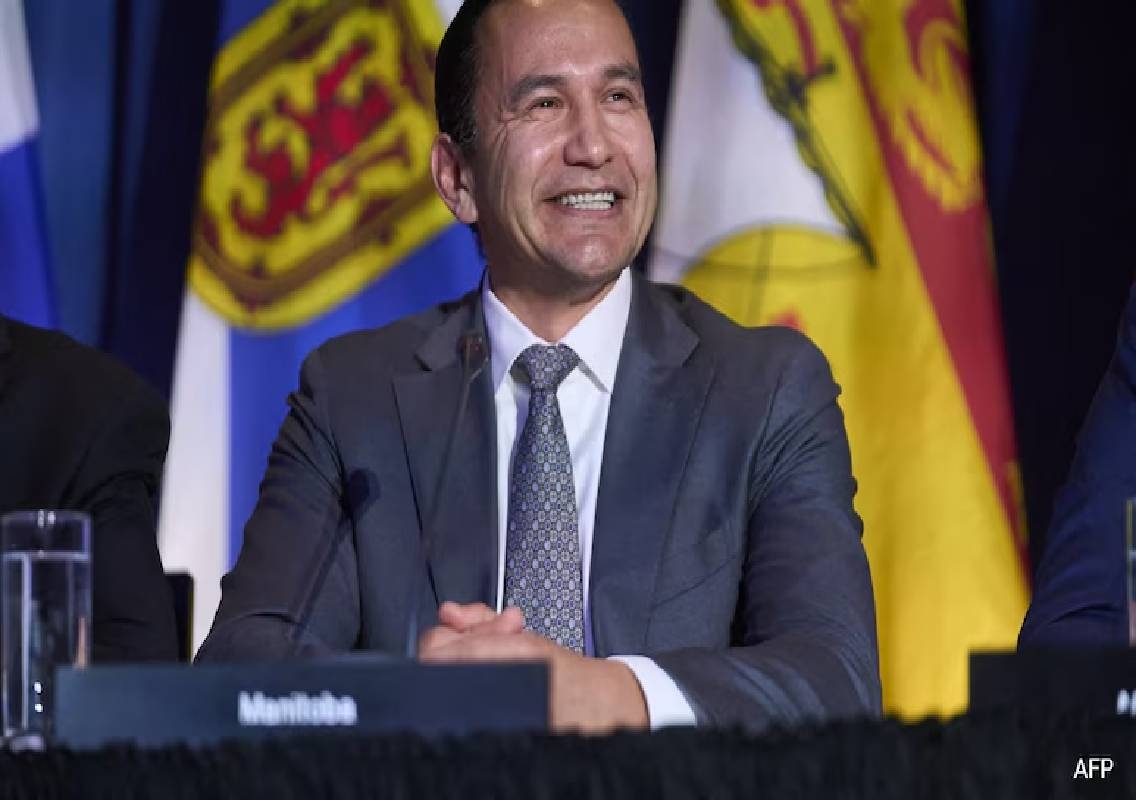


Toronto: Manitoba Premier Wab Kinew has launched a sharp attack on US President Donald Trump, calling him a “bad person” and saying he cannot be trusted as Canada and the United States negotiate a trade agreement aimed at preventing new tariffs on Canadian goods.
Kinew’s comments came as pressure mounted on Canadian provinces to make concessions to Washington, including reconsidering restrictions on the sale of US-made alcohol. Prime Minister Mark Carney has urged provincial leaders to help create the conditions needed for a trade agreement, while Canadian negotiators say the two countries are close to a deal.
Wab Kinew criticises Trump
Kinew, who leads Manitoba, said Canadians should not rush to make concessions simply because the United States is threatening higher tariffs.
He described Trump as a “bad person” and “not to be trusted”, while arguing that Canada still has significant leverage in the negotiations.
The Manitoba premier also urged Canadians to continue supporting domestic businesses and products rather than allowing pressure from Washington to dictate Canada’s economic decisions.
His remarks reflect the increasingly difficult political environment surrounding Canada-US trade relations, where economic negotiations have become intertwined with domestic political pressure.
Canada and US close to trade agreement
The comments came as Canadian and US officials continued negotiations over a new trade arrangement.
Canadian Trade Minister Dominic LeBlanc said the two countries were “very close” to reaching an agreement after discussions with US Trade Representative Jamieson Greer in Washington.
The proposed agreement is intended to ease some of the tariffs and counter-tariffs that have strained economic relations between the two neighbours for nearly two years.
However, several important issues remain unresolved.
Trump threatens 50% tariffs
A major source of pressure in the negotiations is Trump’s threat to impose a 50% tariff on around $20 billion worth of Canadian goods if an agreement is not reached.
The proposed tariffs have created uncertainty for Canadian businesses and industries that depend heavily on access to the US market.
Canadian negotiators have therefore been working to secure better terms while attempting to protect important domestic industries.
The talks have also included discussions over tariffs on Canadian-built vehicles, steel and aluminium.
Auto, steel and aluminium tariffs remain key issues
Under the framework being discussed, tariffs on Canadian-built vehicles could potentially fall from 25% to 15%.
The two sides are also discussing reductions in tariffs on Canadian steel and aluminium.
However, disagreements remain over how Canadian content in manufactured goods should be calculated and which components should qualify for preferential treatment.
These details could have a major impact on Canadian manufacturers and exporters.
US alcohol sales become a major sticking point
One of the more unusual issues in the negotiations involves American alcohol.
Several Canadian provinces restricted or removed US-made alcoholic beverages from government-controlled liquor stores after Trump’s earlier tariffs.
The measures were introduced as part of Canada’s response to US trade actions and became a visible symbol of the country’s economic retaliation.
Trump’s administration has pushed for those restrictions to be removed, making alcohol access an important part of the current negotiations.
Carney urges provinces to compromise
Canadian Prime Minister Mark Carney has asked provincial leaders to consider restoring access to US alcohol products in an effort to help secure a broader trade agreement.
Most provinces are considering such a move, although there has been political resistance in some areas.
The issue is particularly sensitive because provincial governments control much of the retail distribution of alcohol in Canada.
For Carney’s government, however, the potential economic benefits of a wider trade agreement could outweigh the political cost of relaxing the restrictions.
Kinew says Canada still has leverage
Despite the pressure from Washington, Kinew argued that Canada should not assume it is negotiating from a position of weakness.
He pointed to Canada’s importance as a trading partner and suggested that Trump’s political position could become less favourable ahead of the US midterm elections.
Kinew’s argument is that Canada can continue negotiating firmly rather than accepting every demand simply to avoid tariffs.
His comments also reflect wider concerns in Canada about becoming overly dependent on the US economy.
Trade tensions have lasted nearly two years
Relations between the two countries have deteriorated significantly since Trump began imposing tariffs and threatening further trade restrictions.
Canada has responded with its own countermeasures, including restrictions on American products.
The resulting trade dispute has affected businesses on both sides of the border and encouraged Canadian consumers to favour domestic products.
The dispute has also contributed to a stronger political push in Canada to diversify trade and reduce dependence on the US market.
Possible deal could ease economic uncertainty
A trade agreement would provide relief to businesses that have been dealing with uncertainty over tariffs and future market access.
Canadian officials say the two countries have already made substantial progress, although several difficult issues remain on the negotiating table.
The agreement could also provide a foundation for broader discussions surrounding the US-Mexico-Canada Agreement (USMCA).
For businesses, the biggest benefit would be greater certainty over tariff rates and access to the US market.
Political tensions remain despite negotiations
The sharp comments from Kinew demonstrate that reaching an economic agreement does not necessarily mean political tensions between Canada and the Trump administration have disappeared.
While federal officials are working towards a compromise, provincial leaders must also respond to domestic public opinion.
Many Canadians remain strongly opposed to Trump’s tariff policies, making concessions to Washington politically difficult.
At the same time, Canadian exporters and businesses have a major economic interest in maintaining stable access to the US market.
What happens next?
Canadian and US negotiators are expected to continue working on the remaining issues before the tariff deadline.
The two sides are reportedly close to an agreement, but important questions remain over automotive content, agricultural access, alcohol restrictions and other market-access measures.
For Canada, the challenge is to secure favourable trade terms without appearing to surrender too much under pressure from Washington.
For the United States, the objective is to obtain greater access for American products while maintaining leverage through tariffs.
Conclusion
Manitoba Premier Wab Kinew has described US President Donald Trump as a “bad person” and “not to be trusted” as Canada and the United States negotiate a new trade agreement.
Kinew has urged Canada to continue negotiating firmly rather than rushing into concessions, even as Ottawa seeks provincial cooperation on issues such as restrictions on US alcohol sales.
The comments come at a crucial stage in the negotiations, with Canadian officials saying the two countries are very close to a deal that could reduce tariffs on automobiles, steel and aluminium and prevent a threatened 50% US tariff on around $20 billion of Canadian imports.
While an agreement could ease economic uncertainty, the latest remarks show that political tensions between Ottawa, Canada’s provinces and the Trump administration remain significant.