







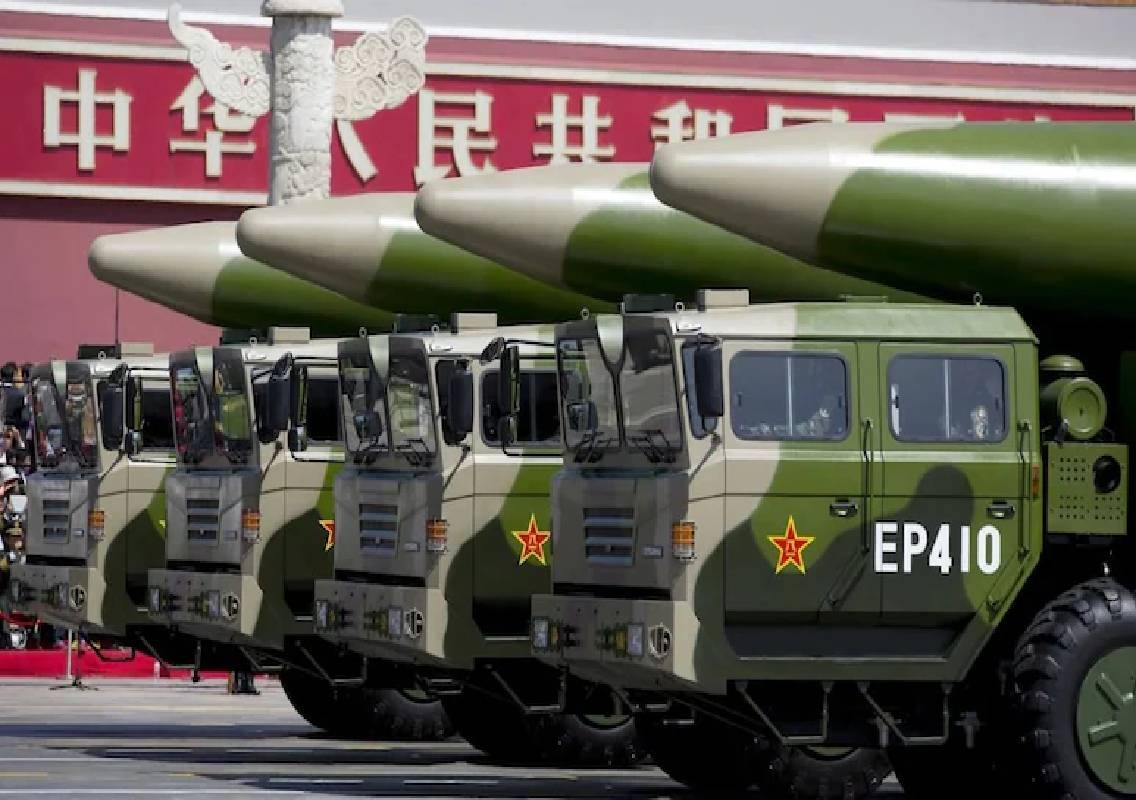


Beijing: China has developed a new long-range missile capability that could potentially threaten high-value US aircraft operating thousands of miles away, according to a Bloomberg report. The development involves hypersonic glide vehicles (HGVs) capable of launching air-to-air missiles, marking a significant expansion of China’s efforts to use its missile arsenal for a wider range of military missions.
The reported capability could put aircraft such as aerial refuelling tankers, airborne early-warning and control aircraft and flying command posts at greater risk during a potential conflict. These aircraft normally operate away from the immediate frontline and provide essential support to fighter jets and other forces.
New capability could threaten US support aircraft
The reported Chinese system is designed around hypersonic glide vehicles that can carry and launch air-to-air weapons against aircraft at very long distances.
This could change the threat faced by high-value US support aircraft, which are crucial to American military operations. Aerial tankers, for example, allow fighter aircraft to remain airborne for longer periods, while airborne early-warning aircraft provide surveillance and help coordinate combat operations.
Aircraft such as the US Air Force’s E-4B Nightwatch, which serves as a flying command post, could also potentially become targets under this concept.
The significance of the development lies not only in the missile’s range but also in the type of targets it could potentially engage.
What is a hypersonic glide vehicle?
A hypersonic glide vehicle is a manoeuvrable weapon system that travels through the atmosphere at hypersonic speeds after being launched by a missile.
Unlike a conventional ballistic warhead that follows a relatively predictable trajectory, an HGV can manoeuvre during its flight. This makes its path more difficult to predict and potentially complicates efforts to intercept it.
China has invested heavily in hypersonic technology and is publicly known to operate and develop HGVs capable of carrying air-to-air weapons.
The latest development reportedly takes that technology further by giving China’s long-range missile force a potential ability to attack aircraft rather than only fixed land or maritime targets.
DF-17 could provide a range of about 2,400 km
One example highlighted in the report is an HGV deployed from China’s DF-17 missile.
The system could travel approximately 2,414 kilometres, according to the report. That distance is slightly shorter than the distance between mainland China and Guam, a strategically important US territory and military hub in the western Pacific.
China’s more advanced DF-27 missile has an estimated maximum range of around 8,000 kilometres.
Such a range could potentially bring targets as far away as Hawaii within the weapon’s reach, although successfully attacking a moving aircraft at such distances presents considerably greater challenges than striking a stationary target.
Tracking a moving aircraft is the biggest challenge
The ability to fly thousands of kilometres does not automatically mean a missile can successfully hit an aircraft at that distance.
A moving aircraft can change direction and speed, while the missile needs continuously updated information about its location.
At maximum range, a ballistic missile could take 20 minutes or more to reach its target, according to the report. That creates a significant targeting problem because the aircraft may have moved hundreds of kilometres during that period.
The system would therefore require a sophisticated network capable of detecting, identifying and continuously tracking the aircraft before transmitting updated targeting information to the missile.
This makes the entire sensor-to-shooter chain as important as the missile itself.
Long-distance “kill chain” creates vulnerabilities
The process required to attack a moving aircraft at extreme range is often described as a kill chain.
It involves detecting the target, determining what it is, tracking its movement, calculating a firing solution and continuously updating that information as the weapon approaches the target.
Every stage creates an opportunity for the opposing side to interfere.
If the aircraft changes course, the sensors lose contact or communications are disrupted, the missile could struggle to find its target.
The report therefore notes that the long kill chain could make such an operation vulnerable to disruption.
Nuclear escalation is another concern
There is another major complication associated with using a ballistic missile against a distant aircraft.
The same type of missile technology can potentially carry conventional or nuclear warheads. An adversary detecting a ballistic missile launch may not immediately know what type of warhead it carries or what its intended target is.
This creates what experts call a discrimination problem.
A conventional attack could potentially be misinterpreted as a nuclear strike, especially during a major military confrontation.
Such uncertainty could increase the risk of escalation between nuclear-armed powers.
China’s missile arsenal continues to expand
The reported development comes amid rapid growth in China’s missile capabilities.
According to estimates cited in the report, China had at least 3,150 ballistic missiles and 300 ground-launched cruise missiles as of 2024.
Compared with 2015, the number of ballistic missiles represented an increase of around 147%, while ground-launched cruise missiles increased by about 50%.
China’s growing arsenal includes weapons designed for different roles, including land attack, anti-ship operations and increasingly sophisticated long-range missions.
The latest reported development indicates that Beijing is also looking at ways to use missile technology against airborne targets.
Hypersonic weapons are becoming central to future warfare
Hypersonic weapons have become a major focus of military modernisation by both China and the United States.
Their combination of speed, manoeuvrability and range is intended to make traditional defensive systems more difficult to use effectively.
China’s development of HGVs capable of launching air-to-air weapons represents another evolution in this area.
Rather than using a conventional fighter aircraft to engage a distant target, the concept could allow a missile launched from far away to carry an air-to-air weapon closer to the target before attempting an interception.
US is also developing longer-range weapons
The development is taking place alongside efforts by the United States to develop its own increasingly long-range air-to-air missiles.
The US Navy has been testing the AIM-424 Malice, produced by RTX’s Raytheon unit, with a reported range of more than 300 miles.
The US is also developing the AIM-260, a long-range air-to-air missile that is in production but has not yet entered service.
The US Air Force has separately sought a new family of long-range missiles capable of reaching targets at least 1,000 nautical miles away as part of its plans to counter Chinese air and naval forces.
This points to an emerging competition between the two countries over long-range strike and counter-strike capabilities.
Why US support aircraft matter
Fighter jets are often the most visible component of an air operation, but support aircraft play a critical role.
Aerial tankers allow combat aircraft to operate far from their bases. Airborne early-warning aircraft provide radar coverage and help coordinate fighters.
Command aircraft can serve as mobile centres for military operations.
If these aircraft are forced to operate farther away because of the threat from long-range missiles, their ability to support frontline aircraft could be reduced.
This could consequently affect how the US plans air operations in the western Pacific.
Guam is an important strategic location
The reported range of some Chinese missiles is particularly significant because of the strategic importance of Guam.
The US territory is home to major American military infrastructure and plays a crucial role in US operations across the western Pacific.
The DF-17’s reported range of approximately 2,414 kilometres is slightly shorter than the distance from China to Guam, while the DF-27’s estimated range of about 8,000 kilometres is considerably greater.
This does not mean that either missile can automatically attack any aircraft operating around Guam.
The actual effectiveness of such a system would depend on sensors, targeting data, communications, missile performance and the ability to track moving targets.
China’s broader strategy is changing
The reported development fits into China’s wider effort to build a military capable of challenging US forces at increasing distances from the Chinese mainland.
Beijing has continued expanding its long-range missile forces while improving surveillance, targeting and anti-access capabilities.
Earlier this year, satellite imagery also showed China deploying advanced J-20 stealth fighters at bases facing India, highlighting the broader modernisation of its air and missile forces.
The combination of long-range missiles, stealth aircraft, surveillance platforms and other sensors could allow China to create a more integrated system for targeting adversary forces.
The US-China military competition intensifies
The latest development adds another dimension to the increasingly sophisticated military competition between Washington and Beijing.
The two countries are competing across areas including stealth aircraft, hypersonic weapons, long-range missiles, drones, space systems and advanced sensors.
The focus is increasingly shifting from simply destroying frontline combat aircraft to disrupting the broader network that allows an air force to operate.
In that environment, tanker aircraft, command posts and surveillance planes could become as strategically important as fighter jets.
Weapon has major limitations
Despite the potential threat, experts caution that such a system would face substantial technical difficulties.
Hitting a moving aircraft at thousands of kilometres requires extremely accurate targeting information.
The farther away the target is, the greater the challenge of maintaining a reliable track.
The missile also needs to survive its flight and successfully transition from a long-range trajectory to an air-to-air engagement.
Electronic warfare, deception, evasive manoeuvres and destruction of surveillance platforms could further complicate the operation.
Therefore, the existence of the reported capability does not mean that US aircraft are automatically vulnerable wherever they operate.
Future warfare could focus on support systems
The development nevertheless highlights a major shift in how future air wars could be fought.
Instead of concentrating exclusively on fighter-versus-fighter combat, military planners are increasingly focused on attacking the infrastructure and support systems that make air operations possible.
If long-range weapons can reliably threaten tankers and command aircraft, air forces may need to operate from greater distances or develop new ways of protecting those platforms.
That could increase the importance of stealth, electronic warfare, unmanned aircraft and distributed operations.
Conclusion
China has developed a reported new capability involving hypersonic glide vehicles that can launch air-to-air missiles, potentially giving Beijing a way to threaten high-value US aircraft thousands of miles away. The weapons could target aerial tankers, airborne early-warning aircraft and command posts that are essential to US military operations.
The development is significant because China’s missile arsenal is already the world’s largest, with more than 3,150 ballistic weapons according to estimates cited in the report. However, the ability to hit a moving aircraft at extreme distances remains technically difficult and depends heavily on accurate, continuously updated targeting information.
The reported Chinese capability also comes as the US develops its own longer-range air-to-air weapons, suggesting that the next phase of military competition could increasingly centre on the ability to threaten the support networks behind frontline aircraft.