


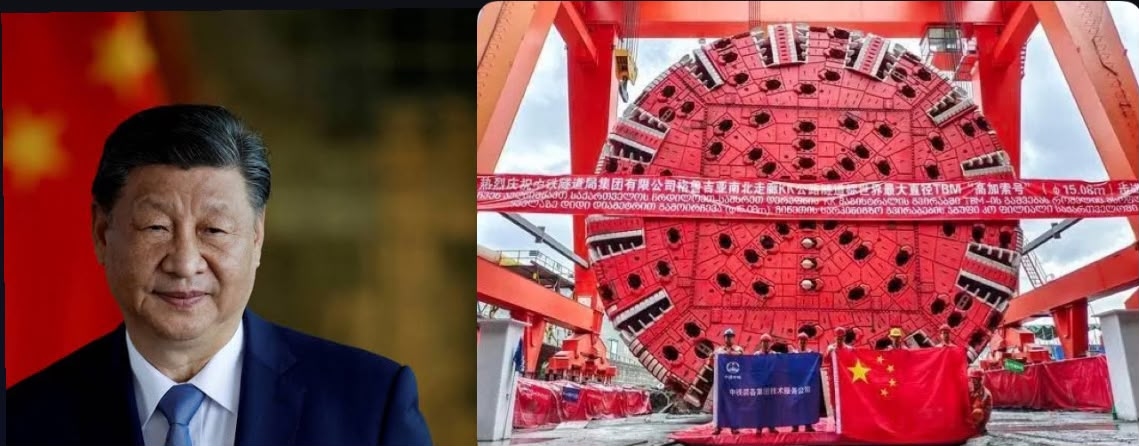


Wuhan: China’s new export controls on tunnel-boring machines (TBMs) have raised concerns about potential disruptions to India’s infrastructure projects, highlighting the country’s dependence on foreign technology for underground construction. The restrictions, announced by Beijing on October 19, are scheduled to take effect on November 18, 2026.
The move could affect projects involving imported tunnelling equipment, including railway corridors, urban transport networks and underground road links. It has also renewed questions about India’s ability to manufacture advanced construction machinery domestically as it expands infrastructure across the country, including in strategically sensitive Himalayan regions.
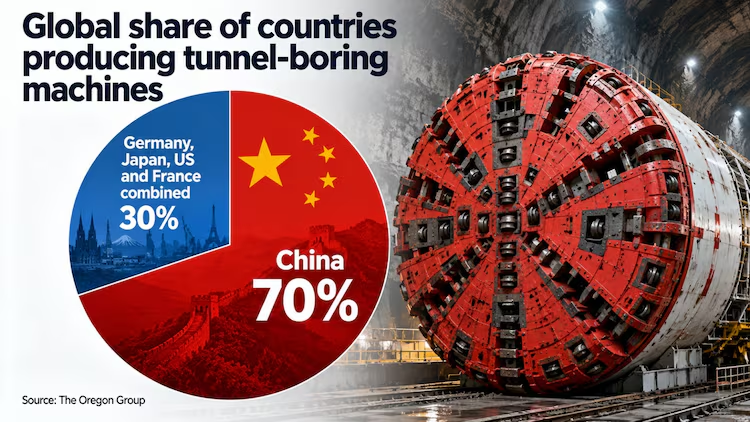
China cited national security and non-proliferation obligations when announcing the controls. With Chinese manufacturers accounting for an estimated 70% of the global tunnel-boring machine market, the new requirements could create additional uncertainty for countries that rely on Chinese production facilities or components.
For India, the challenge is twofold: protecting ongoing infrastructure projects from possible supply disruptions and building a domestic manufacturing ecosystem capable of producing advanced tunnelling equipment.
China’s restrictions raise concerns over project delays
Tunnel-boring machines are specialised engineering systems used to excavate tunnels through soil and rock. They are particularly valuable for underground railway lines, urban road tunnels, hydropower projects and long-distance railway corridors, where conventional excavation can be more disruptive or less suitable.
China’s decision to tighten export controls introduces another layer of uncertainty for projects that depend on machinery manufactured in the country. The restrictions could require additional approvals for affected exports, potentially complicating procurement schedules and equipment deliveries.
India experienced supply difficulties in 2024 when shipments of tunnelling machinery manufactured at Chinese facilities were delayed. The episode highlighted a vulnerability that extends beyond equipment purchased directly from Chinese companies.
German engineering company Herrenknecht, for instance, supplies advanced tunnelling technology internationally. However, a machine ordered from a German manufacturer can still face supply-chain risks if it is produced at a Chinese facility or relies on components affected by Chinese export restrictions.
The latest controls therefore raise questions about manufacturing location, component sourcing and the resilience of international supply chains.
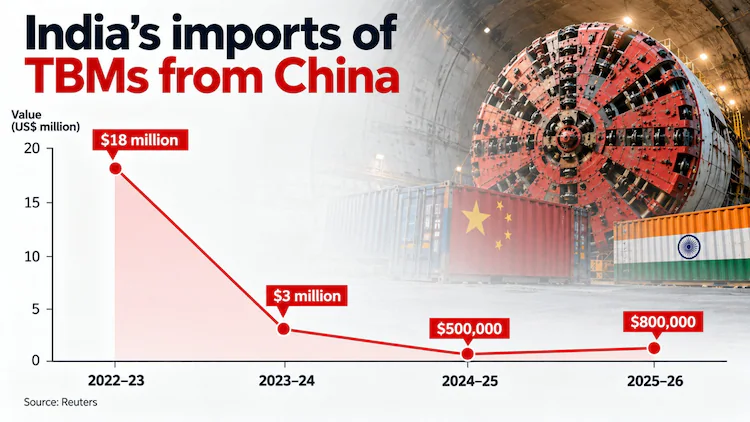
According to figures cited in the source report, India’s imports of tunnelling machinery from China declined from $18 million in 2022-23 to $3 million in 2023-24. They fell further to $500,000 in 2024-25 before rising to $800,000 in 2025-26.
The figures indicate that direct imports from China have reduced substantially from their earlier level. However, they do not capture every potential vulnerability, including machinery assembled elsewhere using components sourced from China.
Will the curbs affect India’s border infrastructure?
India’s concerns extend beyond metro railways and urban road tunnels. Since the Galwan clashes in 2020, in which 20 Indian soldiers were killed, the country has accelerated infrastructure development along the Line of Actual Control (LAC) to improve access to forward areas.
Roads, bridges, tunnels and other connectivity projects are important for moving personnel and supplies through difficult terrain, particularly in eastern Ladakh and Arunachal Pradesh.
However, China’s TBM restrictions should not automatically be interpreted as a direct threat to every border tunnel project. Several important tunnels in the Himalayas have relied on conventional excavation techniques rather than tunnel-boring machines.
The Zojila Tunnel, which is intended to improve all-weather connectivity to Ladakh, achieved its final breakthrough in June 2026 using the New Austrian Tunnelling Method (NATM). The technique involves sequential excavation, drilling and blasting, rock bolting, shotcrete and continuous geological monitoring.
Similarly, the Sela Tunnel in Arunachal Pradesh was constructed using NATM to strengthen all-weather connectivity to the strategically important Tawang sector. The Shyok Tunnel in eastern Ladakh uses a cut-and-cover approach.
These examples demonstrate that large infrastructure projects can be completed using different construction techniques, depending on the terrain, geological conditions and engineering requirements.
In high-altitude regions, difficult rock formations, geological faults, water ingress, limited working seasons and the challenges of transporting heavy equipment can make conventional excavation more practical in certain locations.
Nevertheless, TBMs remain important for long railway tunnels, hydropower projects and other underground infrastructure across the Himalayan region. If India expands their use in strategically important areas, access to reliable tunnelling technology will become increasingly significant.
Himalayan railway projects depend on advanced tunnelling technology
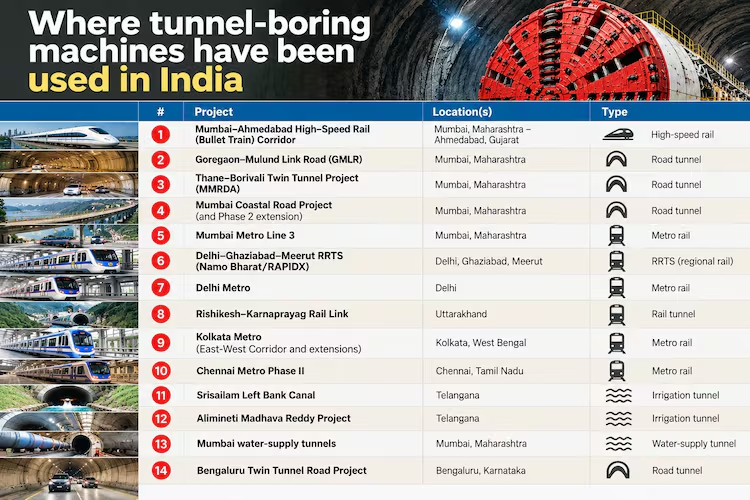
One prominent example is the Rishikesh-Karnaprayag railway project in Uttarakhand, which involves extensive underground construction through challenging Himalayan geology.
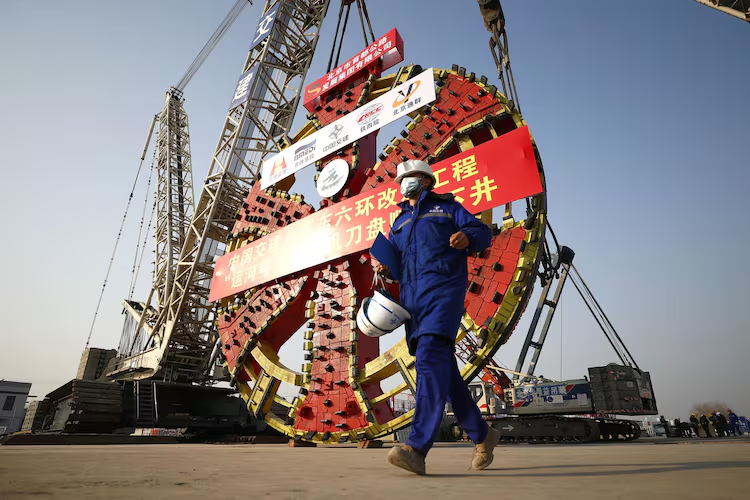
Two large Herrenknecht tunnel-boring machines, named Shiv and Shakti, have been used to excavate a major twin-tube section of the project. Such machinery can help engineers maintain progress through difficult terrain while reducing the need for surface excavation along sections of the route.
TBMs are also being deployed for major urban infrastructure projects where construction must take place beneath densely populated areas.
In August 2026, Megha Engineering and Infrastructures Limited, working with Herrenknecht, developed a machine named Arjuna for the Thane-Borivali Twin Tunnel project in Maharashtra. The machine was designed to bore through basalt formations beneath Sanjay Gandhi National Park.
The examples illustrate the range of projects that depend on sophisticated tunnelling systems, from mountain railways to underground urban road links.
The immediate risk from China’s controls is greatest for projects whose procurement plans rely on affected imported machines. The longer-term concern is whether India can continue expanding its underground infrastructure without remaining vulnerable to restrictions imposed by overseas suppliers.
Earlier supply disruptions exposed India’s dependence
India’s exposure to tunnelling equipment supply chains became particularly visible in 2024, when Union Commerce Minister Piyush Goyal raised concerns with Germany’s then Vice-Chancellor Robert Habeck over delays involving TBMs manufactured by Herrenknecht in China.
The episode highlighted an important distinction between a machine’s manufacturer and its place of production. Buying equipment from a company headquartered in Germany does not necessarily eliminate risks arising from manufacturing facilities or component suppliers in China.
According to the source report, India received delayed TBMs from China in March 2026 as bilateral tensions eased to some extent. Beijing’s new licensing requirements could now introduce further uncertainty into procurement and delivery schedules.
Projects such as the Mumbai-Ahmedabad High-Speed Rail Corridor illustrate why reliable access to TBMs matters. The corridor includes a seven-kilometre undersea tunnel, requiring specialised engineering and equipment.
TBMs can also be advantageous for underground road projects in crowded urban areas, where they can reduce surface disruption and avoid some of the challenges associated with conventional excavation. Their suitability, however, depends on the ground conditions and the engineering design of each project.
For infrastructure developers, potential delays in acquiring machines can affect construction schedules, equipment deployment and overall project planning. Diversifying suppliers and securing access to critical components could help reduce these risks.
India steps up efforts to develop domestic TBMs
India is pursuing several approaches to reduce its dependence on imported tunnelling equipment, including domestic manufacturing, local assembly by international companies and indigenous machine development.
Herrenknecht established an assembly facility in Chennai in 2007. The company manufactured 10 TBMs for Chennai Metro Phase 2 at the facility between July 2022 and July 2023. According to the company’s disclosure, Indian suppliers provided 60% of the components used in the machines, while the remaining 40% came from its facilities in Germany.
In 2025, Herrenknecht acquired 12.4 acres in North Chennai for a planned manufacturing plant, signalling continued interest in India’s expanding tunnelling market.
Local assembly and sourcing are important steps, but they do not automatically amount to complete technological self-reliance. Critical components, precision-engineered systems, control technologies and specialised manufacturing processes may continue to depend on overseas suppliers.
State-owned Bharat Earth Movers Limited (BEML) is pursuing the development of indigenous TBMs. Its plans cover machines ranging from approximately six metres to 16.5 metres in diameter, beginning with a prototype of around 6.5 metres.
Developing machines across this range would require sustained investment in engineering, materials, testing and production capabilities. It would also require a domestic supplier network capable of delivering reliable components at the required quality and scale.
The proposed $1.2 billion incentive scheme for construction and infrastructure equipment manufacturing could provide another boost. The scheme is expected to attract an estimated $1.8 billion in fresh investment over seven years, according to the source report.
For the policy to deliver lasting benefits, incentives would need to support more than assembly operations. Domestic production of critical components, engineering research and development, technical training and dependable after-sales support would all be important.
Predictable policies could encourage investment
Public policy researcher Pranay Kotasthane, deputy director of Bengaluru-based Takshashila Institution, argued that China’s restrictions could create short-term difficulties but encourage manufacturers to expand production outside China over the longer term.
He emphasised the importance of predictable approvals, reliable power supply and faster customs clearance for imported components to make India a more attractive manufacturing destination.
Such measures could help domestic companies and international manufacturers establish deeper supply chains in India. However, developing an indigenous TBM industry would take time, particularly for machines designed to operate in complex geological conditions or beneath densely populated urban areas.
India would also need to ensure that locally manufactured equipment meets demanding standards for safety, reliability and operational performance. A domestic manufacturing base would be most effective if it could support the entire equipment lifecycle, from design and component production to maintenance and repairs.
Can India turn the restrictions into an opportunity?
China’s export controls are a reminder that infrastructure development depends not only on funding and construction capacity but also on secure access to specialised technology.
The restrictions are unlikely to stop all Indian tunnel construction, particularly projects that use conventional excavation methods. Their potential impact will depend on which machines and components are covered, how licensing requirements are implemented and whether alternative suppliers can meet project requirements.
The immediate priority for New Delhi and infrastructure developers is to identify exposed projects, assess delivery risks and diversify sourcing wherever practical. Over the longer term, domestic research, manufacturing and supplier development will be essential to reducing dependence on external production centres.
BEML’s indigenous development plans, Herrenknecht’s investments in India and the proposed manufacturing incentives provide a starting point. Their effectiveness will depend on execution and on whether India can develop capabilities extending from local assembly to the production of critical components and complete machines.
China’s decision has brought these questions into sharper focus. For India, the challenge is to protect current projects while building the technological capacity needed for future infrastructure expansion. A resilient domestic TBM industry could strengthen both the country’s infrastructure ambitions and its ability to withstand geopolitical supply-chain disruptions