







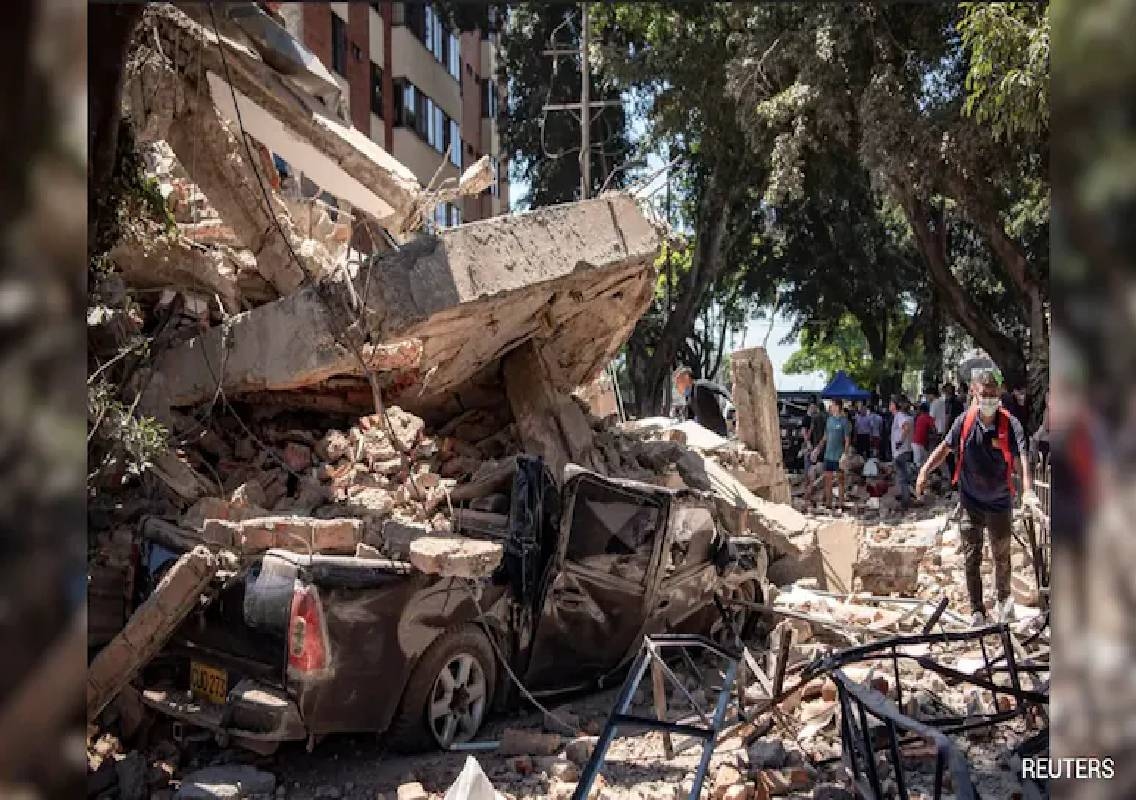


Bogota: A powerful 7.4-magnitude earthquake struck western Colombia on August 10, killing at least 132 people and leaving hundreds injured, according to reports cited by NDTV. The devastating tremor caused buildings to collapse, damaged hospitals and other infrastructure, and sent terrified residents running into the streets as rescue teams began searching through the rubble.
The earthquake was centred in the Choco region, with the tremors strongly felt across several cities, including Cali, Pereira, Quibdo, Armenia and Manizales. Videos from the affected areas showed people fleeing buildings as structures shook violently and portions of buildings collapsed.
The death toll remained fluid as rescue operations continued and authorities assessed damage in areas that were difficult to reach. Reuters reported at least 111 confirmed deaths in an earlier count, while Colombian reports cited by NDTV and other media put the toll at 132.
The disaster has become one of the most serious earthquakes to hit Colombia in decades.
Powerful earthquake strikes western Colombia
The earthquake struck western Colombia on Monday, August 10.
The epicentre was reported near San Jose del Palmar in Choco, around 400 kilometres west of Bogota. The quake occurred at considerable depth, with Reuters reporting a depth of approximately 107 kilometres.
Despite its depth, the earthquake produced severe shaking and widespread damage.
The tremor was felt across a broad part of the country, including major urban centres. Residents rushed out of buildings as walls shook, objects fell and structures were damaged.
The Colombian Geological Service described the earthquake as exceptionally powerful, with reports characterising it as the strongest earthquake recorded in the country during the 21st century.
Videos show panic as buildings collapse
Videos emerging after the earthquake showed the scale of the destruction and the panic among residents.
In some locations, people could be seen running away from buildings as the ground shook. Other footage showed damaged structures and collapsed portions of buildings.
The scenes were particularly alarming in urban areas, where densely populated neighbourhoods faced the risk of falling debris.
The NDTV report highlighted videos showing people fleeing as buildings collapsed following the powerful tremor.
The footage also showed the difficulties faced by emergency teams trying to reach damaged areas.
Cali among the worst-hit cities
Cali, Colombia’s third-largest city, was among the areas significantly affected by the earthquake.
Reuters reported at least 35 deaths in Cali in an earlier assessment, along with approximately 700 injuries. Buildings and infrastructure were damaged, while emergency teams worked to search affected areas.
The city’s hospitals also faced the consequences of the disaster.
Reports indicated that patients and medical facilities were affected by the shaking, adding pressure to emergency services at a time when hospitals were already dealing with large numbers of injured people.
The damage in Cali demonstrated the challenges of responding to a major earthquake in a densely populated urban area.
More than 1,600 buildings damaged
The earthquake caused extensive structural damage across western Colombia.
According to the Associated Press, more than 1,600 buildings were damaged, while at least 61 buildings completely collapsed.
The figures are expected to change as emergency officials inspect more structures.
Some areas were easier to assess than others. Remote parts of Choco presented particular challenges because of difficult terrain and disrupted communications.
Buildings that appear damaged from the outside may also require detailed structural inspections before residents can safely return.
Rescue teams search for survivors
Emergency teams were deployed to search collapsed buildings and assist injured residents.
Rescue workers and volunteers were reported to have pulled survivors from rubble, including a baby and her mother, according to Reuters.
The search operation was complicated by damaged infrastructure and concerns about further collapses.
Rescue workers also had to remain alert for aftershocks.
At least 21 aftershocks were reported after the main earthquake, adding to fears among residents and creating additional risks for people trapped under damaged structures.
Thousands reported missing
The scale of the disaster was reflected in the number of people reported missing.
The Associated Press reported that thousands were missing, particularly in Cali and Pereira, although these figures were still being assessed as rescue and communication efforts continued.
Missing-person figures can change rapidly during a disaster.
People may initially be reported missing because telephone networks are disrupted, roads are blocked or families are unable to contact relatives.
Authorities therefore face the difficult task of separating confirmed missing persons from temporary communication failures while simultaneously searching damaged areas.
Hospitals and schools affected
The earthquake also damaged essential public infrastructure.
Hospitals and schools were among the structures affected, according to reports from the disaster zone.
Damage to hospitals is particularly serious during a major earthquake because medical facilities are needed immediately to treat injured residents.
Some hospitals also had to deal with patients being moved or treated in difficult conditions following structural damage.
Schools can also become important emergency shelters after disasters, making damage to these buildings an additional challenge for local authorities.
Airports disrupted after earthquake
The earthquake also disrupted transport infrastructure.
Several regional airports were closed following the disaster, affecting travel and making it more difficult to move emergency personnel and supplies.
Road infrastructure was also affected in parts of the region.
For rescue teams, access is crucial during the first hours following a major earthquake. Blocked roads, damaged bridges and disrupted communications can slow the delivery of medical supplies and rescue equipment.
Authorities therefore prioritised restoring transport links alongside search-and-rescue operations.
Curfews imposed in affected cities
Some cities introduced curfews following the earthquake.
The measures were reportedly aimed partly at preventing looting and maintaining order while emergency operations continued.
Large disasters can leave neighbourhoods temporarily without electricity, communications or normal policing services.
Authorities therefore often increase security around damaged areas, particularly when residents have been evacuated from homes.
Colombia declares national emergency
Colombian President Abelardo de la Espriella, who had taken office only days before the disaster, declared a national emergency following the earthquake.
The move was intended to speed up the deployment of resources and allow the government to focus on rescue and relief operations.
The president visited affected areas as authorities assessed the extent of the damage.
The disaster represents an early and major test for the new administration, which must coordinate rescue operations, medical assistance, temporary accommodation and infrastructure repairs.
Why the earthquake caused such widespread damage
Colombia is located in a seismically active region.
Its location near the Pacific Ring of Fire means that parts of the country are vulnerable to earthquakes and other geological hazards.
The depth and magnitude of this earthquake contributed to the wide area in which strong shaking was experienced.
Urban development also plays an important role in determining the impact of an earthquake.
Buildings that are not adequately designed or maintained to withstand strong shaking can be particularly vulnerable.
Strongest earthquake of the century in Colombia
The scale of the earthquake has made it particularly significant in Colombia’s recent history.
Reports described it as the country’s strongest earthquake this century.
The event has renewed attention on earthquake preparedness, building standards and emergency response systems.
Even modern buildings can suffer damage during very powerful earthquakes, while older or poorly constructed structures can face an even greater risk of collapse.
Aftershocks add to rescue challenges
Aftershocks are a major concern following a large earthquake.
More than 20 aftershocks were reported following the main tremor, according to reports.
Aftershocks can damage structures that have already been weakened.
For people trapped beneath rubble, additional shaking can make rescue operations more dangerous.
Residents who have evacuated damaged buildings may also be reluctant to return until engineers confirm that structures are safe.
International assistance offered
The scale of the disaster has prompted international support.
The United States pledged $15.5 million in assistance, while countries including El Salvador, Mexico and Chile offered help.
International assistance can provide emergency supplies, medical support, rescue equipment and financial resources.
For Colombia, such support could be particularly valuable in remote areas where local resources may be stretched by the scale of the disaster.
Rescue operation remains the priority
The immediate priority for Colombian authorities remains finding survivors and providing medical care to those injured.
Rescue workers must continue searching collapsed structures while engineers assess damaged buildings.
Authorities also need to provide food, water and temporary shelter to residents who cannot return home.
At the same time, emergency teams have to restore communications and transportation networks so that relief supplies can reach isolated communities.
Death toll could change
The reported death toll of 132 is not necessarily final.
Rescue operations were still underway, and emergency teams had not yet been able to fully assess every affected area.
The number of missing people also meant that authorities could face further changes in casualty figures as search teams reach damaged locations and families are reunited.
In major earthquakes, early casualty figures frequently change as rescue operations continue.
Colombia faces long recovery
Even after rescue operations end, Colombia will face a lengthy recovery.
Thousands of residents may require temporary accommodation, while damaged homes, hospitals, schools and roads will need to be repaired or rebuilt.
The government will also need to assess the economic cost of the earthquake.
For families who have lost relatives or homes, however, the recovery will be about far more than rebuilding infrastructure.
Communities will have to deal with grief, displacement and the psychological impact of experiencing a major earthquake.
Conclusion
The 7.4-magnitude earthquake in western Colombia has caused widespread destruction, with the reported death toll reaching 132 and hundreds of people injured. The earthquake damaged more than 1,600 buildings, while at least 61 structures were reported to have collapsed completely.
Cities including Cali, Pereira, Quibdo, Armenia and Manizales were among the areas affected. Videos from the disaster zone showed residents fleeing collapsing buildings as emergency workers began searching through the rubble.
The earthquake also disrupted hospitals, schools, airports and other essential infrastructure. More than 20 aftershocks were reported, creating additional risks for rescue teams and residents living near damaged buildings.
President Abelardo de la Espriella declared a national emergency and directed resources towards rescue and relief operations. International assistance has also begun reaching Colombia, with the United States pledging $15.5 million and several other countries offering support.
As rescue operations continue, authorities are still assessing the full extent of the devastation. The reported death toll and number of missing people could change as teams reach remote and badly damaged areas.
For Colombia, the earthquake has become one of the country’s most devastating natural disasters in recent years. The immediate focus remains on saving lives, treating the injured and providing shelter to survivors, while the longer-term challenge will be rebuilding communities and infrastructure damaged by the powerful tremor.