







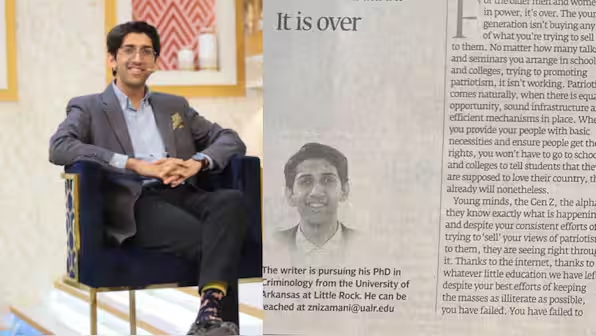


Pakistan may be witnessing a quiet but powerful Gen Z uprising — not on the streets, but in ideas that refuse to be silenced. A now-deleted opinion article by a young Pakistani academic has ignited a nationwide debate on censorship, youth disillusionment, and the shrinking space for dissent.
The op-ed, titled “It Is Over”, was written by Zorain Nizamani, a Pakistani PhD student based in the United States, and published by The Express Tribune on January 1. The article was taken down within hours, allegedly under pressure from Pakistan’s powerful military establishment, triggering a fierce backlash online.
Screenshots of the article quickly went viral on social media, with users accusing the state of censorship and hailing Nizamani as a symbol of youthful resistance. Nizamani, who is pursuing a PhD in criminology at the University of Arkansas at Little Rock, is also the son of Pakistani actors Fazila Qazi and Qaiser Khan Nizamani.
What the op-ed argued
In the article, Nizamani contended that Pakistan’s ruling elites have lost their grip over younger generations. He argued that state-sponsored lectures, seminars, and campaigns promoting patriotism no longer resonate with Gen Z and Gen Alpha.
“For the older men and women in power, it’s over,” he wrote, adding that young people are no longer willing to “buy” manufactured patriotism. Without explicitly naming the military, he stressed that patriotism cannot be enforced through slogans or speeches.
According to Nizamani, genuine national loyalty emerges only when citizens are given equal opportunities, functioning infrastructure, justice, and dignity. He also argued that access to the internet and information has weakened traditional methods of controlling public opinion.
“You have failed to tell people what to think; they are thinking for themselves,” he wrote, noting that many young Pakistanis choose to leave the country rather than challenge entrenched power structures, fearing consequences faced by those who spoke out.
Outrage over removal
The article’s removal intensified its impact. The Canadian wing of Pakistan Tehreek-e-Insaf said the takedown itself proved the article’s point, arguing that forced patriotism and propaganda no longer work.
Activists, lawyers, and former ministers echoed similar sentiments. Pakistan’s Human Rights Council condemned the move, calling it a violation of constitutional rights and press freedom.
A wider signal
While authorities have not officially commented on the article’s removal, the episode has become a flashpoint for broader frustrations among Pakistan’s youth. For many, “It Is Over” is not just an essay — it is a reflection of a generation that feels unheard, disillusioned, and increasingly unwilling to accept old narratives.
Excerpt (125–150 characters):