








Billionaire entrepreneur and Tesla owner Elon Musk found himself at the centre of a heated online controversy after an exchange with Indian-origin venture capitalist Vinod Khosla escalated into a public spat on social media platform X. The argument, which quickly went viral, revolved around accusations of racial bias, free speech, and long-standing ideological differences between the two prominent figures in the global technology ecosystem.
The dispute began when Khosla, the founder of Khosla Ventures and an early investor in several Silicon Valley companies, shared an old post by Musk that referenced demographic changes in the global population. In the post, Musk cited statistics claiming that the global white population had declined from 36 per cent in 1900 to about 8 per cent today. While Musk had earlier framed the post as an observation about demographic trends, Khosla alleged that it reflected a racially motivated worldview.
Khosla accuses Musk of promoting racial ideology
Khosla reposted Musk’s old comment and accused him of harbouring ideas linked to white supremacy. In a sharply worded message, Khosla suggested that Musk’s political outlook went beyond the “Make America Great Again” slogan and instead leaned towards what he termed “WAGA”, or “White America Great Again”.
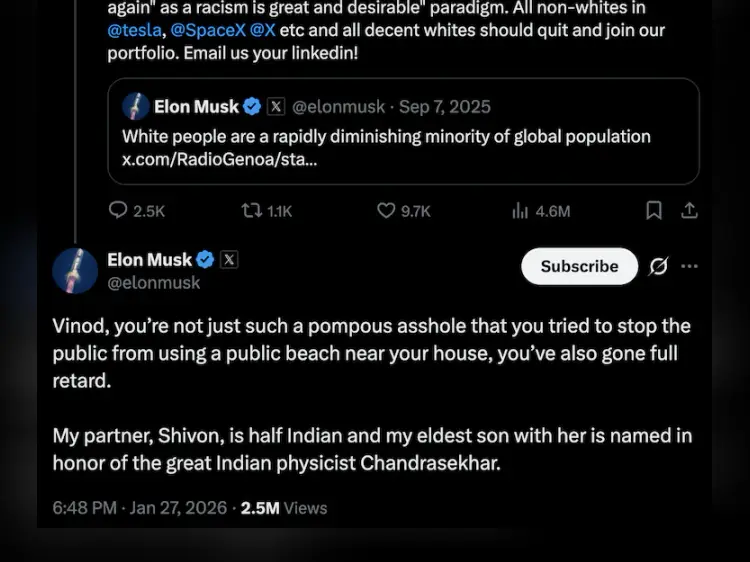
In his post, Khosla wrote that Musk’s views made racism appear “desirable” and urged non-white employees working at Musk-owned companies such as Tesla, SpaceX and X to leave. He went a step further by inviting them to consider opportunities within Khosla Ventures’ portfolio companies, even encouraging them to share their LinkedIn profiles.
The remarks immediately drew widespread attention, with social media users, political commentators and technology industry insiders weighing in on the exchange. Many criticised Khosla for making sweeping generalisations, while others supported his stance and questioned Musk’s repeated engagement with controversial political narratives online.
Musk responds with personal attack
Elon Musk responded forcefully to Khosla’s accusations, rejecting claims that his views were racially motivated. In his reply, Musk used strong and offensive language to lash out at Khosla, calling him a “pompous” individual and accusing him of hypocrisy. Musk also referenced a previous controversy involving Khosla, alleging that the venture capitalist had once tried to restrict public access to a beach near his residence.
Musk insisted that the allegations of white supremacy made little sense, arguing that his personal life contradicted such claims. He pointed out that his partner, Shivon Zilis, is of Indian heritage, and that one of their children has been named after the renowned Indian-American physicist Subrahmanyan Chandrasekhar. Zilis, a Canadian technology executive and venture capitalist, has four children with Musk.
“My partner is half Indian, and my eldest son with her is named in honour of the great Indian physicist Chandrasekhar,” Musk wrote, suggesting that these personal choices undermined accusations of racial bias.
History of friction between Musk and Khosla
The latest exchange is not the first instance of friction between the two influential businessmen. Khosla has previously criticised Musk’s lawsuit against OpenAI and Microsoft, where Musk alleged fraud and sought damages reportedly running into billions of dollars. Khosla had suggested that Musk’s criticism of OpenAI stemmed from losing influence over the organisation’s direction after stepping away from its board.
Industry observers note that the disagreement reflects deeper ideological and business-related differences between Musk and Khosla, both of whom are outspoken and unafraid to engage publicly with critics. While Musk often positions himself as a free-speech absolutist, Khosla has repeatedly raised concerns about the social and ethical responsibilities of technology leaders.
Wider debate on race, politics and tech leadership
The spat has reignited broader debates about race, political ideology and accountability among tech leaders. Musk, who has more than 180 million followers on X, has faced criticism in the past for amplifying polarising viewpoints and engaging with far-right commentators. Supporters argue that he merely raises uncomfortable questions and promotes open discussion, while critics say his platforming of certain ideas legitimises harmful narratives.
Khosla’s call for employees to quit Musk-owned companies also sparked discussion about workplace diversity and the limits of political activism within the corporate world. Some analysts questioned whether such appeals could realistically influence employees’ career decisions, while others viewed the gesture as symbolic rather than practical.
Conclusion
As the online exchange continues to circulate, it underscores how personal disagreements between powerful tech figures can quickly escalate into global conversations about race, politics and influence. While neither Musk nor Khosla appears likely to back down, the episode highlights the growing scrutiny faced by technology leaders whose words, posted in seconds, can shape debates far beyond Silicon Valley.