







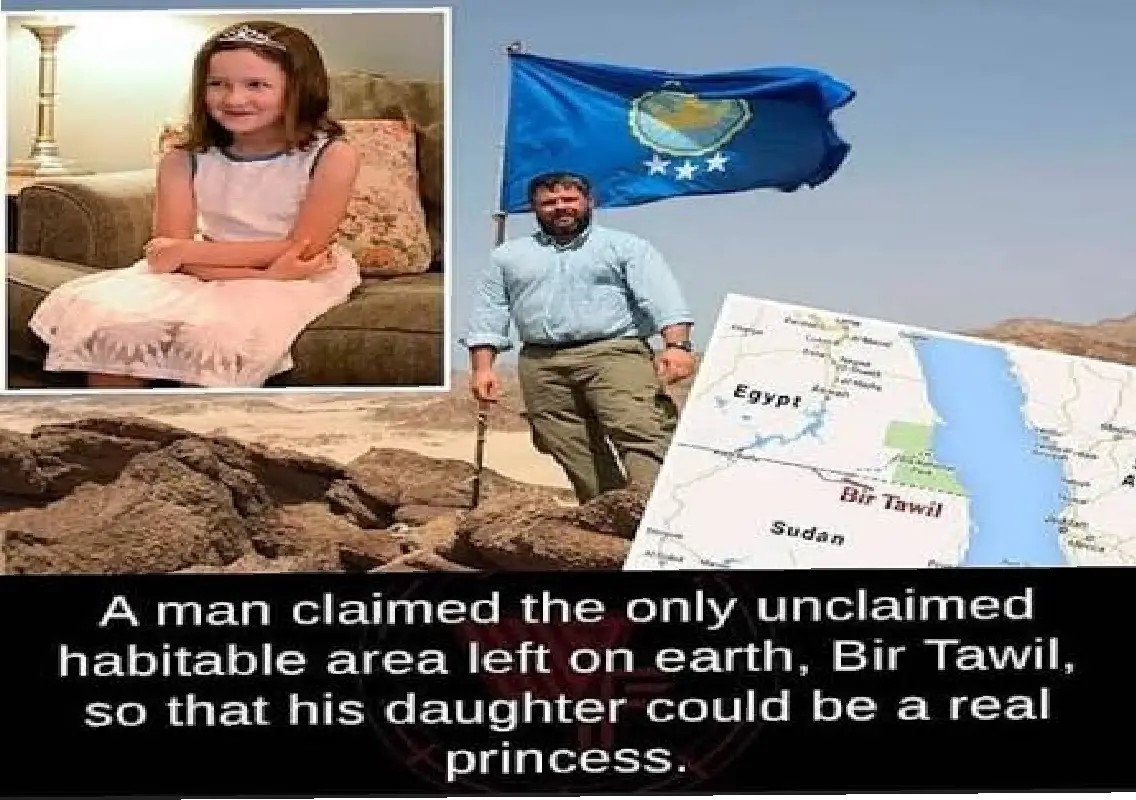


When seven-year-old Emily Heaton told her father that she wanted to become a real-life princess, he decided not to dismiss her dream as something from a fairy tale.
Instead, Jeremiah Heaton began searching for a place on Earth that was not claimed by any country. His search eventually led him to Bir Tawil, a remote desert territory between Egypt and Sudan.
On Emily’s seventh birthday, June 16, 2014, Heaton travelled to the region and planted a blue flag designed by his children. He declared the territory the Kingdom of North Sudan and named Emily its princess.
A daughter’s dream became a father’s mission
Rather than simply buying Emily a crown or a princess costume, Heaton took her question seriously and researched the possibility of finding unclaimed land.
He travelled from the United States to Cairo before undertaking the difficult journey into the desert. After reaching Bir Tawil, he raised the family-designed flag, featuring four stars and a golden crown.
For Emily, the moment transformed an imaginative childhood dream into a remarkable family story.
Why does Bir Tawil belong to no country?
Bir Tawil’s unusual status stems from a historic disagreement over the Egypt-Sudan border.
A boundary established in 1899 placed the Hala’ib Triangle under Egypt and Bir Tawil under Sudan. A different administrative boundary introduced in 1902 reversed those positions.
Both Egypt and Sudan have continued to claim the strategically more valuable Hala’ib Triangle. As a result, neither country claims Bir Tawil.
The remote territory covers about 2,060 sq km and consists largely of barren desert. It has no permanent settlement or surface water, making it an extremely inhospitable place to call home.
Emily became a princess in name, not law
Heaton’s declaration did not legally create a new country.
International recognition is required for a territorial claim to have meaningful standing as a state, and the Kingdom of North Sudan has not been recognised by Egypt, Sudan or the United Nations.
There is no established government, permanent population or functioning state institutions exercising recognised authority over Bir Tawil.
Emily therefore became a princess in the imaginative and symbolic sense rather than under international law.
Yet the story continues to attract attention for a reason that has little to do with sovereignty. It captures a father’s determination to take his child’s dream seriously.
For one seven-year-old girl, her father crossed a harsh desert, raised a family-made flag and gave her something far more memorable than a toy crown — a story in which, for a moment, she really was a princess.