







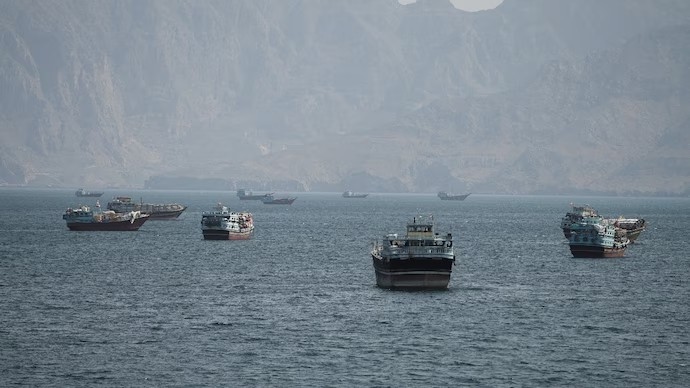


New Delhi: Five Indian nationals aboard a Kuwait-flagged tanker were safely brought ashore after the vessel was struck by a projectile while sailing through the Strait of Hormuz, the Indian Embassy in Oman said.
The tanker was identified as MT Kazimah III. The Indian mission in Muscat said it coordinated the rescue of the five Indian nationals and thanked Omani authorities for their support and assistance during the operation.
The incident comes amid heightened security risks for commercial shipping in and around the Persian Gulf, with Indian authorities closely monitoring the safety of Indian seafarers operating in the region.
Five Indian crew members shifted ashore safely
The Indian Embassy in Oman confirmed that all five Indian nationals aboard MT Kazimah III had been rescued and shifted ashore safely.
In a post on X, the mission said it had coordinated the rescue after the Kuwait-flagged tanker was struck by a projectile in the Strait of Hormuz.
The embassy did not provide details on the origin of the projectile or the extent of damage suffered by the tanker. Reports identified MT Kazimah III as a crude oil tanker sailing under the Kuwaiti flag.
The vessel was reportedly travelling towards Lomé in Togo when it was struck. However, details about the incident remain limited, and authorities have not publicly attributed responsibility for the projectile attack.
Strait of Hormuz remains a high-risk shipping route
The incident has highlighted the risks faced by commercial vessels operating through the Strait of Hormuz amid continuing tensions in West Asia.
The Strait is a narrow maritime passage connecting the Persian Gulf with the Gulf of Oman and the Arabian Sea. It is a strategically important route for international energy and commercial shipping.
Commercial vessels and seafarers have faced heightened security risks in several areas affected by regional conflicts, including the Strait of Hormuz, Gulf of Oman, Red Sea, Gulf of Aden, Bab-el-Mandeb and Black Sea.
The latest incident involving MT Kazimah III adds to concerns about the safety of civilian crews operating in these waters.
India has a particularly significant interest in the safety of shipping routes because thousands of Indian nationals work aboard commercial vessels operating across the region.
More than 4,500 Indian seafarers in region
Earlier this week, Ministry of External Affairs spokesperson Randhir Jaiswal said more than 4,500 Indian seafarers were serving aboard various commercial vessels operating in the region.
He also said 163 Indian seafarers were aboard 12 active cargo vessels in the Persian Gulf. The group included six India-flagged commercial ships and six foreign-flagged vessels carrying cargo to India.
The government has been monitoring the movement of these vessels and the welfare of Indian crew members amid the heightened maritime security situation.
The Ministry of Shipping is coordinating with Indian diplomatic missions and other stakeholders to track vessels and provide assistance when required.
The rescue of the five Indians from MT Kazimah III demonstrates the role of diplomatic missions and local authorities in responding when Indian seafarers encounter emergencies at sea.
India raises concerns over attacks on shipping
India has also raised concerns internationally over attacks targeting commercial shipping and seafarers.
External Affairs Minister S Jaishankar highlighted the issue during his address to the General Debate of the 81st session of the United Nations General Assembly.
Jaishankar said continuing attacks on commercial shipping and seafarers had added to existing challenges in the maritime domain and stressed the need to protect civilian crews and maintain the security of international shipping routes.
The concerns are particularly relevant for India because of the large number of Indian seafarers working aboard both Indian-flagged and foreign-flagged vessels.
Any disruption to major maritime routes can also have consequences beyond the safety of individual crews, given the importance of these waterways to global trade and energy supplies.
Omani authorities assist rescue operation
The Indian Embassy specifically thanked Omani authorities for their continued support and assistance during the rescue of the five Indian nationals.
Oman lies adjacent to the Strait of Hormuz and has played an important role in maritime and humanitarian responses in the region.
The safe evacuation of the five crew members means that no Indian national aboard the tanker was left onboard following the incident, according to the Indian mission.
The embassy’s coordination with Omani authorities also reflects the importance of regional cooperation when commercial vessels come under threat.
Safety of Indian seafarers remains priority
The incident involving MT Kazimah III comes at a time when India is closely monitoring the safety of its maritime workforce.
Indian seafarers form a significant part of the international commercial shipping workforce, with thousands currently operating on vessels in and around conflict-affected maritime zones.
The government has said Indian diplomatic missions and relevant authorities are monitoring developments and remaining in contact with stakeholders involved in vessel operations.
For the five Indians aboard MT Kazimah III, the immediate priority was completed with their safe evacuation and transfer ashore.
However, the incident once again highlights the risks faced by civilian crews navigating through strategically important waterways during periods of heightened regional tensions.
As authorities continue to monitor the security situation in the Gulf, the safety of commercial vessels and seafarers remains a key concern for India and other countries whose citizens work in international shipping.