




Paris: France is facing a fresh wave of unrest that has exposed deep divisions over living costs, public services and the government’s plans to repair the country’s finances. The violence on October 17, when buildings were set ablaze and shops were looted in several cities, has intensified questions about whether the country can implement spending cuts without triggering further social upheaval.
French Interior Minister Laurent Nuñez estimated that 550,000 people participated in demonstrations across the country, while organisers put the turnout at 800,000. Prime Minister Sébastien Lecornu said 1,200 people had been arrested and 150 police officers and gendarmes injured in the violence. Reports described fires and damage in Limoges, Marseille, Lyon and Paris.
The demonstrations began amid concerns about conditions in schools and the cost of living before widening into a broader expression of dissatisfaction with public spending priorities, wages and pensions. Although most participants marched peacefully, smaller groups engaged in arson, looting and clashes with police.
The unrest comes at a difficult moment for Lecornu’s minority government. France is under pressure to reduce its deficit, contain borrowing costs and maintain spending on defence, while a divided parliament makes agreement on the budget difficult.
The implications extend beyond France. Across Europe, governments face competing demands to strengthen defence, manage ageing populations, maintain public services and control public debt. France’s crisis illustrates how difficult it can be to reconcile those priorities when younger generations believe they are being asked to shoulder a disproportionate share of the adjustment.
Public debt puts France under pressure
France’s fiscal position has become a central part of the political debate.
According to France’s national statistics agency, Insee, public debt reached €3.595 trillion at the end of the second quarter of 2026, equivalent to 119% of gross domestic product (GDP). The debt ratio had stood at 117.5% in the previous quarter.
The scale of the debt limits the government’s room for manoeuvre. As interest payments absorb more public revenue, less money is available for other priorities unless the government raises taxes, borrows more or reduces spending elsewhere.
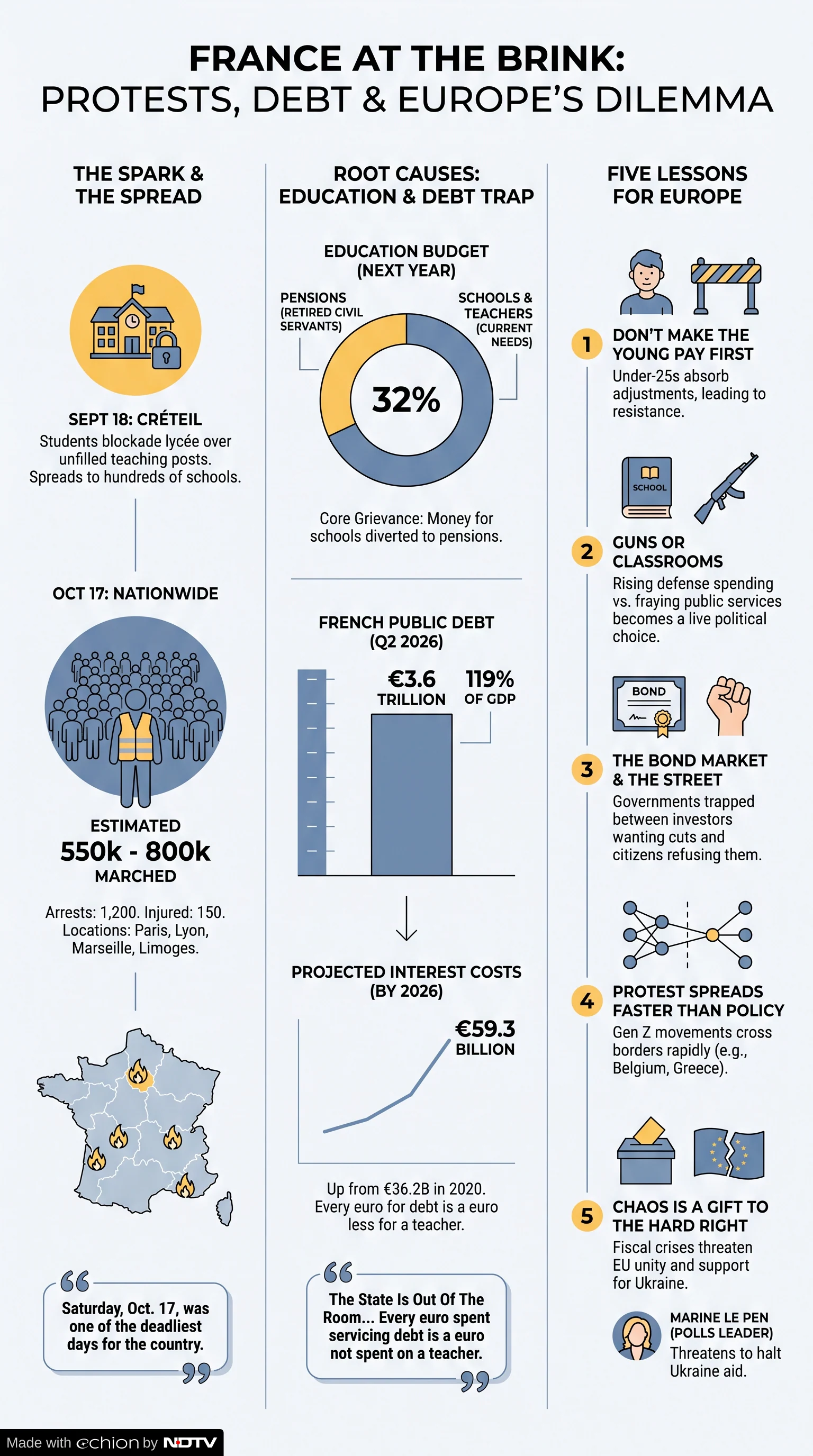
Lecornu has proposed a fiscal adjustment of approximately €54 billion in the 2027 budget, aiming to bring the deficit down to 5% of GDP. Without additional measures, he warned that the deficit could approach 6.5% of GDP. The proposal includes a freeze in government spending in cash terms in several areas, while defence spending and selected ministries would receive different treatment.
A cash freeze can amount to a real reduction in spending power when prices rise. Public institutions may therefore find it harder to maintain the same level of services, even if their nominal budgets do not fall.
For households already facing higher living costs, the prospect of constrained public services and limited income growth can add to dissatisfaction.
Why the protests have become a political challenge
France has experienced major protest movements during Emmanuel Macron’s presidency, including the Yellow Vest demonstrations that began in 2018 and the nationwide protests against pension reform in 2023.
The latest unrest differs in its combination of student activism, trade union participation, cost-of-living concerns and anger over public services. The destruction of public buildings and commercial property has also intensified the debate over public order and the government’s response.
The scale of the October 17 demonstrations suggests that dissatisfaction extends beyond a single policy dispute. However, the turnout figures do not establish that all participants shared the same demands or supported the same political parties.
Lecornu and other government figures have blamed radical groups and looters for the violence. Left-wing politicians, including France Unbowed leader Jean-Luc Mélenchon, have questioned the authorities’ handling of the demonstrations. Those competing accounts underline the political dispute over responsibility for the unrest.
The timing is also significant. France’s next presidential election is scheduled for 2027, and parties are positioning themselves ahead of the campaign. The government must therefore manage the immediate security crisis while attempting to negotiate a budget that can survive parliamentary scrutiny.
Five lessons for Europe
1. Young people cannot be treated as the easiest group to cut
When governments seek savings, education, youth services and other programmes serving people with limited political influence can become targets for restraint.
But young people are not passive recipients of policy. Student demonstrations can disrupt schools, draw public attention and connect local grievances to wider movements.
European governments need to explain how fiscal adjustments affect different generations. If younger citizens believe that pension commitments and other existing obligations are protected while their education and future opportunities deteriorate, public trust can weaken.
Fairness does not mean shielding every programme from savings. It means making the distribution of costs transparent and assessing the long-term consequences of cuts to education, training and employment support.
2. Defence spending must be explained alongside public services
European governments are increasing their defence commitments in response to a more uncertain security environment, particularly following Russia’s full-scale invasion of Ukraine.
That spending competes with other demands on public finances. Governments must therefore explain how military commitments will be funded and what trade-offs they entail.
The debate is not simply a choice between weapons and classrooms. Defence can be essential to national and European security, while education, healthcare and infrastructure are equally important to long-term resilience.
The political challenge is to prevent citizens from feeling that the cost of security is being met through unexplained deterioration in essential services.
3. Financial markets and public opinion impose different limits
Governments with large debts face pressure from investors concerned about repayment capacity and future borrowing costs. Higher yields can increase the expense of refinancing debt, adding to the burden on public budgets.
But financial markets are not the only constraint. Citizens may reject spending reductions they consider unfair, even when governments argue that fiscal consolidation is necessary.
France’s experience illustrates why governments need credible and carefully designed plans to manage debt before pressure becomes acute. The distribution of savings matters as much as the headline target.
A programme that spreads the burden transparently and protects essential services may be easier to defend publicly than abrupt cuts that disproportionately affect lower-income households or younger people.
4. Networked protests can spread faster than policy responses
Social media allows demonstrations, slogans and tactics to spread rapidly across borders. Young people facing similar concerns about living costs, housing, education and employment can draw inspiration from events elsewhere.
Reports of unrest and demonstrations in other European countries have reinforced questions about whether governments are responding quickly enough to these concerns. However, similar protests do not necessarily have identical causes, political affiliations or objectives.
Governments need to distinguish peaceful protest from violence while addressing the grievances that bring people onto the streets. Security measures alone cannot resolve disputes over public services, economic opportunity or the distribution of public spending.
5. France’s fiscal choices could affect European support for Ukraine
France’s budget debate also has implications for European policy beyond its borders.
Marine Le Pen, the leader of the far-right National Rally, has questioned the affordability of further French contributions to European Union funding for Ukraine. In an interview reported by the Financial Times, she argued that France’s financial constraints should limit its ability to support additional European funding commitments.
Her position highlights how domestic fiscal pressures can become linked to foreign policy. If disagreements over debt and spending intensify, decisions about defence, aid to Ukraine and contributions to the EU budget could become more politically contentious.
That does not mean France’s fiscal difficulties will automatically lead to a reduction in support for Kyiv. The outcome will depend on the election result, parliamentary decisions and the policies adopted by the next government.
Nevertheless, France is a major European economy, and its choices can influence debates over the EU’s shared priorities and capacity to finance them.
A test of Europe’s social contract
France’s latest protests expose a difficult problem for governments across Europe: how to make public finances sustainable without undermining the services and opportunities that give citizens confidence in the future.
Reducing deficits can be necessary, particularly when debt and interest costs constrain spending choices. But the process becomes politically harder when households face rising expenses, schools and other public institutions report pressure, and younger people believe that established commitments are being protected at their expense.
The government must also respond to the violence and damage caused during the demonstrations. Peaceful protest is distinct from arson and looting, and the authorities face the task of protecting public safety while respecting the right to demonstrate.
For Europe, the wider lesson is that fiscal consolidation cannot be treated as an accounting exercise alone. Decisions about taxes, pensions, defence and public services are also decisions about who bears the cost of economic and geopolitical change.
France is not necessarily a forecast of what will happen elsewhere. But its unrest provides a warning that governments need to explain their choices, distribute the burden of adjustment fairly and maintain public trust if they want difficult financial reforms to endure.