







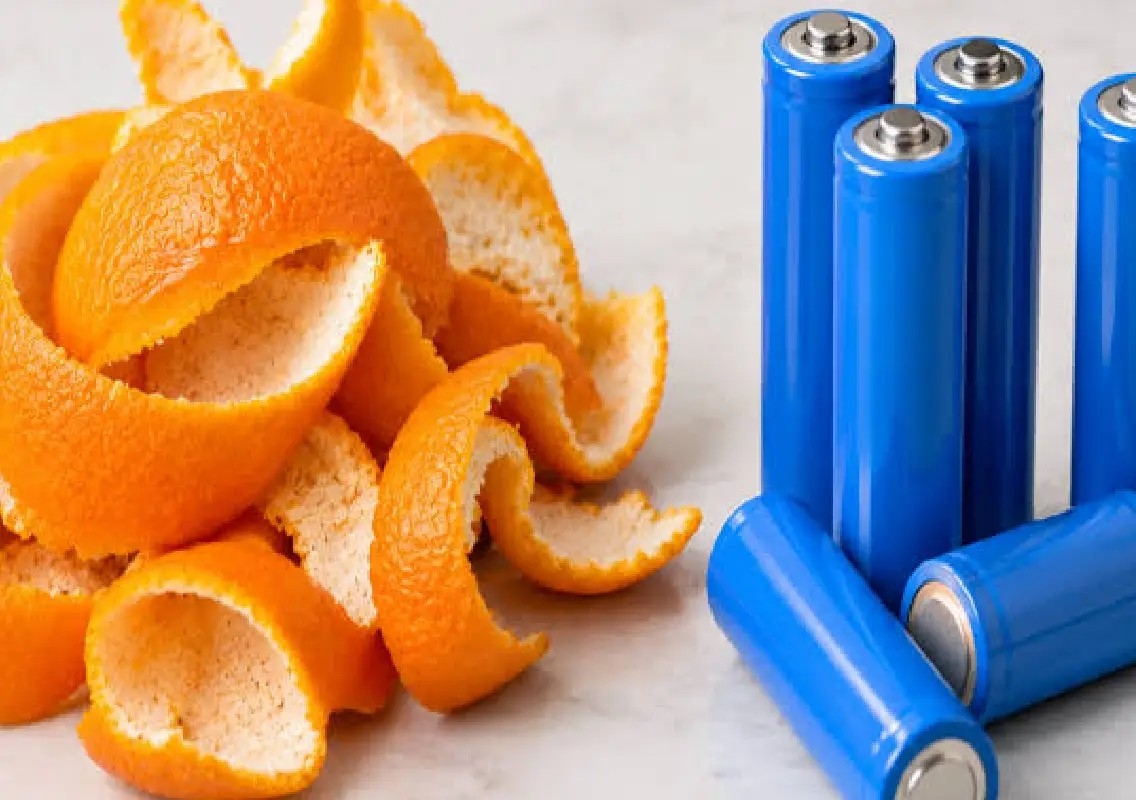


Singapore : Discarded fruit peels could help tackle two growing waste problems at once, with researchers in Singapore developing a method that uses orange, lemon and pineapple waste to recover valuable metals from used lithium-ion batteries. The technology has progressed from laboratory research to a pilot recycling facility near Pioneer.
The work is being carried out by researchers from Nanyang Technological University (NTU) in partnership with Se-cure Waste Management (SWM). The approach uses naturally occurring acids and compounds in fruit peels to dissolve battery materials and recover metals that can potentially be used again in new lithium-ion batteries.
The development is significant as demand for lithium-ion batteries continues to rise in areas including electric vehicles, portable electronics and energy storage. Recycling spent batteries can reduce the need for fresh raw materials while helping address the environmental challenges associated with battery waste.
From laboratory experiment to pilot facility
NTU’s work on using fruit waste for battery recycling began with a proof-of-concept study in 2020, when researchers demonstrated that orange peels could help recover materials from used batteries. Subsequent research found that lemon and pineapple peels could also be used in the extraction process.
The research has since moved beyond laboratory experiments. NTU and SWM have partnered to develop the process at a pilot facility near Pioneer, which has been operating since late 2022.
The facility can process up to 2,000 litres of shredded batteries at a time, while SWM processes about 18 tonnes of spent batteries each day. The project is supported by Singapore’s National Research Foundation and National Environment Agency.
The move towards a pilot-scale operation is intended to assess how the technology can work outside controlled laboratory conditions and whether it can eventually contribute to commercial battery recycling.
How fruit peels recover battery metals
The recycling process begins by shredding used lithium-ion batteries. Plastics and metals such as copper and aluminium are separated first.
The remaining material, commonly known as black mass, contains materials from the battery electrodes, including valuable metals. Researchers then use mixtures derived from fruit-peel waste to dissolve this material.
Natural acids present in the peels help extract cobalt, lithium, nickel and manganese at relatively low temperatures. The recovered materials are subsequently converted into metal salts.
According to the report, around 90% of the metals in lithium-ion batteries can be recovered through the process. The recovered salts can then be used as raw materials for producing new batteries.
This creates a potential circular process in which materials from discarded batteries are recovered rather than being treated simply as waste.
Why oranges, lemons and pineapples?
The researchers found that the peels of different fruits contain sugars and natural acids that can assist in breaking down battery materials.
The original research focused on orange peels, but expanding the process to lemons and pineapples provides greater flexibility in sourcing the required waste material.
Using several types of fruit waste could make the approach less dependent on a single source of raw material. The pilot facility currently obtains fruit peels from a partnering supplier.
The concept is particularly interesting because it connects two separate waste streams — discarded food and spent batteries — in a single recycling process.
Instead of requiring specially produced chemical agents alone to extract metals, the researchers are investigating whether materials that would otherwise be discarded can perform part of that role.
Recovered metals can return to battery production
The process does not simply extract metals and separate them for disposal.
Cobalt, lithium, nickel and manganese recovered from the battery material are converted into metal salts. These materials can subsequently be used in the manufacture of new lithium-ion batteries.
Earlier tests also produced encouraging results. Batteries made using the recovered materials showed a charge-storage capacity similar to that of commercial batteries, according to the report.
The finding suggests that materials recovered from spent batteries could potentially retain sufficient quality for another cycle of battery production.
However, the technology remains part of an ongoing development and commercialisation process, and its wider industrial performance will depend on factors such as processing efficiency, costs, supply of waste materials and the ability to operate consistently at larger scales.
Tackling two waste problems together
The researchers’ approach has an important environmental dimension because it attempts to address both food waste and battery waste.
Fruit peels are commonly discarded after the edible portion of the fruit has been consumed. At the same time, used lithium-ion batteries contain valuable materials that can be difficult and costly to recover.
The Singapore project seeks to bring the two problems together by using fruit waste as part of the process for recovering battery materials.
Such approaches could become increasingly important as societies use more rechargeable batteries. Electric vehicles, consumer electronics and renewable-energy storage systems are all contributing to growing demand for battery materials.
At the same time, large numbers of batteries will eventually reach the end of their useful lives, creating a need for efficient recycling systems.
Growing need for battery recycling
NTU and SWM have said that less than 5% of lithium-ion batteries are currently recycled, while the amount of spent batteries could reach 11 million tonnes by 2030.
These figures underline the scale of the challenge facing the battery industry.
Lithium-ion batteries contain valuable resources, but recycling them involves technical and economic challenges. Recovering metals efficiently can reduce pressure on mining and potentially create a more circular supply chain for battery manufacturing.
A process that can recover valuable materials while making use of another waste stream could therefore have advantages if it proves economically and technically viable at larger scale.
Commercialisation remains a key challenge
NTU and SWM had previously announced plans to commercialise the technology and supply recycled materials to battery manufacturers. However, the current report notes that it is unclear whether the original commercialisation target was achieved as planned.
The pilot facility nevertheless represents an important step in testing the technology outside the laboratory.
Moving from a successful scientific experiment to a commercially viable recycling system requires consistent access to feedstock, efficient processing, competitive costs and reliable quality of recovered materials.
The researchers will therefore need to demonstrate that the fruit-peel method can operate efficiently on a much larger scale before it can become a widespread alternative to conventional battery recycling technologies.
A promising example of circular innovation
The Singapore research offers an unusual example of how everyday food waste could contribute to solving a modern technological problem.
What would normally be discarded as fruit peel is being investigated as a useful ingredient in the recovery of materials from sophisticated lithium-ion batteries.
The approach does not mean fruit peels alone can solve the world’s battery-waste challenge. But by combining waste reduction with resource recovery, researchers are demonstrating how circular-economy principles can be applied to emerging technologies.
As battery use expands globally, innovations that recover lithium, cobalt, nickel and manganese from spent cells could become increasingly important. Singapore’s fruit-peel recycling project shows how scientific research can look beyond traditional raw materials and find value in waste that is already available.