







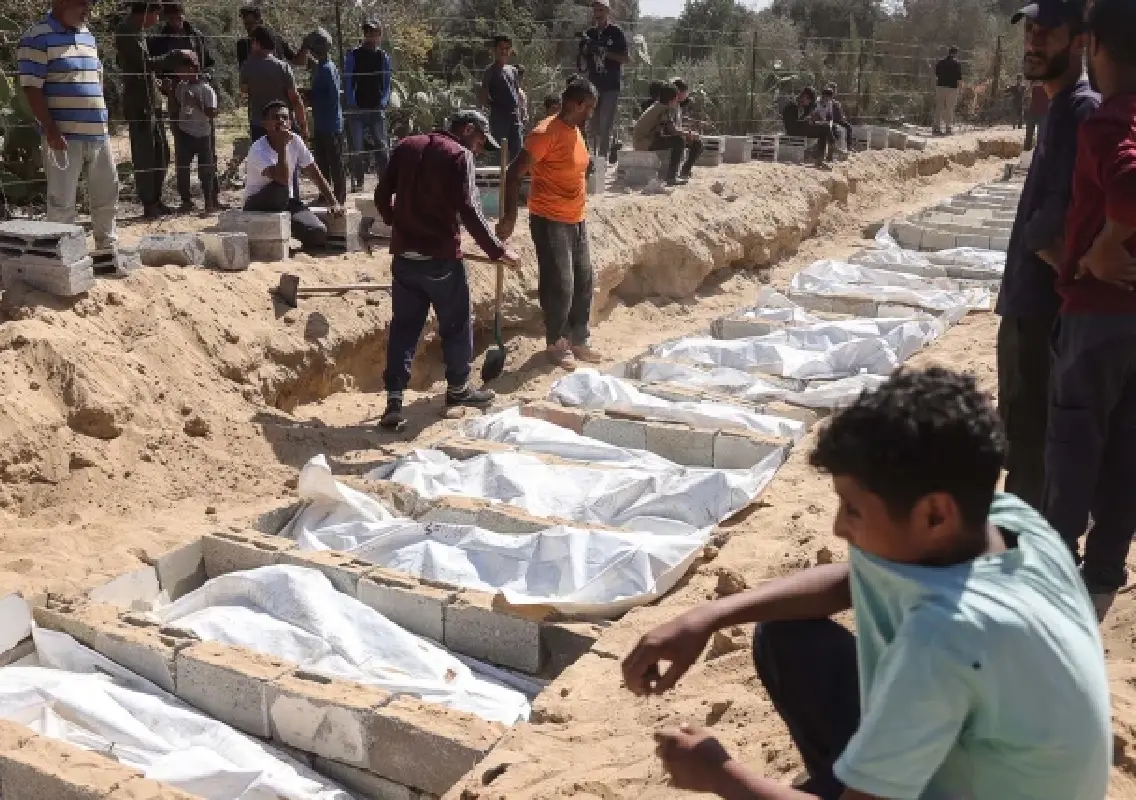


The recovery of the remains of an Israeli policeman in Gaza has ignited intense debate over humanitarian double standards, after Israeli forces reportedly used overwhelming military power to retrieve a single body while thousands of Palestinian dead remain buried beneath rubble without identification or dignity.
According to reports by Al Jazeera, the Israeli military deployed tanks, drones and so-called “explosive robots” to retrieve the remains of Ran Gvili, an Israeli policeman killed more than two years ago. The operation took place in Gaza City’s Tuffah neighbourhood, where the al-Batsh cemetery was dug up during a two-day incursion.
Neighbourhood turned into ‘kill zone’
Local journalist Khamis al-Rifi said the area was sealed off and turned into a “kill zone”, with tanks and helicopters firing at anything that moved. Engineering units reportedly dug up nearly 200 Palestinian graves, examining bodies one by one until Gvili’s remains were identified.
Four Palestinian civilians were killed during and after the operation, including residents who later returned to inspect the damaged cemetery. Witnesses said Palestinian bodies were reburied haphazardly by bulldozers, with some remains left visible on the surface.
Thousands of Palestinians still missing
The National Committee for Missing Persons has stated that more than 10,000 Palestinians are believed to be buried under Gaza’s rubble, decomposing without identification. Families continue to grieve without closure, unable to recover or properly bury their loved ones.
Alaa al-Din al-Aklouk, the committee’s spokesperson, has described Gaza as “the world’s largest graveyard”, pointing to restrictions on heavy rescue equipment that prevent the recovery of Palestinian victims.
‘A fatal injustice’, say leaders
Palestinian National Initiative secretary-general Mustafa Barghouti said the contrast was deeply troubling. While acknowledging every family’s right to bury their dead, he said the unequal treatment reflected a broader denial of Palestinian humanity.
Israeli Prime Minister Benjamin Netanyahu hailed the recovery of Gvili’s remains as a national commitment. For many in Gaza, however, the operation has become a stark symbol of a war in which dignity in death is afforded to one side alone.