







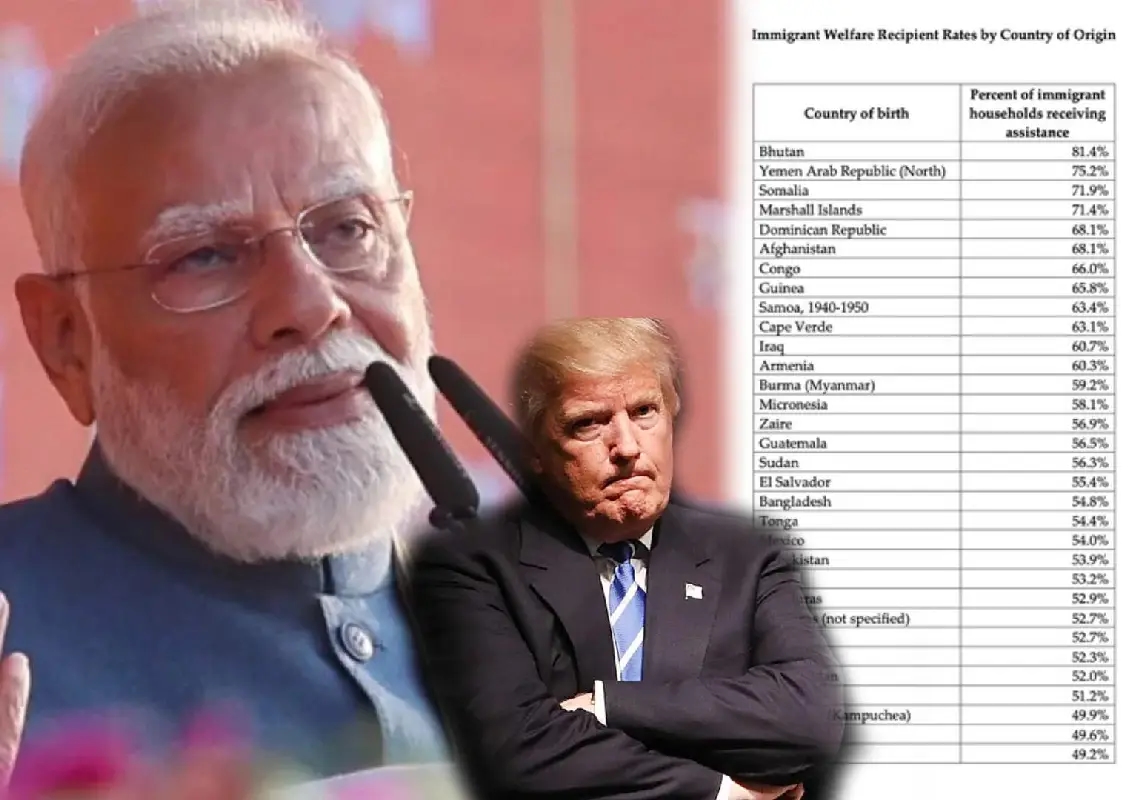


A social media post by former US President Donald Trump has triggered widespread discussion after India was conspicuously absent from a chart showing immigrant households receiving welfare and public assistance in the United States.
The chart, titled Immigrant Welfare Recipient Rates by Country of Origin, was shared on Trump’s platform, Truth Social. While it listed nearly 120 countries and territories, India did not feature anywhere, even as neighbouring nations such as Pakistan, Bangladesh, Nepal, Bhutan and China were clearly included.
What the chart showed
According to the data shared, Bhutan topped the list with over 80 per cent of immigrant households receiving welfare support, followed by countries such as Yemen, Somalia and the Marshall Islands. Bangladesh was listed at over 50 per cent, Pakistan at around 40 per cent, Nepal at nearly 35 per cent and China at about 33 per cent.
The post, however, did not clarify which welfare schemes were included or the duration for which assistance was received, leaving questions about methodology and thresholds used.
Why India may not appear
While no official explanation was provided, experts point to the strong economic profile of Indian immigrants in the US. Multiple studies, including data from the US Census Bureau and the Pew Research Center, show that Indian-American households are among the highest earners in the country.
Most Indian immigrants arrive through skilled visa routes such as the H-1B and are employed in sectors like technology, medicine, engineering and finance. This high educational attainment and stable employment significantly reduce reliance on public assistance programmes.
A broader perspective
Indian Americans constitute one of the largest and most economically successful immigrant groups in the US. Their median household income far exceeds the national average, and welfare usage is believed to be well below levels reflected in the chart.
The episode has been viewed by many as an unintended acknowledgment of the Indian diaspora’s economic contribution, even as debates continue globally on immigration, welfare and public policy.
For context on how welfare eligibility works in the US, see Public charge rule.