







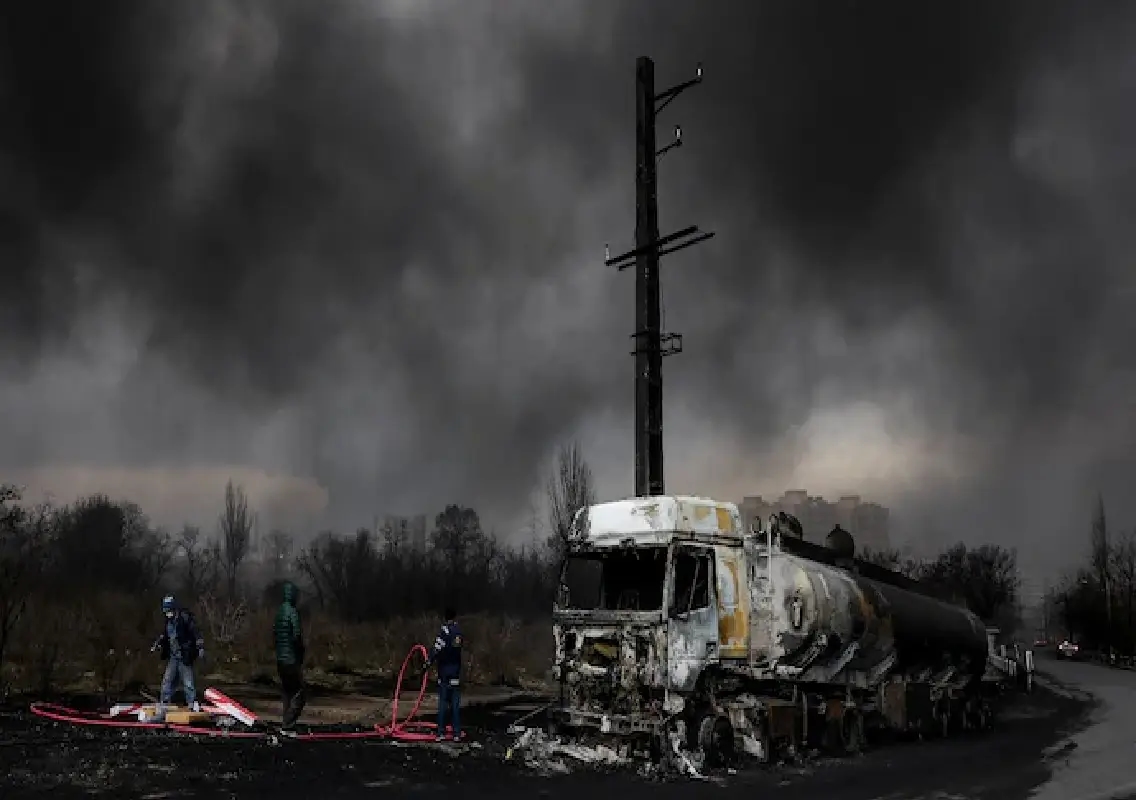


Tehran: Iran appears to be pursuing a strategy of endurance in its ongoing conflict with the United States and Israel, seeking to prolong the war and impose economic and political costs on its adversaries rather than relying solely on military victory.
According to analysts and regional observers, Tehran’s approach focuses on sustained drone and missile attacks, disruption of energy routes in the Gulf and the creation of volatility in global markets. The strategy aims to pressure Washington and its allies by raising economic and political stakes over time.
Despite the shock of coordinated strikes by the United States and Israel and the reported loss of key leaders, the Islamic Revolutionary Guards Corps (IRGC) remains firmly in control of the country’s military strategy and operational planning.
IRGC directing war strategy
Tehran-based observers and analysts say the IRGC, which has long served as the most powerful security institution within Iran, is directing the battlefield strategy and overseeing contingency plans prepared before the conflict began.
The Guards’ military network is believed to be coordinating missile launches, drone attacks and other operations across the region. These actions are part of a broader effort to transform the conflict into a prolonged war of attrition.
Experts believe Iran anticipated a confrontation with Washington and Israel well before the current war erupted.
“This is an existential fight for them,” said Fawaz Gerges of the London School of Economics, describing the mindset of Iranian leadership.
“They believe their survival is at stake and are willing to escalate dramatically,” he added.
Alex Vatanka, a senior fellow at the Middle East Institute, compared Iran’s current posture to a wounded but dangerous animal, suggesting that Tehran could become more aggressive as the conflict intensifies.
Leadership shift after Khamenei’s death
The early stages of the conflict reportedly saw a major shift in Iran’s leadership structure.
According to insiders and regional sources, Mojtaba Khamenei, the son of former supreme leader Ayatollah Ali Khamenei, was elevated to the position of supreme leader after his father was killed in the initial wave of US–Israeli strikes.
Observers say the decision highlights the growing influence of the IRGC in shaping Iran’s political future.
While the supreme leader remains the formal head of the Islamic Republic, analysts suggest that the Revolutionary Guards now play a decisive role in determining strategic direction and political leadership.
This shift underscores how military institutions have gained greater authority within Iran’s governance structure during the crisis.
Attacks aimed at economic disruption
Iran’s military strategy has focused heavily on targeting energy infrastructure and key economic nodes across the Gulf region.
Recent strikes have reportedly been aimed at energy hubs in countries such as Qatar and Saudi Arabia, moves analysts say are intended to disrupt oil and gas supply chains.
By targeting these critical assets, Tehran is attempting to drive up global energy prices and increase economic pressure on Western nations.
Higher fuel costs and market instability could affect both Europe and the United States, potentially creating domestic political pressure in those countries.
Iranian planners appear to believe that sustained economic disruption could force Washington to reconsider its military campaign.
US vows decisive victory
United States President Donald Trump has indicated that military operations against Iran will continue until Tehran is decisively defeated.
Speaking to Republican lawmakers, Trump reportedly said the conflict would end only when Iran’s ability to threaten the United States, Israel and their allies had been eliminated.
At the same time, he suggested that the campaign might conclude relatively soon once Iran’s military capabilities were sufficiently degraded.
However, analysts note that the duration of the war could ultimately depend on how long Iran can sustain its missile campaign.
Uncertainty over missile stockpile
One of the central questions in the conflict is the size of Iran’s remaining missile arsenal.
US officials claim that a substantial portion of Iran’s missile capabilities has already been destroyed during the initial stages of the war.
However, regional sources suggest that Tehran may still possess more than half of its pre-war missile stockpile.
If these estimates are accurate, Iran could potentially continue launching missile strikes for several weeks.
Such a timeline could significantly affect the political and economic dynamics of the conflict, particularly if global energy markets continue to react strongly.
Shift toward a war economy
Inside Iran, authorities appear to be adapting the country’s economy to wartime conditions.
Observers report that government agencies are accelerating logistics and supply chain processes to ensure that goods continue to move despite the conflict.
For instance, cargo that previously remained at ports for weeks is now reportedly being cleared immediately, with administrative procedures postponed until later.
Officials say these measures are designed to maintain essential supply lines while reinforcing the IRGC’s influence over key sectors of the economy.
Domestic stability remains intact
Despite the ongoing air strikes and missile attacks, there are currently few signs of large-scale unrest or political fractures inside Iran.
Observers and contacts within the country report that daily life in cities such as Tehran continues despite frequent bombardment.
An individual in the capital described the situation as tense but manageable.
“The windows shake day and night,” the source said, referring to the impact of nearby strikes. “But life goes on.”
Shops and banks remain open, and most residents have not fled the city.
Some analysts believe the external attacks may have strengthened national unity, at least temporarily, as citizens rally in response to the perceived threat.
A contest of endurance
Strategists increasingly view the conflict as a contest of endurance between Iran and its adversaries.
On one side, Iran is attempting to sustain missile attacks and economic disruption long enough to weaken political resolve in Washington and allied capitals.
On the other side, the United States and Israel are seeking to degrade Iran’s military infrastructure while managing the economic consequences of a prolonged war.
Analysts say the central question may ultimately be which side is willing—or able—to absorb the greater cost.
“The big question is who blinks first in this all-out war,” Gerges said, referring to the strategic standoff between Washington and Tehran.
For Iran, even surviving the conflict could be presented domestically as a form of victory.
Uncertain future for the region
If the conflict continues, experts warn that the region could face extended instability, particularly if energy infrastructure remains under threat.
Rising oil and gas prices are already affecting global markets, while the possibility of further escalation keeps geopolitical tensions high.
Whether the war ends quickly or evolves into a prolonged struggle will likely depend on both military developments and political calculations in Washington, Tehran and other global capitals.
For now, the situation remains fluid, with both sides preparing for what could become a drawn-out confrontation with far-reaching consequences.