







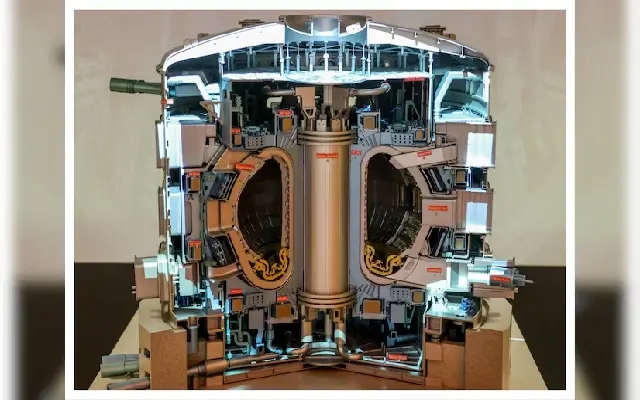


A monumental step in the world’s most ambitious clean energy experiment is finally underway. The International Thermonuclear Experimental Reactor (ITER)—a long-delayed nuclear fusion project involving over 30 nations—is now assembling the world’s most powerful magnet, essential for containing the ultra-hot plasma required to initiate fusion.
Based in southern France, ITER is backed by countries including the US, China, Russia, Japan, and the EU. At the heart of the fusion process lies the central solenoid, a powerful magnet designed to create an “invisible cage” to trap and stabilize superheated plasma so that atoms can fuse and release energy—mimicking the sun’s core.
The solenoid, constructed and tested in the United States, marks the final piece of ITER’s magnetic system and has now entered the assembly stage. ITER Director General Pietro Barabaschi compared its function to a wine bottle: “The wine may be more important, but you need the bottle to hold it.”
Initially expected to be ready in 2021, the magnet’s completion faced multiple setbacks. NYU professor Charles Seife noted the delays reflect deeper challenges in the project’s execution. Despite the slow progress, Barabaschi said construction is now accelerating, with the plasma-generating phase set for 2033.
Barabaschi also praised the unity of international partners amid global tensions, saying ITER is a testament to cooperation in science. While private firms rush to build commercial reactors, Barabaschi remains cautious about timelines for cost-effective fusion becoming reality.
Read Also: