









Tokyo: A powerful 7.1-magnitude earthquake struck southern Japan’s Kumamoto Prefecture on Tuesday, causing widespread damage, power outages and fires, while authorities fear casualties following an explosion at a shopping mall amid the chaos.
The quake, which hit near the city of Kumamoto on the island of Kyushu, disrupted infrastructure, halted transport services and forced the evacuation of nearly 3 lakh people as aftershocks continued to rattle the region.
Extensive damage and rescue efforts underway
Japanese Prime Minister Sanae Takaichi said authorities were still assessing the full scale of destruction. She confirmed that injuries had been reported and highlighted damage to roads, bridges and buildings.
“Power outages and fires have occurred in some areas, and there has also been damage to roads and bridges and the collapse of buildings,” Takaichi said, urging residents to move to safer locations.
Japan’s disaster management agency said approximately 3 lakh people had been directed to evacuation centres. The government has deployed 3,600 soldiers to assist in rescue and relief operations as emergency teams continue to search for survivors.
Explosion at shopping mall raises casualty fears
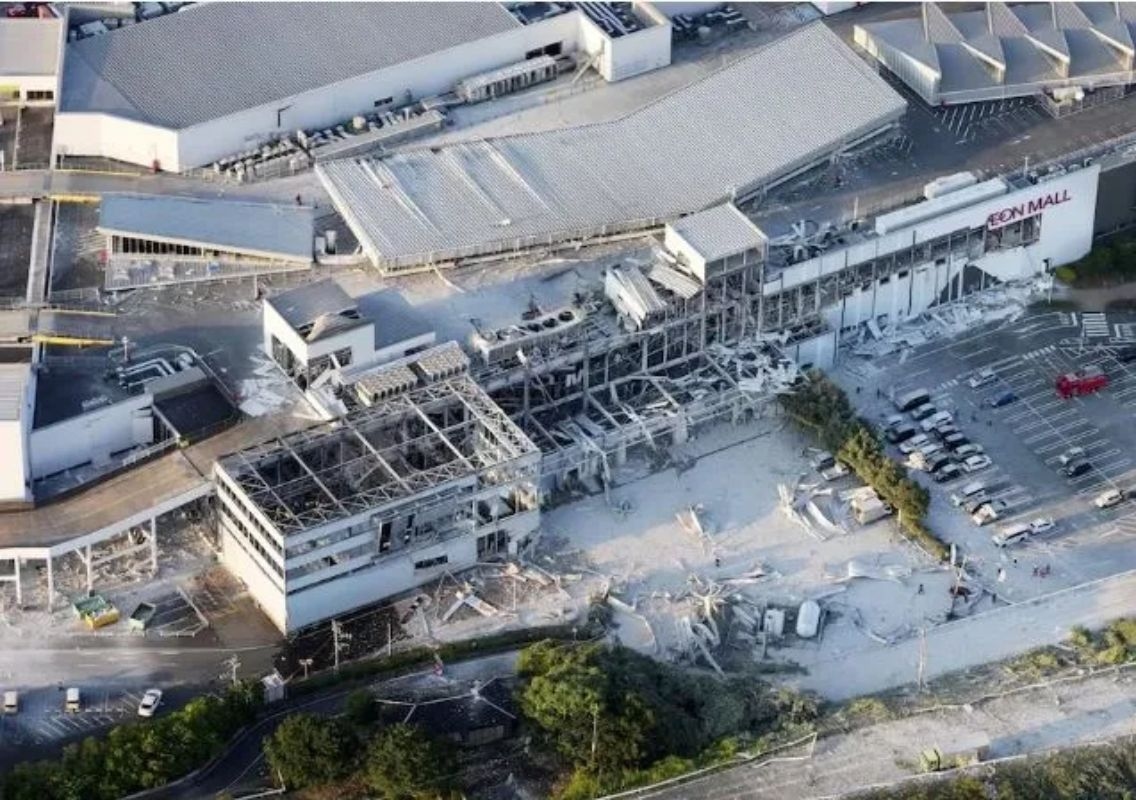
One of the most serious incidents occurred at an Aeon shopping mall, where an explosion followed the earthquake.
Fire services reported that multiple individuals were trapped inside the partially collapsed structure. Police indicated that “quite a few” people were feared dead, though official confirmation of fatalities is awaited.
An Aeon spokesperson stated that customers and staff were evacuated immediately after the quake, and the cause of the explosion remains under investigation.
Eyewitnesses described a dramatic scene, with one local resident saying a massive plume of smoke rose into the air, making the surroundings appear as though “volcanic ash was falling.”
Infrastructure hit as transport and power disrupted
The earthquake caused severe disruption to essential services across the region.
- Around 48,000 homes lost electricity, according to Kyushu Electric Power
- High-speed bullet train services operated by JR Kyushu were suspended
- Flights were grounded as Kumamoto Airport shut its runway
- Mobile networks operated by KDDI and NTT Docomo faced disruptions
Visuals from public broadcaster NHK showed buildings on fire, partially collapsed structures, and major cracks on highways, including elevated roads.
Industries suspend operations as precaution
Major corporations with facilities in the affected region took precautionary measures.
- TSMC evacuated workers from its plant
- Sony and Fujifilm also evacuated staff
Companies said they were assessing the situation and prioritising employee safety.
Injuries reported, hospitals under pressure
Local media reported that at least one hospital had treated over 50 injured people, while additional injuries were reported among passengers on a high-speed train caught during the quake.
Emergency services are continuing rescue operations, particularly in collapsed buildings where people may still be trapped.
Tsunami warning lifted, aftershock risk remains
A tsunami warning issued immediately after the quake was later lifted. However, officials from the Japan Meteorological Agency cautioned that strong aftershocks could continue for up to a week.
Residents have also been warned about the risk of landslides, especially in hilly areas affected by heavy tremors.
Region recalls deadly 2016 earthquake
The latest quake has revived memories of the devastating 2016 earthquake in Kumamoto, which killed 275 people and injured over 2,700.
Authorities reported that parts of Kumamoto Castle, a major tourist attraction previously damaged in 2016, have again suffered structural damage.
Japan’s vulnerability to earthquakes
Japan remains one of the most earthquake-prone countries in the world, located along the Pacific “Ring of Fire.” The country experiences frequent seismic activity, accounting for nearly 20% of the world’s earthquakes of magnitude 6.0 or higher.
Conclusion
The powerful earthquake in Kumamoto has once again highlighted Japan’s vulnerability to natural disasters, despite its advanced preparedness systems. With rescue efforts ongoing and fears of casualties in the mall explosion, authorities face a critical period in managing relief and recovery. The coming days will be crucial as aftershocks continue and the full extent of the damage becomes clearer.