


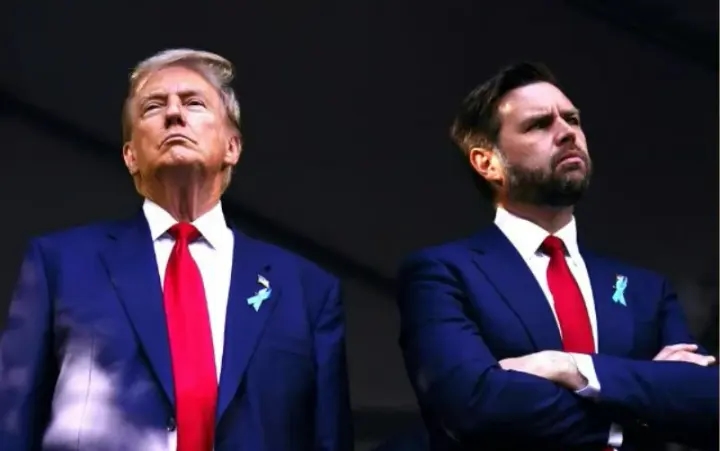


Washington: US Vice-President JD Vance has triggered an online political backlash after blaming soaring fuel prices on “tin-pot dictators” who cause international crises, with critics questioning whether his remarks could also apply to President Donald Trump and the administration’s war with Iran.
Speaking at a Republican midterm rally in Montana on Monday, Vance acknowledged public frustration over rising petrol prices but argued that fuel costs had historically surged during periods of international conflict. His comments quickly drew criticism because he did not mention the conflict with Iran, which began under the current administration in February, according to the supplied report.
The controversy comes as fuel prices remain a concern for American households ahead of the November 3 midterm elections. Republicans are seeking to retain control of Congress, making inflation, energy costs and the economic impact of the Iran conflict politically significant issues.
Vance blames global conflicts for rising petrol prices
During his address, Vance sought to explain why Americans were paying more for fuel, pointing to previous periods when international conflicts coincided with sharp increases in petrol prices.
He cited price spikes in 1979, 2001, 2007 and 2022, when Russia launched its full-scale invasion of Ukraine.
“Remember in 2022 when Russia invaded Ukraine, and gas prices skyrocketed — they skyrocketed, by the way, far higher than they are today,” Vance said.
He continued by referring to earlier episodes of rising fuel costs before adding: “They skyrocket every time some tin-pot dictator decides to throw a tantrum. And we’ve got to remember that.”
Vance acknowledged that the administration still had work to do to address inflation and the cost of living. His remarks appeared intended to place current fuel-price pressures within the broader history of global conflicts and their effects on energy markets.
However, his choice of words became the main focus of the political reaction rather than his comparison with earlier price increases.
Why the remark prompted comparisons with Trump
Critics quickly drew a connection between Vance’s description of foreign leaders and Trump’s decision to launch the war with Iran in February.
The president’s role in the conflict has become a point of political scrutiny as fuel prices have risen. Critics argued that if international leaders whose decisions trigger conflicts are responsible for fuel-price increases, the same reasoning could be applied to the current administration.
Vance did not explicitly refer to Trump as a “tin-pot dictator”, nor did he directly criticise the president during the rally. The comparisons emerged from social media users interpreting his remarks in the context of the Iran conflict.
One user asked, “Is he really talking about his boss that way?”
Another commenter described the remark as “a pretty aggressive opening move for a presidential campaign that’s still two years away.”
The reactions reflected speculation about the political implications of Vance’s wording rather than evidence that he intended the comment as a criticism of Trump.
Social media recalls Vance’s past criticism of Trump
The controversy also revived references to Vance’s earlier criticism of Trump before he joined the president’s political team.
During the 2016 presidential campaign, Vance had publicly expressed strong reservations about Trump. Critics have since used those earlier comments to question how Vance’s political positions have evolved.
One social media commenter referred to Vance’s previous comparison of Trump to Hitler, writing: “That’s the most truthful thing he’s said since he compared Trump to Hitler.”
Another user warned Vance: “Careful, JD. That tinpot signs your checks.”
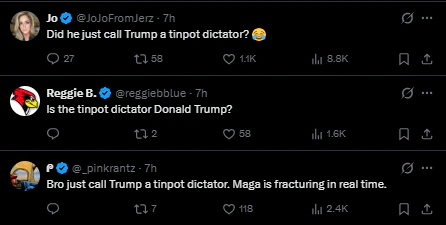
The comments added a personal and political dimension to the reaction, turning the vice-president’s remarks into a debate about his relationship with Trump and the possibility of future presidential ambitions.
However, the online responses do not establish that Vance was deliberately sending a message to the president. His remarks at the rally focused on historical fuel-price increases and the effects of international conflicts.
Vance takes aim at Democrats over energy costs
The vice-president also criticised Democrats during the rally, arguing that their approach to energy costs would not adequately address the pressures facing American consumers.
Vance characterised the Democrats’ response as an attempt to “whine and build a few windmills”, using the comment to attack their energy policies.
The remark reflected the broader political divide over how the United States should manage energy prices, domestic production and the transition to renewable sources.
Republicans have frequently argued that expanding conventional energy production can help improve energy security and reduce costs. Democrats have supported a range of approaches, including renewable energy investment, efficiency measures and policies aimed at reducing dependence on fossil fuels.
The rally therefore combined an argument about international conflicts with a broader attack on the opposition’s approach to energy.
Yet the comparison with Trump dominated the subsequent online discussion, particularly because the administration’s own military decisions have become part of the debate over the current fuel-price increase.
US petrol prices remain elevated
The controversy comes as petrol costs remain an important concern for American motorists.
According to the figures supplied in the report, the average price of regular petrol in the United States reached US$4.12 per gallon on October 19, 2026, up 40.6 per cent from US$2.93 a year earlier.
Prices have fluctuated considerably during the year. The reported average fell to US$2.67 per gallon in January before reaching US$4.35 in May.
The average for 2026 so far stands at US$3.71 per gallon, compared with US$2.98 for 2025.
These figures indicate a substantial increase in the cost of filling up for American motorists. However, petrol prices are influenced by several factors, including crude oil prices, refining costs, distribution expenses, taxes and changes in demand.
International conflicts can disrupt oil supplies or increase uncertainty in energy markets, potentially pushing prices higher. The extent of the impact depends on the conflict’s effect on production, shipping routes, sanctions and market expectations.
The reported figures show that fuel prices have increased, but they do not, by themselves, establish how much of the rise can be attributed specifically to the Iran conflict.
Fuel prices become a midterm election issue
With the November 3 midterm elections approaching, the cost of living has become a politically sensitive issue for the Trump administration.
Higher petrol prices affect household budgets directly and can also increase transportation and business costs. Those increases may feed into the prices of goods and services, adding to concerns about inflation.
For Republicans, retaining control of Congress will depend partly on how voters assess the administration’s economic record. Fuel prices are one of several issues that can shape those assessments, alongside employment, wages, housing costs and broader inflation.
The political challenge is complicated by the relationship between global events and domestic economic conditions. While presidents have limited control over many international market forces, voters often judge administrations by the economic consequences they experience at home.
Vance’s remarks sought to place rising fuel prices in the context of earlier international crises. Critics, however, argued that the explanation did not adequately address the current administration’s role in the Iran conflict.
A remark that has taken on a life of its own
Vance’s comments have become a political talking point because of the contrast between his criticism of foreign leaders who trigger international crises and Trump’s role in the war with Iran.
The vice-president did not explicitly direct his remarks at the president. Nevertheless, the timing and wording prompted critics to question whether the administration’s explanation for rising fuel costs was consistent with its own foreign-policy decisions.
The dispute also illustrates how economic concerns can intersect with political messaging during an election campaign. A comment intended to explain higher prices can become controversial when voters connect it to decisions made by the government itself.
For now, the online backlash centres on the interpretation of Vance’s words rather than any confirmed disagreement between the vice-president and Trump.
With petrol prices remaining a concern ahead of the midterms, the administration will continue to face questions about inflation, energy costs and the economic consequences of the Iran conflict. Whether the controversy has any lasting effect on the Republican campaign remains uncertain, but Vance’s choice of words has ensured that the issue has attracted renewed attention.