







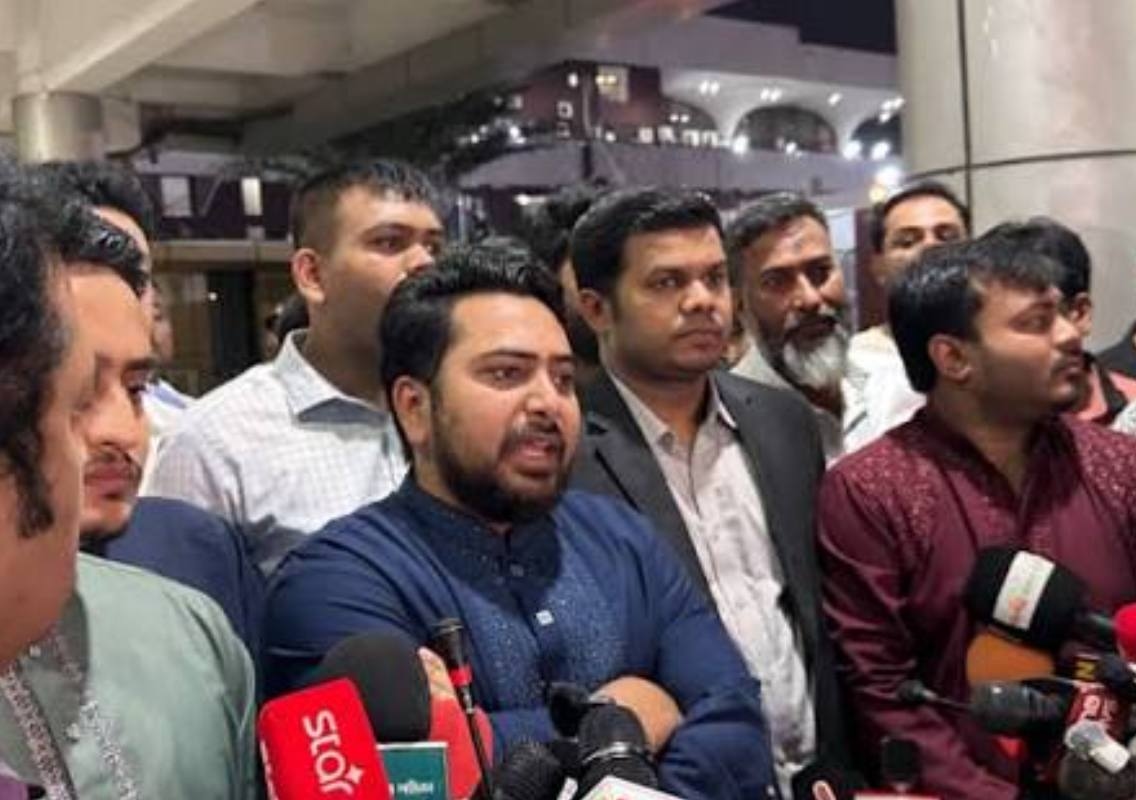


Dhaka: Bangladesh‘s National Citizen Party (NCP) chief Nahid Islam on Monday called on political parties to unite against what he described as “Indian hegemony”, accusing New Delhi of allowing ousted prime minister Sheikh Hasina to use its territory against Bangladesh.
The remarks came after Nahid met Bangladesh Prime Minister Tarique Rahman at the Secretariat in Dhaka, where the two sides reportedly discussed the country’s political situation, bilateral relations with India and several domestic issues.
Nahid accused India of attempting to destabilise Bangladesh and urged the government to adopt a firm position on matters including Hasina’s extradition and the renewal of the Ganga water-sharing treaty, which is due to expire on December 12.
His comments come amid renewed political tensions in Bangladesh, with the Awami League facing allegations over recent violence and arson attacks, and Hasina reiterating her intention to return to Bangladesh in December.
Nahid Islam accuses India of interfering in Bangladesh
Speaking to reporters after the meeting with Tarique Rahman, Nahid alleged that India was providing political space to Hasina, whom he accused of being responsible for violence in Bangladesh.
“India is providing space to a murderer and allowing a group to use its territory against Bangladesh. Our fight now is not with the Awami League. It is against Indian hegemony. We defeated the Awami League on August 5 itself,” Nahid said.
He further alleged that New Delhi was attempting to destabilise Bangladesh and called for political forces and citizens to unite in response.
“India is trying to destabilise Bangladesh. Therefore, the people and political forces must unite. We believe India is directly involved in everything that is happening in Bangladesh,” he added, according to reports.
The NCP delegation that met Tarique Rahman reportedly included Nahid Islam, senior joint convener Hasnat Abdullah, member secretary Akhter Hossen and political council member Akram Hossain.
The meeting was held at the invitation of the Bangladesh Prime Minister to discuss the country’s political situation and issues concerning national interests.
Nahid urges stronger position on Ganga water treaty
Nahid also urged the Bangladesh government to send a strong message to New Delhi during negotiations over the Ganga water-sharing treaty.
The treaty, which governs the sharing of Ganga waters between India and Bangladesh, is due to expire on December 12. Nahid stressed that Bangladesh should ensure it receives a fair share of the river’s water.
The water-sharing arrangement has long been a significant issue in bilateral relations, with negotiations involving water availability, seasonal flows and the interests of communities on both sides of the border.
According to reports, Nahid also raised several domestic political issues during the meeting, including the implementation of the July Charter in accordance with the referendum verdict, the execution of the verdict against Sheikh Hasina, justice for victims of the July 2024 uprising and security for those who participated in the movement.
In a separate account of the meeting, The Daily Star reported that Nahid called for a long-term roadmap for national unity and a common foreign policy to protect Bangladesh’s sovereignty, national security and economic interests.
He also reportedly criticised the government over what he described as its failure to clearly articulate its diplomatic position towards India and maintain law and order.
Bangladesh faces renewed political tensions
Nahid’s remarks come amid a period of political uncertainty in Bangladesh, with the Awami League facing renewed activity among its supporters following the party’s ban from political activities.
Sheikh Hasina, who was ousted from power in August 2024 following student-led protests and subsequently fled to India, has reiterated her intention to return to Bangladesh in December.
Recent incidents of violence, including arson attacks, have reportedly been blamed on Awami League supporters. Several BNP-linked properties and a police station in Gopalganj were reportedly targeted in recent incidents.
The ancestral home of Muhammad Yunus, who headed Bangladesh’s interim government following Hasina’s removal, was also reportedly set on fire.
The developments have further intensified political tensions in the country as parties debate the future of the political system, the role of the Awami League and Bangladesh’s relationship with neighbouring India.
The NCP, formed by student leaders who played a prominent role in the protests that led to Hasina’s ouster, has emerged as one of the political forces in the country. The party has aligned with Jamaat-e-Islami in opposition to the BNP-led political establishment, according to the source report.
Nahid Islam’s earlier anti-India statements
Monday’s remarks were not the first time Nahid Islam has accused India of interference in Bangladesh’s internal affairs.
On October 25, he accused the BNP-led government of entering into a “secret deal” with India to destabilise Bangladesh’s hill regions. Speaking at a public outreach programme in Mirpur-10, Nahid alleged that the BNP had come to power through an understanding with New Delhi and claimed that India was fuelling unrest in the hills and carrying out border killings to exert pressure on Bangladesh.
In August, Nahid had also warned Tarique Rahman against visiting India before resolving issues related to Hasina’s extradition and justice for those accused in the killing of Sharif Osman Hadi and during the July uprising.
He argued that normal diplomatic relations with India could not be restored without addressing the extradition issue.
Nahid also criticised New Delhi following Hasina’s virtual press conference from Delhi on August 5, alleging that the event had been organised with the Indian government’s direct or indirect support.
At an NCP rally in Dhaka on October 30, Nahid again accused India of conspiring against Bangladesh and raised concerns about border killings and the treatment of Muslims in Assam and West Bengal.
On November 1, he posted the slogan “No water, no transit”, warning that Indian goods would not be allowed transit through Bangladesh if New Delhi failed to ensure Bangladesh received its share of Ganga waters.
These statements reflect the NCP leader’s increasingly critical position on India’s policies towards Bangladesh and his calls for a tougher diplomatic approach.
India denies allowing Sheikh Hasina political activities
Nahid’s allegations that India is allowing Sheikh Hasina to conduct political activities from its territory have been disputed by New Delhi.
In a report tabled in Parliament on July 30, 2026, the Parliamentary Standing Committee on External Affairs said the Indian government had informed it that Hasina was not being provided a political platform or space to undertake political activities from Indian territory.
The committee also recorded India’s position that it adheres to the principle of not allowing its territory to be used for political activities directed against another country.
Following Hasina’s virtual press conference from New Delhi on August 5, the Ministry of External Affairs spokesperson Randhir Jaiswal had clarified that the Indian government had no role in the event, which was organised by a private media organisation. New Delhi also said it did not endorse the remarks Hasina made about Bangladesh’s government.
India has acknowledged receiving Bangladesh’s extradition requests for Hasina but has said the matter is being examined under applicable laws and established procedures. New Delhi has not announced a final decision on the request.
The diplomatic dispute continues to place pressure on bilateral relations, with the Ganga water-sharing treaty, Hasina’s extradition and allegations of political interference emerging as key issues between the two countries.