







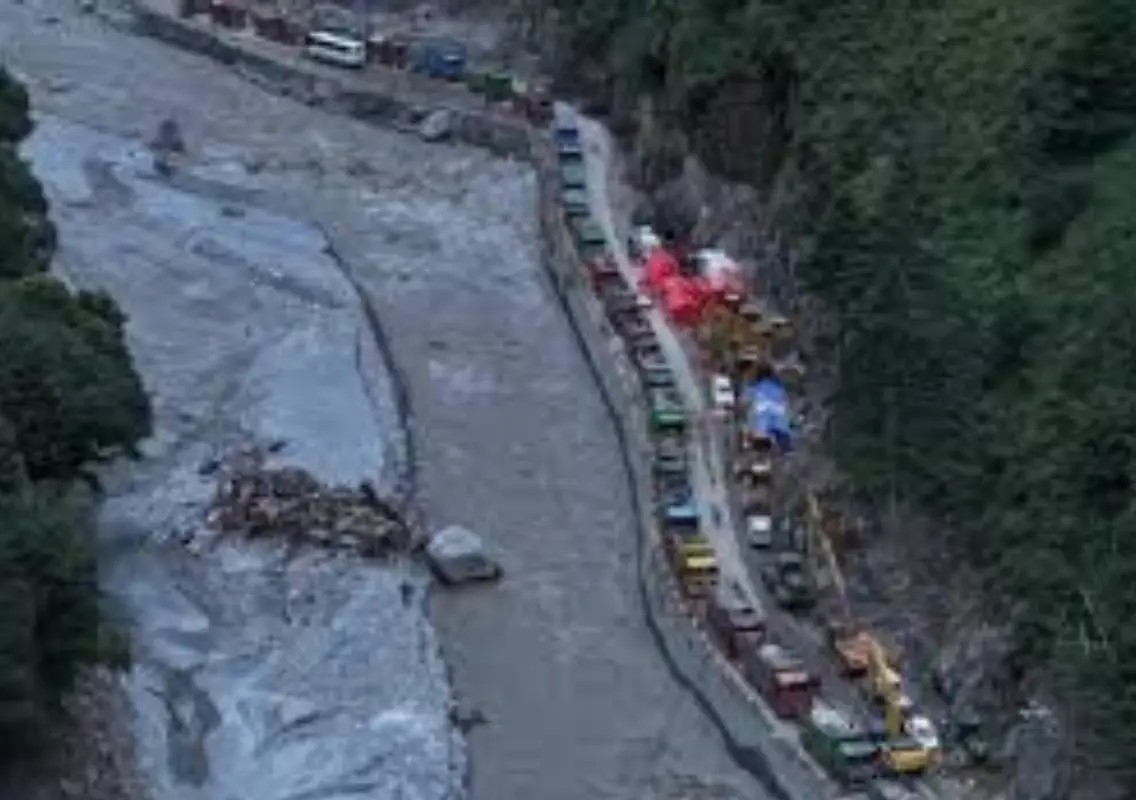


Kathmandu : A week after devastating flash floods swept through parts of Nepal, the scale of the tragedy continues to emerge, with more than 1,200 people confirmed dead and over 4,000 still missing.
The disaster, which struck on August 26, was triggered by the collapse of a glacier in the Lhende Khola river, a tributary of the Bhote Koshi. A massive surge carrying water, ice, mud and debris travelled downstream at an estimated speed of around 150 kmph, overwhelming communities with little time for people to escape.
Around 500 foreign nationals are among those still missing. Many had been in Nepal as pilgrims, trekkers and tourists. About 3,500 people have also been displaced and are staying at relief and holding centres.
For families still searching for loved ones, however, the numbers represent deeply personal losses. Each passing day is making the possibility of finding survivors more uncertain.
Families continue to search for missing relatives
In Kathmandu, the disaster has left families caught between hope and grief.
Padam Bahadur Raut has been visiting Tribhuvan University Teaching Hospital every day in search of his brother, Krishna Raut, an engineer who was working in Timure near the Nepal-Tibet border when the floods struck.
Raut has carried missing posters while also being forced to look at photographs of recovered bodies and remains displayed at the hospital.
His experience reflects the anguish of thousands of families who still do not know whether their relatives are alive or dead. The uncertainty is particularly painful because identification of bodies has been difficult following the scale and force of the flooding.
As search operations continue, families are being asked to provide information and, where necessary, DNA samples to help authorities identify recovered remains.
blob:https://newskarnataka.com/8f1064ed-1d03-4db2-878c-4b1b9c4688a9Meta Boxes
Use up and down arrow keys to resize the meta box pane.
Rescue teams face a daunting tunnel operation
The Nepal Army and Armed Police Force remain engaged in rescue operations in some of the worst-affected areas, particularly Rasuwa and Nuwakot.
Around 21,000 security personnel have been mobilised for the response. The Nepal Army has rescued more than 11,000 people, including survivors evacuated by helicopter.
One of the greatest challenges now lies underground.
More than 900 people are feared trapped in hydropower tunnels and underground powerhouses along the Trishuli river. Rescue teams have been working to enter damaged tunnels, but the operation is complicated by debris, unstable structures and difficult mountain terrain.
After a week of searching, only three bodies had reportedly been recovered from inside the tunnels.
Brigadier General Rajaram Basnet, spokesperson for the Nepal Army, said teams were using different methods, including drones and excavators, in an effort to gain access.
Specialist teams from India and China have also been called in to assist with the tunnel rescue effort.
Communication failures complicated the rescue
The floods also severely damaged communications infrastructure.
More than 200 communication towers were affected, leaving border areas including Dhunche, Timure and Syabrubesi difficult to reach during the first days after the disaster.
The breakdown in communications added to the difficulties faced by authorities attempting to establish the scale of the disaster and locate people who had survived.
Officials and neighbouring countries are now working to improve information-sharing, particularly concerning glacier monitoring and flood warnings.
The need is especially urgent because several rivers flowing through Nepal originate in Tibet, meaning developments upstream can have devastating consequences downstream.
No time for warnings as flood surged downstream
One of the most troubling aspects of the disaster was the speed with which the flood arrived.
Early assessments by Nepal’s National Disaster Risk Reduction and Management Authority, the International Centre for Integrated Mountain Development and later the US Geological Survey linked the disaster to a major glacier collapse in Tibet.
The resulting surge carried enormous quantities of water, ice, mud and debris into the river system.
Eyewitnesses said the event unfolded so quickly that there was little or no effective warning, particularly in parts of Rasuwa near the border.
Nepal’s Prime Minister Balendra Shah told Parliament that authorities acted after receiving information about the flooding but that the scale and timing of the event made it impossible to effectively warn everyone.
The disaster has since prompted Nepal and China to discuss stronger communication systems, glacier monitoring and flood-warning mechanisms.
Devighat residents return to devastation
In Devighat, in Nuwakot district, the aftermath is visible in every direction.
Residents returned on September 1 to find their town covered in mud and silt, with the smell of buried animal carcasses lingering in the air.
Excavators were used to clear the main road through Devighat bazaar, allowing residents to return to their damaged properties and search for belongings.
More than 400 residents escaped just minutes before the floods struck, helped by the quick action of local police officers. Their survival offered a rare moment of relief amid the devastation.
But escaping with their lives did not mean escaping the consequences.
Many residents lost their homes, shops and livelihoods within minutes. Some returned to properties that had been extensively damaged or completely swept away.
Entire livelihoods washed away
For people in Devighat, the disaster was not simply the loss of buildings.
It destroyed years, and in some cases decades, of work.
Shopkeeper Nabin Shreshta said his house and shop were extensively damaged. Like many others, he faced the daunting task of rebuilding his livelihood after losing much of what he had accumulated over his lifetime.
The destruction has also affected roads, bridges, electricity infrastructure and commercial establishments.
A resident who had watched Devighat develop over three decades described the devastating speed of the destruction. A town that had taken years to build was transformed within a matter of minutes.
Such accounts illustrate the enormous difference between the immediate survival of a person and the much longer struggle that follows a natural disaster.
Economic damage could reach billions
The Nepal government initially estimated that the total economic loss from the floods could be between $4 billion and $5 billion, equivalent to roughly 10 per cent of the country’s economy.
The figure reflects the widespread destruction of infrastructure and property, but the actual cost is likely to extend far beyond easily measurable financial losses.
Homes, shops and farms have been damaged or destroyed. Roads and bridges have been swept away, communications disrupted and electricity infrastructure affected.
For displaced families, rebuilding will require not only financial resources but also access to basic services, employment and safe housing.
The recovery could therefore take years.
Relief camps become temporary homes
About 3,500 displaced people are currently staying in relief and holding centres.
For many survivors, these camps provide essential shelter after their homes were destroyed. But they also represent the uncertainty of life after a disaster.
Families who once had houses, businesses and established communities are now dependent on temporary arrangements while authorities clear debris and assess damage.
The immediate needs include food, water, healthcare, sanitation and safe accommodation. Over time, however, the focus will have to shift towards permanent housing and restoring livelihoods.
The transition from rescue to rehabilitation is likely to be one of the biggest challenges facing Nepal.
Search continues despite fading hopes
Despite the growing death toll and the passage of a week, rescue teams have not abandoned the possibility of finding survivors.
The focus on hydropower tunnels reflects the belief that some people could potentially have survived in protected underground spaces.
Rescuers are using helicopters, drones, excavators and other equipment while working in extremely difficult conditions.
International assistance from India and China has added specialist capabilities to the operation.
At the same time, search teams must balance the urgency of rescue with the dangers posed by unstable tunnels and flood-damaged infrastructure.
A disaster that has changed communities forever
The floods have left Nepal facing two crises at once: an immediate humanitarian emergency and a long-term reconstruction challenge.
More than 1,200 confirmed deaths represent an enormous loss, while more than 4,000 missing people mean that many families are still living without answers.
The disaster has also highlighted the vulnerability of communities living along Himalayan rivers and the difficulty of predicting sudden events linked to glacial instability.
The latest figures from other reports put Nepal’s confirmed death toll at 1,204, with more than 4,200 people still missing, although figures continue to be updated as identification and search operations proceed.
For survivors in places such as Devighat, the immediate relief of escaping the flood has now given way to the painful reality of rebuilding.
For families of the missing, the search continues.
And for Nepal, the road ahead is likely to be measured not in days but in years — as communities attempt to recover homes, livelihoods and infrastructure from one of the country’s most devastating disasters.