







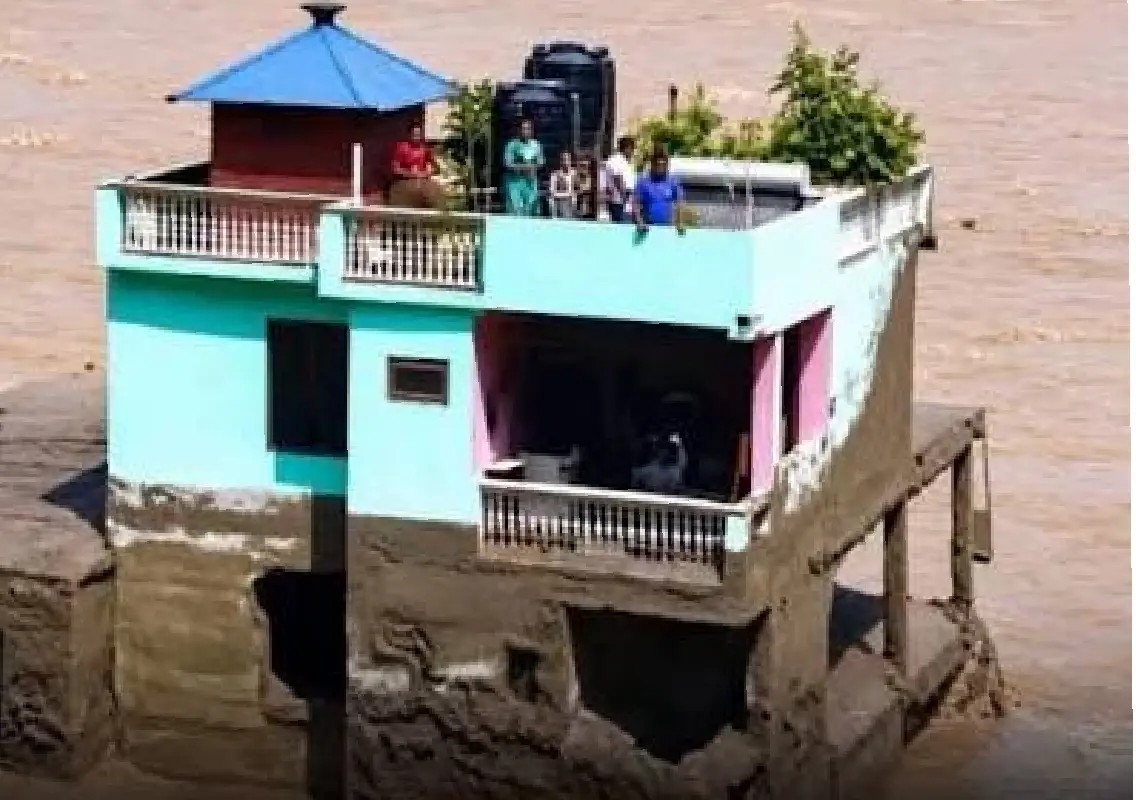


Kathmandu : Amid the devastation caused by catastrophic floods in Nepal, one modest green-painted house has emerged as a powerful symbol of survival after standing remarkably firm while much of the surrounding area was destroyed.
The house belonging to the Pyakurel family in Dhunge Bazaar, Nuwakot, survived the raging floodwaters that swept through the Trishuli River basin on August 26. The disaster destroyed homes, roads, vehicles and other infrastructure across the region, while the death toll from the wider Nepal-China disaster has risen above 1,100. Thousands of people remain missing.
For the family inside the green house, however, the disaster became a terrifying struggle for survival that ended with an extraordinary outcome.
A house surrounded by destruction
As the floodwaters surged through the area, the Pyakurel family’s approximately 40-year-old house was surrounded by fast-moving water and debris.
Images and videos of the structure standing amid the devastation quickly attracted attention. While neighbouring buildings were swept away or severely damaged, the green house remained standing.
The floodwaters damaged the lower portion of the house, but the main structure held firm. The family members moved to higher parts of the building as the water continued to rise, waiting anxiously for the danger to pass.
For those trapped inside, the experience was filled with fear and uncertainty.
Family describes survival as a second chance
The family has described their survival as being like receiving a second life.
According to accounts of the incident, Laxmi Pandey Pyakurel, her husband Prakash, their children, elderly in-laws and a neighbour were inside or associated with the house when the flood struck.
As water surrounded the building, the family feared that the structure could collapse at any moment.
They moved to safer, higher areas of the house and waited while floodwaters battered the surrounding landscape.
Eventually, all the family members were rescued and survived the disaster.
Why did the green house survive?
The survival of the house has prompted questions about what made it withstand such destructive floodwaters.
The family has pointed to the building’s age and solid construction. The house was built around four decades ago, at a time when construction methods and materials differed from many newer structures in the area.
Its location may also have played an important role.
The house appears to have avoided the full force of the flood compared with structures directly exposed to the strongest flow. Its foundation and construction may have helped it withstand the pressure of the water and debris.
However, experts would need to conduct a detailed structural assessment before determining precisely why the building survived.
A rare symbol of hope amid tragedy
The house’s survival has gained emotional significance because it contrasts so sharply with the scale of destruction around it.
The recent floods have left communities across parts of Nepal devastated. Entire settlements have been damaged, roads and bridges destroyed, and thousands of families separated.
Against this background, the image of one green house standing amid the destruction has become a symbol of hope.
For the Pyakurel family, however, the house is more than an extraordinary photograph. It is the place where they survived one of the most frightening experiences of their lives.
Nepal faces a devastating humanitarian crisis
The remarkable story of the house comes as Nepal continues to deal with the consequences of the catastrophic flooding.
The disaster followed a glacial collapse in the Himalayas, which triggered enormous quantities of water, ice and debris into downstream river systems. The resulting floods caused widespread destruction in Nepal and neighbouring areas of Tibet.
More than 1,100 people have now been confirmed dead in Nepal, according to recent reports, while thousands remain missing. Rescue teams continue searching for survivors, including workers believed to be trapped inside hydropower tunnels.
The scale of the disaster has made rescue operations extremely difficult, with damaged roads, unstable terrain, mud and disrupted infrastructure creating major challenges.
Rescue efforts continue across affected areas
Nepalese authorities and international rescue teams continue working in affected regions.
Teams from India, China and the United States are assisting with rescue operations, while specialised teams are focusing on locations where survivors may still be trapped.
At hydropower projects, rescue workers have been exploring tunnels where air chambers and remaining supplies could potentially allow missing workers to survive.
The search is being conducted alongside efforts to restore essential infrastructure and provide assistance to displaced families.
The importance of stronger construction
The survival of the green house has also drawn attention to the importance of construction quality in disaster-prone areas.
While there is no indication that the house was specifically designed to withstand a disaster of this magnitude, its survival raises questions about the role that strong foundations, durable materials, structural design and location can play when communities face extreme natural events.
At the same time, one surviving building should not be taken as evidence that older construction is automatically safer. Structural safety depends on many factors, including design, materials, maintenance, foundations and the nature of the disaster.
A professional assessment would be required to understand the precise reasons for the building’s resilience.
A family grateful for survival
For the Pyakurel family, such technical questions are secondary to the fact that they are alive.
Their home survived when much of the surrounding community did not. The family members escaped with their lives and now face the difficult task of dealing with the aftermath.
The house may have suffered damage, but it provided the protection they desperately needed when the floodwaters arrived.
That makes the green house an especially poignant image from Nepal’s ongoing disaster — one ordinary family home standing amid extraordinary destruction.
A beacon amid Nepal’s grief
The Pyakurel family’s green house has become known as a “miracle house” because of the extraordinary circumstances surrounding its survival.
Yet its story should not overshadow the thousands of families still searching for missing loved ones or coping with the loss of homes, livelihoods and relatives.
Instead, the house offers a small but powerful reminder that even amid overwhelming destruction, stories of survival can emerge.
As rescue and recovery operations continue across Nepal, the green house in Dhunge Bazaar stands as a quiet symbol of resilience — a structure that remained standing, and a family that was given a second chance to begin again.