







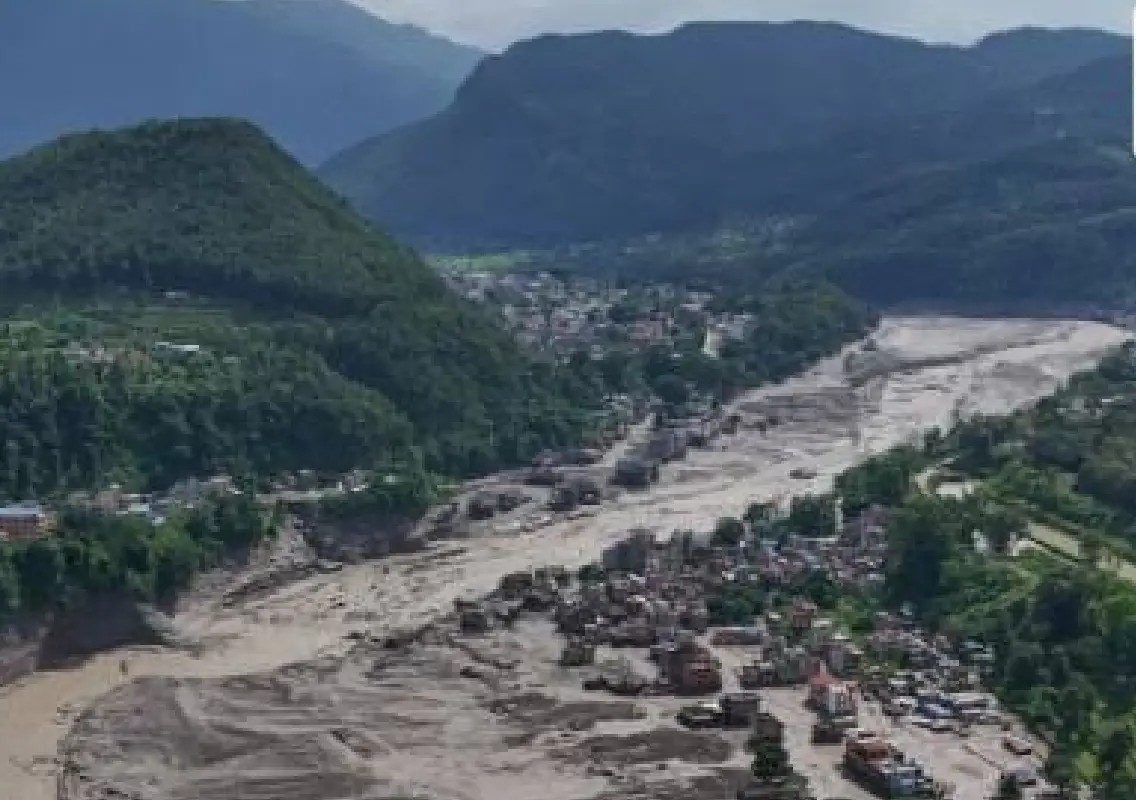


Kathmandu : Warning signs were reportedly visible in the days before a catastrophic glacier collapse triggered devastating floods across parts of Nepal and China, raising fresh questions about whether earlier detection and stronger warning systems could have helped save lives.
The disaster, which struck on August 26 after a glacier collapse in Nepal’s Langtang region, unleashed a massive flow of water, ice, rock and mud through Himalayan valleys. The latest reports put Nepal’s death toll at at least 1,114, with nearly 4,000 people still unaccounted for. China has reported 16 deaths and hundreds missing on the Tibetan side of the border.
The scale of the destruction has intensified scrutiny of monitoring systems in one of the world’s most vulnerable mountain regions.
Scientists identify signs before glacier collapse
A new report from the HiRISK scientific consortium found what researchers described as “pre-event indications” before the glacier collapse.
Among the reported warning signs were visibly brown meltwater and cracks developing in the surrounding bedrock slope. These changes suggested that instability was increasing in the area before the eventual collapse.
Scientists have said that identifying such physical changes in advance could potentially provide valuable information for communities downstream.
However, detecting a warning sign and converting it into a reliable public alert are two different challenges, particularly in remote and difficult Himalayan terrain.
Disaster killed more than 1,100 people
The collapse triggered a landslide and flash floods that swept through communities and infrastructure in Nepal’s mountainous districts.
The devastation has been enormous. Thousands of people remain missing, while roads, bridges, power infrastructure and other essential facilities were destroyed or badly damaged.
Rescue teams are continuing to search for survivors, including people believed to be trapped inside tunnels at hydropower projects. Authorities have said 279 people have been rescued from affected hydropower sites, while hundreds remain unaccounted for.
As the days pass, however, officials have warned that the likelihood of finding more survivors is declining.
Early warning systems under scrutiny
The findings have prompted renewed questions about whether an operational early-warning system for glacier-related hazards could have provided communities with more time to evacuate.
Experts cited in reports said that comprehensive monitoring and warning mechanisms downstream could potentially have saved a significant number of lives.
The challenge is particularly severe in the Himalayas, where settlements, roads and hydropower projects are often located along narrow valleys and river systems.
A sudden release of enormous quantities of water and debris can therefore travel rapidly through populated areas, leaving residents with little time to react.
Nepal and China had discussed data sharing
The disaster has also revived questions about cooperation between Nepal and China in monitoring risks along their Himalayan border.
Officials from the two countries met in Kathmandu in May to discuss sharing real-time information, improving early-warning systems, monitoring glacial lakes and conducting joint research into mountain hazards.
However, according to information cited by CNN, the two sides had not reached a specific agreement on real-time data sharing following that meeting and had planned to meet again.
The issue has become particularly significant following the disaster, as both countries face growing risks from rapidly changing Himalayan landscapes.
Climate change increasing Himalayan risks
Scientists and United Nations officials have warned that the Himalayan region faces increasing risks from glacial floods as temperatures rise.
Warming conditions can accelerate glacier melt and destabilise ice and rock formations. The resulting changes can increase the possibility of sudden landslides, glacial lake outburst floods and other dangerous events.
A senior UN official has warned that the Himalayan region faces severe glacial flood risks in the years ahead. Scientists have also identified numerous potentially dangerous glacial lakes across Nepal, China and India.
The recent disaster has therefore become part of a much wider discussion about climate change and the vulnerability of mountain communities.
Another threat remains in the region
Concerns have not ended with the main flood.
Earlier warnings from Nepal and China highlighted the danger posed by a newly formed glacial lake created by debris near the border. Authorities feared that the lake could breach its natural barrier and send another surge of water downstream.
This illustrates the difficulty facing rescue and relief teams: even after the initial disaster, unstable glaciers, landslides, swollen rivers and newly formed lakes can create additional hazards.
Rescue operations therefore have to balance the urgency of reaching missing people with the safety of those involved in the search.
Rescue gives way to rehabilitation
With hopes of finding survivors diminishing, Nepal is beginning to shift attention towards rehabilitation and reconstruction.
Prime Minister Balendra Shah has said the government is focusing increasingly on protecting people in affected areas while providing medical treatment and psychological counselling.
The United Nations has estimated that the disaster left approximately 2.2 million tonnes of debris, illustrating the enormous challenge facing communities trying to clear roads, homes and public spaces.
Thousands of displaced people remain in temporary shelters, while damaged healthcare facilities and contaminated water are creating additional public health concerns.
A warning for the Himalayan region
The tragedy has exposed the growing vulnerability of communities living in the Himalayan region.
The discovery of warning signs before the collapse does not necessarily mean that the disaster could have been completely prevented. But it does highlight the importance of investing in continuous glacier monitoring, satellite observation, real-time data sharing and reliable evacuation warning systems.
For countries such as Nepal, India and China, where millions of people depend on Himalayan rivers and live downstream from glaciers and glacial lakes, strengthening these systems could become increasingly important.
The devastating floods have already left more than a thousand people dead and thousands more missing. The discovery that signs of instability may have appeared beforehand now adds another painful question to the disaster: could better monitoring and faster warnings have given more people a chance to escape?
As Nepal moves from rescue towards recovery, answering that question could be crucial for preventing future Himalayan disasters from becoming equally catastrophic.