


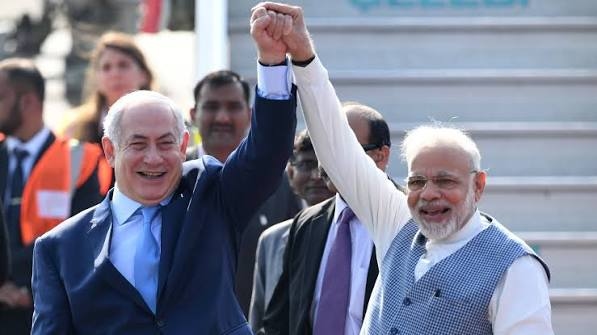


Israel: Israeli Prime Minister Benjamin Netanyahu has invited Indian Prime Minister Narendra Modi to light a torch alongside an Indian pilot during Israel’s Independence Day celebrations, highlighting the longstanding relationship between the two countries and their cooperation on security issues.
Netanyahu announced the invitation in a post on X on Thursday following a telephone conversation with Modi. According to the Israeli leader, the Indian Prime Minister thanked him for the invitation and spoke about the countries’ joint efforts to combat terrorism on land and in the air.
The two leaders also discussed the momentum in India-Israel bilateral relations and exchanged views on recent developments in West Asia, with Modi stressing the need to restore peace and stability in the region.
Netanyahu highlights decades-old India-Israel ties
In his post on X, Netanyahu described Modi as his friend and said he had invited the Indian leader to participate in Israel’s Independence Day torch-lighting ceremony.
“Spoke with my friend, Indian Prime Minister Narendra Modi, and invited him to light the torch alongside a brave Indian pilot on Israel’s Independence Day,” Netanyahu wrote.
He added that Modi had thanked him for the invitation and described India and Israel as working together against terrorism.
“Modi thanked me for the invitation and said that on land and in the air, India and Israel are fighting terrorism together. He also commended the strong and decades-old ties between us,” the Israeli Prime Minister said.
The invitation places the two countries’ relationship in the spotlight, particularly their cooperation on security and their continued engagement at the highest political level.
However, the announcement did not provide further details about the proposed participation, including whether Modi would attend the ceremony in person or the identity of the Indian pilot who would join the torch-lighting event.
PM Modi discusses bilateral partnership and West Asia
Modi also confirmed the telephone conversation in a post on X, focusing on the continuing development of India-Israel relations and the security situation in West Asia.
“Received a phone call from Israeli Prime Minister Benjamin Netanyahu. We reviewed the sustained momentum in our bilateral ties and reaffirmed our commitment to further strengthening our partnership,” Modi said.
The Indian Prime Minister added that the two leaders had exchanged views on recent developments in the region.
“We also exchanged views on recent developments in West Asia and underscored the urgent need to restore peace and stability in the region,” he said.
Modi’s statement placed regional stability alongside bilateral cooperation as a key subject of the conversation. While Netanyahu highlighted the invitation and counterterrorism cooperation, the Indian Prime Minister’s account emphasised the broader partnership and the need for peace in West Asia.
Neither statement provided a detailed account of the leaders’ discussion on the regional situation or outlined any specific decisions arising from the call.
Security cooperation remains a key theme
Counterterrorism was a prominent theme in Netanyahu’s description of the conversation. His reference to cooperation on land and in the air underlined the security dimension of India-Israel relations.
The two countries have developed a broad partnership covering areas such as defence, technology, trade, agriculture and innovation. Security cooperation has been an important part of their engagement, alongside diplomatic exchanges and economic collaboration.
The leaders’ latest conversation reflects their continued engagement on these issues. However, Netanyahu’s public remarks did not specify any new security agreement, operational arrangement or joint initiative announced during the call.
The invitation to Modi also offers a symbolic dimension to the relationship. Israel’s Independence Day torch-lighting ceremony is a prominent national event, and Netanyahu’s proposal to involve the Indian Prime Minister and an Indian pilot connects the occasion with the two countries’ bilateral ties.
Further details about the ceremony and the invitation were not included in the statements released by either leader.
West Asia developments feature in leaders’ discussion
The conversation took place against the backdrop of continuing developments in West Asia, a region whose security situation has implications for India’s diplomatic and economic interests.
Modi’s statement underscored the need to restore peace and stability, indicating that regional developments formed part of the leaders’ exchange. India has significant interests in West Asia, including energy security, trade and the welfare of Indian nationals living and working across the region.
The Indian government’s public account did not identify particular incidents or proposals discussed during the call. It also did not announce a new diplomatic initiative or provide further details about the steps the two leaders believe are necessary to achieve regional stability.
Netanyahu’s statement, meanwhile, focused primarily on the invitation, the relationship between the two countries and their shared efforts against terrorism.
The two accounts therefore highlighted different aspects of the same conversation: Israel’s emphasis on the bilateral relationship and security cooperation, and India’s focus on strengthening the partnership while addressing regional instability.
Invitation underscores continued diplomatic engagement
The proposed torch-lighting appearance comes as India and Israel continue to engage through political and diplomatic channels. Direct communication between their leaders provides an opportunity to review bilateral cooperation and discuss international developments affecting both countries.
Netanyahu’s description of Modi as his friend and his reference to decades-old ties conveyed the importance he attaches to the relationship. Modi, in turn, reaffirmed India’s commitment to strengthening the partnership while emphasising the need for peace in West Asia.
The next steps regarding the Independence Day invitation remain unclear from the public statements. Neither leader disclosed whether a visit had been finalised or provided additional details about the Indian pilot mentioned by Netanyahu.
For now, the announcement highlights the diplomatic engagement between New Delhi and Jerusalem, with counterterrorism cooperation, longstanding bilateral ties and the situation in West Asia featuring prominently in the leaders’ conversation.