


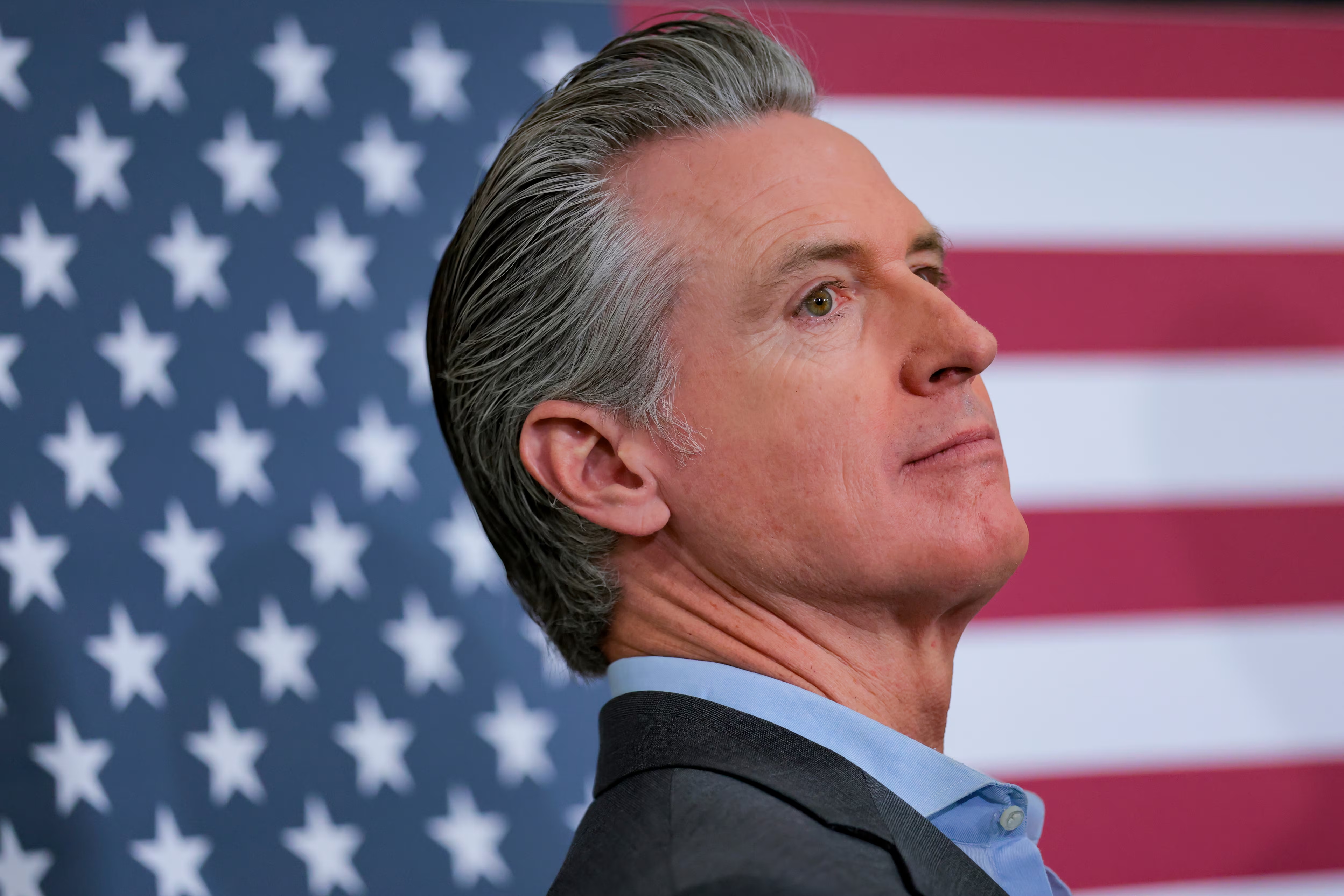


Sacramento: California Governor Gavin Newsom has announced plans to commute the death sentences of all 548 inmates on the state’s death row, in what could become the largest mass clemency action in US history. The proposed commutations would change their punishment to life imprisonment without the possibility of parole, ending the prospect of execution for those affected if the process is completed.
Newsom announced the decision on Thursday, November 5, in a three-page open letter addressed to Californians. The move comes as he approaches the end of his second and final four-year term as governor in January 2027. The Democrat, who previously served as San Francisco mayor and California lieutenant governor, has been widely discussed as a potential contender for the 2028 presidential election.
However, the announcement does not mean all 548 sentences have already been changed. California’s rules require the state Supreme Court to approve commutations in hundreds of cases involving prisoners with multiple felony convictions. The court’s role means the process is not entirely within the governor’s unilateral control.
Newsom has long opposed capital punishment and halted executions in California through a moratorium in March 2019. The state has not carried out an execution since January 2006, when Republican Governor Arnold Schwarzenegger was in office.
382 cases require California Supreme Court approval
The commutation process involves an important constitutional requirement. Under California law, the governor cannot independently grant clemency to a prisoner who has been convicted of more than one felony. Such cases require approval from the California Supreme Court.
According to figures released by Newsom’s office, 382 of the 548 death row inmates fall into this category. That represents approximately 70 per cent of the total. The remaining cases can be covered directly by the governor’s clemency action, while the others must go through judicial review before their sentences are formally changed.
The distinction means the announcement is not the same as all 548 sentences being immediately and unconditionally converted. The court’s review will be a significant part of completing the process.
If the commutations take effect, the prisoners will remain incarcerated for life without the possibility of parole. The decision would therefore remove execution as a punishment for those individuals, but it would not release them from prison.
California has not executed a prisoner since 2006
Newsom imposed a moratorium on executions in March 2019, approximately two months after taking office. The order halted executions in the state, although the death penalty remained part of California law and hundreds of prisoners continued to be held on death row.
The last execution in California took place in January 2006, during the tenure of Republican Governor Arnold Schwarzenegger.
California has the largest death row in the Western Hemisphere. According to figures provided by Newsom’s office, the 548 prisoners include 529 men and 19 women.
The state has also debated the future of capital punishment through ballot measures. Voters rejected proposals to abolish the death penalty in 2012 and 2016, keeping it legally available as a sentencing option.
Newsom’s action is therefore a decision to commute individual sentences rather than abolish capital punishment across California. The death penalty remains on the state’s statute books, and a future administration could take a different approach to executions, subject to the law.
Newsom cites opposition to state-sanctioned killing
In his letter to Californians, Newsom reiterated his long-standing opposition to capital punishment and explained why he had decided to commute the sentences.
“After nearly 30 years in public office, I have come to understand the limits of what government can justly accomplish,” he wrote.
He added: “I take this action because I firmly believe that state-sanctioned killing is incompatible with California’s values, undermines the foundations of our legal system, and diminishes each of us.”
Newsom also acknowledged the impact the decision could have on families of murder victims. He described the move as one of the most difficult decisions of his career, recognising that the announcement could bring back painful memories for people who had lost relatives to violent crimes.
The decision has received support from death penalty opponents and civil rights organisations. The American Civil Liberties Union (ACLU) welcomed the announcement, arguing that the implementation of capital punishment has been affected by racial disparities and the risk of wrongful convictions.
The organisation has also been involved in a legal challenge to California’s death penalty statute, alleging that the system is racially discriminatory and unconstitutional. Those allegations form part of the ongoing legal debate over capital punishment in the state.
Victims’ rights advocates raise concerns
The proposed commutations have also drawn criticism from people and organisations representing crime victims.
Patricia Wenskunas, founder of the California advocacy nonprofit Crime Survivors, criticised Newsom’s decision, describing it as offensive to victims and their families.
The California District Attorneys Association had also expressed concern before the announcement. In a letter to the governor last month, the organisation warned that a blanket commutation could cause further distress to victims’ families.
Its president, Jeannine M. Pacioni, argued that every death sentence followed an individual legal process in which a jury considered the evidence and circumstances before deciding that capital punishment was warranted. She questioned whether changing all the sentences without considering each case individually would serve the interests of justice.
The contrasting reactions reflect the wider disagreement over capital punishment in the United States. Supporters of commutation point to concerns about racial bias, wrongful convictions and the fairness of the justice system. Opponents argue that the punishment should remain available for the most serious crimes and that sweeping clemency decisions may disregard the experiences of victims’ families.
Execution controversies have renewed the debate
Newsom’s announcement comes amid renewed attention to the use of capital punishment in the United States.
On September 30, Tennessee authorities attempted to execute condemned prisoner Christa Pike through lethal injection. The procedure was unsuccessful, and she was transported to a medical facility. Her case subsequently drew scrutiny over the execution process and the treatment of prisoners subjected to unsuccessful attempts.
The Tennessee Department of Correction said it had followed the state’s established execution protocol. Pike’s lawyers and the circumstances surrounding the incident have also kept questions about execution procedures in public discussion.
Another controversy involved Nidal Hasan, who was convicted of killing 13 people and injuring more than 30 others in the 2009 shooting at Fort Hood, Texas. US Defence Secretary Pete Hegseth had announced plans to make Hasan’s scheduled firing-squad execution public through a livestream.
President Donald Trump later said the execution would not be broadcast, although it would remain scheduled for December 3, according to reports published in October. The issue prompted debate over the public presentation of executions and the role of government in communicating capital punishment.
A major clemency decision, but not an end to the death penalty
Newsom’s proposed action would affect all 548 people currently sentenced to death in California and could significantly reduce the number of prisoners facing execution in the United States.
The Death Penalty Information Center described the move as the largest mass clemency action of its kind in American history. The organisation said that, if the commutations are completed, the US death row population would fall by nearly 30 per cent. Death Penalty Information Center
The decision also comes as Newsom prepares to leave office after eight years as governor. His record on capital punishment, including the 2019 execution moratorium and the latest commutation action, is likely to remain a significant part of his tenure.
However, the announcement does not abolish the death penalty in California or change the sentences of prisoners in other states. Its impact is limited to the individuals covered by the clemency process.
The California Supreme Court’s review of 382 cases will determine how the remaining commutations proceed. If the process is completed, all 548 prisoners will serve life sentences without the possibility of parole instead of facing execution.