


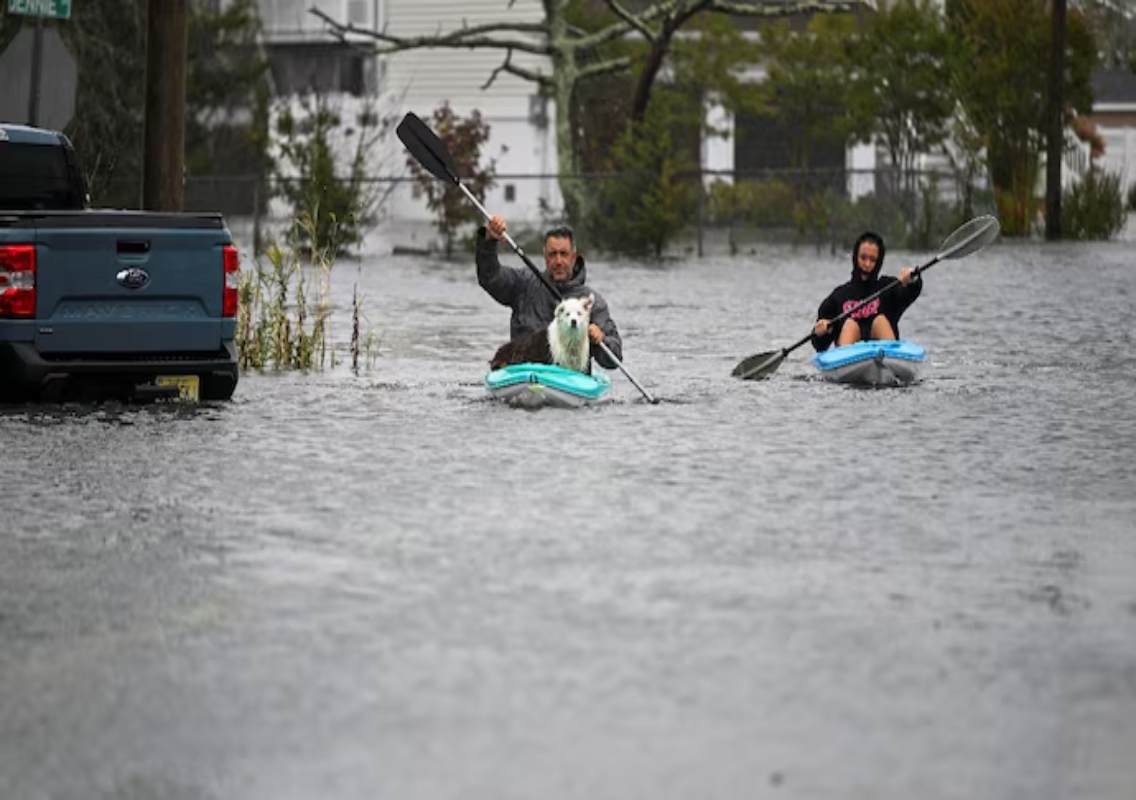


Washington: A powerful nor’easter swept across the US East Coast on Saturday, bringing heavy rain, strong winds, coastal flooding and dangerous travel conditions from Washington, DC, to Maine. The storm disrupted air travel, knocked out electricity for more than 100,000 homes and businesses at one point and prompted emergency declarations in parts of the region.
The storm affected several densely populated areas, including New York, New Jersey, Connecticut, Massachusetts and Pennsylvania. Authorities warned that coastal flooding, high waves and strong wind gusts could continue through the weekend and into Monday.
More than 400 flights cancelled
The nor’easter caused widespread disruption at US airports, with more than 400 flights cancelled and more than 1,300 delayed at one stage on Saturday, according to FlightAware data cited by Reuters.
Airports in the New York City region, Boston and other northeastern locations were affected as airlines adjusted schedules because of deteriorating weather conditions.
Major carriers, including American Airlines, JetBlue and United Airlines, had issued travel waivers for eligible passengers earlier in the storm period, allowing some travellers to change their bookings without paying the usual fees.
The disruptions came as thousands of people were travelling to and from the region following the United Nations General Assembly in New York.
Power outages spread across several states
Strong winds brought down trees, branches and power lines across parts of the Northeast.
More than 100,000 homes and businesses were without electricity at one point on Saturday. By early afternoon, more than 88,000 customers remained without power across New Jersey, Connecticut, New York and Pennsylvania, according to outage-monitoring data cited by Reuters.
Connecticut, New Jersey and New York each had more than 25,000 customers without electricity shortly after 1 pm local time.
PSEG Long Island reported that trees, branches and wires had been brought down by the storm and said it had already restored electricity to more than 34,600 customers affected since Friday morning.
Utility crews were working to restore supplies while the storm continued to affect parts of the region.
States declare emergencies
The governors of New York and New Jersey declared states of emergency in counties expected to experience the most severe impacts, including New York City. Connecticut also activated its Emergency Operations Center.
Officials urged residents in vulnerable coastal and low-lying areas to prepare for flooding and avoid unnecessary travel.
New York Governor Kathy Hochul warned that coastal communities should expect significant rainfall and strong winds as the system moved through the region.
The National Weather Service warned of coastal flooding, rip currents, strong wind gusts and heavy rain across the Mid-Atlantic and New England regions through Monday.
Coastal flooding becomes major concern
Flooding was reported in parts of the New Jersey coast as heavy rain combined with high tides and rough seas.
The National Weather Service warned that repeated high-tide cycles could produce significant coastal flooding in vulnerable locations. Roads in low-lying areas were at risk of becoming inundated, while high waves posed additional dangers along the coastline.
In parts of New Jersey, residents saw floodwater entering streets and approaching homes. Local authorities issued warnings for coastal communities as the storm intensified.
The combination of rainfall, high tides and strong onshore winds increased the potential for flooding beyond what would normally be expected from rainfall alone.
Strong winds affect New York and New England
The storm’s wind field extended across a large portion of the East Coast.
Forecasts indicated that wind gusts could reach around 55 mph in some areas, making driving difficult and increasing the risk of falling trees and power lines.
Along parts of the New Jersey and Delaware coasts, winds were expected to become particularly strong. Eastern Long Island and southeastern Connecticut were also facing the possibility of damaging gusts.
The timing of the storm added to concerns because leaves remain on many trees in the region during early autumn. Strong winds acting on trees with substantial foliage can increase the risk of branches coming down.
Events cancelled across the region
The severe weather also forced organisers to cancel several major public events.
The Global Citizen festival in New York and the All Things Go festival were among events affected. The Oceans Calling festival in Maryland was also cancelled because of safety concerns.
British singer Ed Sheeran’s weekend concerts near Boston were also cancelled as the storm threatened the area with heavy rain and strong winds.
Organisers cited safety concerns as the reason for cancelling or changing events rather than attempting to continue under worsening weather conditions.
What is a nor’easter?
A nor’easter is a powerful storm system that affects the northeastern United States, with winds generally coming from the northeast over the coastal region.
Such storms can occur throughout the year but are more common from autumn through early spring. They can bring heavy rain or snow, strong winds, coastal flooding and dangerous surf.
The latest system is particularly notable because it developed early in the autumn season while large parts of the region were still experiencing relatively mild conditions.
The National Weather Service has warned that the storm will continue to produce coastal impacts through the weekend, with conditions expected to gradually change as the system moves away.
Travel disruption expected to continue
Airlines and authorities continued advising passengers to check flight status before travelling.
The storm’s combination of high winds, heavy rain and potential flooding can affect airport operations as well as road and rail transportation. Flight schedules can also change quickly when weather conditions deteriorate.
The Federal Aviation Administration had warned before the storm that flights at the three major New York City-area airports could be disrupted by strong winds.
With the nor’easter affecting a large section of the East Coast, authorities have urged residents to avoid unnecessary journeys, particularly in areas vulnerable to flooding or falling trees.
Storm adds to recent Northeast travel disruptions
The latest weather disruption comes only days after a separate technical failure at a Federal Aviation Administration facility in Philadelphia caused major flight problems across the Northeast.
That earlier incident affected airports including Newark, JFK, LaGuardia and Philadelphia, with hundreds of flights cancelled and thousands delayed. Operations were restored after damaged communications infrastructure was repaired.
The nor’easter is unrelated to that technical incident, but its arrival has created another challenge for passengers and airlines operating across the same region.
As the storm continues to move through the Northeast, the immediate concerns remain coastal flooding, power restoration, flight disruptions and dangerous road conditions.