







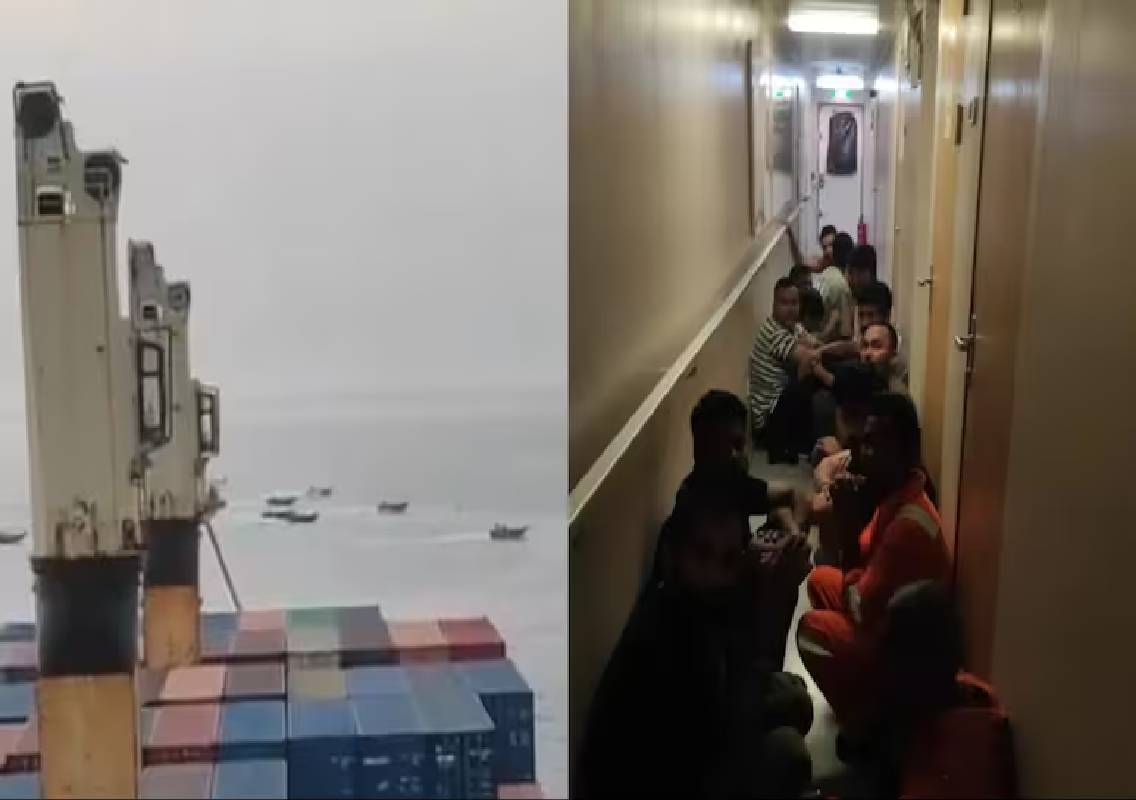


New Delhi: An old video showing the moment a Panama-flagged container ship carrying 21 Indian sailors came under fire from Iranian boats in the Strait of Hormuz has resurfaced, highlighting the risks faced by Indian seafarers operating in the conflict-hit region.
The footage, released by the Forward Seamen’s Union of India (FSUI), captures a tense confrontation from April 22, 2026, when several boats identified as belonging to Iran’s Islamic Revolutionary Guard Corps (IRGC) surrounded the vessel. Gunfire was reported during the incident, and the video appears to show a rocket-propelled grenade being fired as crew members took shelter inside the ship.
21 Indian sailors were on board
The vessel was carrying 22 crew members, including 21 Indians, when the confrontation took place in the Strait of Hormuz.
India’s shipping authorities later confirmed that all 21 Indian seafarers were safe and that none of them was injured in the incident.
The resurfacing of the footage has renewed attention on the dangers faced by Indian sailors as commercial shipping continues to operate in waters affected by the wider conflict involving Iran, the US and Israel.
Video captures tense confrontation
According to the seafarers’ union, the incident began when several small boats approached and surrounded the merchant vessel.
The footage shows the boats moving close to the ship as the confrontation escalates. Gunfire can be heard, while crew members are seen taking cover inside the vessel.
A rocket-propelled grenade is also visible being fired during the confrontation, underscoring the seriousness of the threat faced by the sailors.
The union stressed that the attackers were not pirates, but Iranian naval forces belonging to the IRGC.
Why the video has resurfaced now
The footage has been released publicly months after the April incident as concerns about the safety of Indian seafarers in and around the Strait of Hormuz continue to grow.
The waterway has become a major flashpoint amid the ongoing conflict in the region. The Strait of Hormuz is also one of the world’s most important maritime routes, carrying roughly one-fifth of global oil and LNG shipments under normal circumstances.
With repeated attacks and military confrontations involving commercial vessels, the risks for merchant crews have increased significantly.
Indian sailors increasingly caught in conflict
Indian seafarers form one of the largest groups of maritime workers globally, accounting for around 12.2 per cent of the world’s seafarer workforce, according to the report.
That large presence means Indian nationals are frequently among the crew members exposed when commercial shipping routes become affected by military conflicts.
The Hormuz crisis has already resulted in casualties among Indian sailors in separate incidents.
At least 15 seafarers, many of them Indians, were reported to have died in attacks on merchant vessels in and around the Strait of Hormuz since the US-Israeli war with Iran began on February 28, according to a UN report cited in the latest report.
India has taken steps to protect seafarers
The growing security concerns have prompted India to issue stronger precautions for its maritime workforce.
The Directorate General of Shipping directed shipowners, ship managers and recruitment companies not to deploy Indian seafarers on vessels undertaking trips through the Strait of Hormuz amid the renewed fighting.
The regulator also asked ship masters to maintain heightened vigilance and continuously monitor security and navigational warnings covering the Persian Gulf, the Strait of Hormuz and surrounding waters.
The measures reflect the government’s concern that civilian merchant crews could increasingly become collateral victims of the conflict.
The wider threat to commercial shipping
The Strait of Hormuz is strategically important because it connects the Persian Gulf with the Gulf of Oman and the Arabian Sea.
Any prolonged disruption can affect the movement of crude oil, petroleum products and LNG, with consequences for energy prices and international trade.
For shipping companies, however, the immediate concern is the safety of crews.
Merchant sailors generally have no role in the political or military disputes taking place around them, yet their vessels can become targets or find themselves caught between opposing forces.
Other Indian sailors have also been affected
The latest video comes after another serious incident involving an Indian-heavy crew earlier this year.
In June, three Indian sailors were confirmed dead after US forces attacked the Palau-flagged tanker Settebello off the coast of Oman. The vessel had 28 crew members, including 24 Indians. Twenty-one Indian sailors were initially rescued, while three others were later confirmed dead.
India subsequently condemned the attack and called for de-escalation, highlighting the broader danger to international shipping in the region.
The Settebello incident and the April confrontation involving the 21 Indian sailors demonstrate that the threat to Indian maritime workers is not limited to a single side of the conflict.
Strait of Hormuz remains a major security concern
The latest footage provides a visual reminder of how quickly a routine commercial voyage can turn dangerous in the region.
The April incident involved an Indian-heavy crew aboard a civilian container ship, yet the vessel became caught up in a confrontation involving armed Iranian forces.
For the sailors inside, the priority was simply survival.
The incident also illustrates why shipping authorities have become increasingly cautious about sending Indian crews through waters affected by military activity.
What happened to the sailors?
Despite the intensity of the confrontation, all 21 Indian sailors were reported safe and unharmed after the April incident.
The resurfaced video therefore does not depict a new attack on the sailors. It shows an earlier incident that took place on April 22 and has now been released publicly by the seafarers’ union.
The distinction is important as the footage circulates online and may otherwise be mistaken for a fresh attack.
A warning for Indian maritime workers
The incident has become another reminder of the vulnerability of merchant crews during geopolitical conflicts.
India has a large maritime workforce employed on ships operating across some of the world’s busiest trade routes. When those routes pass through conflict zones, sailors can face risks despite having no involvement in the underlying hostilities.
The government’s recent restrictions on deploying Indian seafarers through the Strait of Hormuz indicate the seriousness with which the risks are being viewed.
Conclusion
An old video from April 22 has brought renewed attention to the dangers faced by Indian sailors in the Strait of Hormuz. The footage shows a Panama-flagged container ship with 21 Indian crew members surrounded by Iranian boats, with gunfire and a rocket-propelled grenade visible during the confrontation.
All 21 Indian sailors were subsequently confirmed safe. However, the release of the footage comes amid a broader deterioration in maritime security around Hormuz, where several merchant vessels have been caught in attacks linked to the wider regional conflict.
With Indian seafarers making up a significant share of the global maritime workforce, the latest incident has reinforced calls for stronger protection of civilian crews and greater caution when operating through conflict-affected waters.