







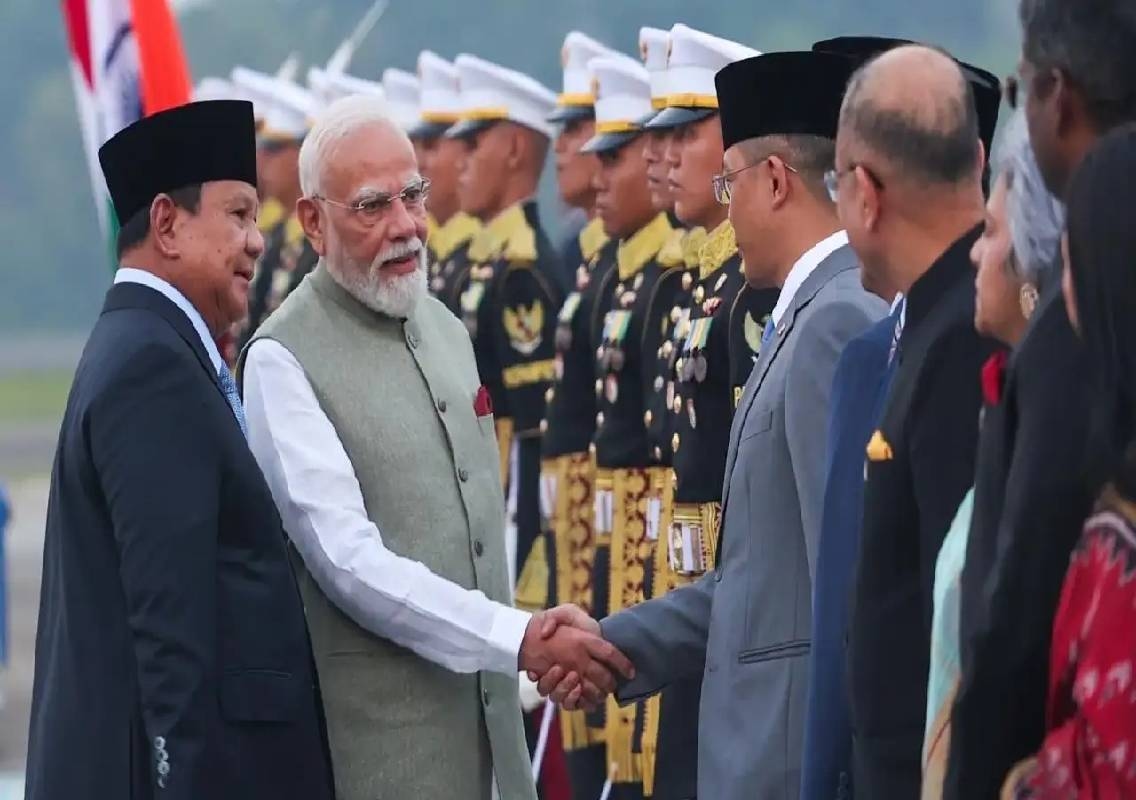


Jakarta: Prime Minister Narendra Modi received a rare ceremonial honour as Indonesian Air Force fighter jets escorted his aircraft into the country’s airspace before landing in Jakarta on Monday, marking the beginning of his three-nation diplomatic tour. The gesture underscored the growing strategic partnership between India and Indonesia as the two nations seek to deepen cooperation under India’s Act East Policy and strengthen collaboration in the Indo-Pacific region.
Upon his arrival at Jakarta’s airport, Prime Minister Modi was personally welcomed by Indonesian President Prabowo Subianto. The visit is PM Modi’s first bilateral trip to Indonesia since the two countries elevated their relationship to a Comprehensive Strategic Partnership. It also follows President Prabowo’s visit to India as the Chief Guest for the Republic Day celebrations in January 2025.
The Indonesian Air Force’s decision to escort the Prime Minister’s aircraft is regarded as a significant diplomatic honour, reflecting the importance Jakarta attaches to its relationship with New Delhi.
Fighter jet escort highlights growing strategic partnership
As Prime Minister Modi’s aircraft entered Indonesian airspace, fighter jets from the Indonesian Air Force accompanied it until landing, providing a ceremonial escort rarely extended to visiting foreign leaders.
The aerial reception symbolised the warmth in bilateral ties and highlighted the expanding defence and strategic cooperation between India and Indonesia. Both nations have increasingly worked together on maritime security, regional stability and economic partnerships amid evolving geopolitical developments in the Indo-Pacific.
The honour also demonstrated Indonesia’s recognition of India’s growing role as a key regional partner in ensuring a free, open and rules-based Indo-Pacific.
PM Modi receives warm welcome from President Prabowo
After landing in Jakarta, Prime Minister Modi was welcomed by Indonesian President Prabowo Subianto at the airport, signalling the importance both governments place on the bilateral relationship.
Sharing his thoughts on social media platform X, PM Modi expressed gratitude for the warm reception.
“Landed in Jakarta. I’m touched by President Prabowo Subianto’s gesture of welcoming me at the airport. In 2018 we elevated our relations to a Comprehensive Strategic Partnership, which has benefitted our people,” the Prime Minister said.
He added that discussions with President Prabowo would focus on further strengthening cooperation across multiple sectors and giving fresh momentum to the strategic partnership.
The visit comes at a time when India and Indonesia are expanding cooperation in trade, defence, maritime security, connectivity, renewable energy and digital technologies.
Focus on Act East Policy and MAHASAGAR Vision
Before departing from New Delhi, Prime Minister Modi said his visits to Indonesia, Australia and New Zealand would reinforce India’s Act East Policy and its MAHASAGAR Vision.
MAHASAGAR, which stands for Mutual and Holistic Advancement for Security Across the Regions, outlines India’s commitment to promoting regional security, sustainable development and shared prosperity across the Indo-Pacific.
The initiative seeks greater cooperation among regional partners in areas such as maritime security, disaster management, economic growth, connectivity and environmental sustainability.
India has consistently emphasised the importance of maintaining a free, open, inclusive and rules-based Indo-Pacific region, with Indonesia playing a central role in this vision due to its strategic geographical location.
Leaders to visit historic Prambanan Temple
During the visit, Prime Minister Modi and President Prabowo are scheduled to travel to the historic Prambanan Temple complex in Yogyakarta.
The UNESCO World Heritage Site is Indonesia’s largest Hindu temple and one of Southeast Asia’s most significant cultural landmarks. Built during the 9th century, the temple reflects the deep historical and cultural connections between India and Indonesia that span centuries.
PM Modi said the visit would strengthen cultural ties between the two nations while highlighting their shared civilisational heritage.
The Prime Minister also expressed his eagerness to interact with members of the Indian diaspora living in Indonesia, acknowledging their contribution to strengthening people-to-people relations between the two countries.
Three-nation tour includes Australia and New Zealand
Indonesia marks the first stop of Prime Minister Modi’s three-country diplomatic tour.
Following the bilateral engagements in Jakarta, the Prime Minister will travel to Melbourne at the invitation of Australian Prime Minister Anthony Albanese. The two leaders are expected to discuss defence cooperation, trade, technology, clean energy and regional security under the India-Australia Comprehensive Strategic Partnership.
The final leg of the visit will take PM Modi to Auckland, where he will hold talks with New Zealand Prime Minister Christopher Luxon. Discussions are expected to focus on strengthening bilateral trade, education, innovation, agriculture and people-to-people exchanges.
The three-nation tour reflects India’s continued diplomatic outreach across the Indo-Pacific region and reinforces its efforts to build stronger partnerships with key regional economies.
Visit expected to deepen regional cooperation
Prime Minister Modi’s visit comes amid increasing geopolitical significance of the Indo-Pacific, where India has been expanding its engagement with regional partners through economic cooperation, maritime collaboration and strategic dialogue.
Indonesia remains one of India’s most important partners within ASEAN and serves as a crucial maritime neighbour due to its location along vital international sea lanes.
The ceremonial fighter jet escort, high-level reception and planned bilateral engagements underscore the importance both nations place on further strengthening their Comprehensive Strategic Partnership.
As discussions begin between Prime Minister Modi and President Prabowo Subianto, both countries are expected to explore new opportunities for collaboration in defence, trade, connectivity, culture and regional security while reaffirming their shared commitment to a peaceful, stable and prosperous Indo-Pacific.