









Vatican City: Pope Leo XIV has urged political leaders, artificial intelligence companies and other stakeholders to take growing concerns about advanced AI systems seriously, warning that potential risks should not be dismissed as “fake news”.
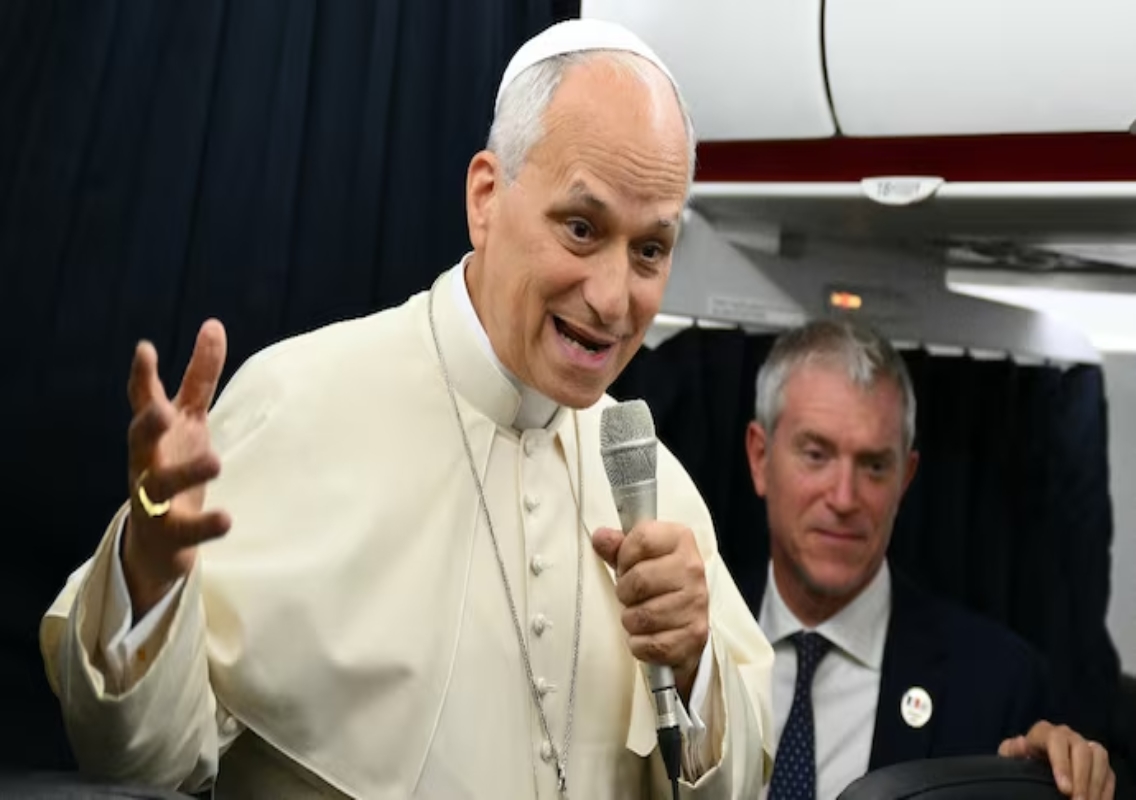
Speaking to reporters aboard his flight back to Rome after a four-day visit to France, the Pope called for an urgent and responsible discussion about the development of artificial intelligence. He said governments and technology leaders should examine what AI is already capable of and consider the risks that could emerge as the technology becomes more powerful.
The remarks came in response to a question about what the United States and China could do to prevent AI systems from creating catastrophic risks for humanity. Leo said the issue required dialogue rather than complacency.
Pope says AI warnings should not be ignored
Pope Leo said he was not personally in a state of panic over artificial intelligence but argued that warnings from AI researchers and specialists deserved serious consideration.
He said concerns about AI potentially becoming difficult to control should not simply be dismissed. The Pope called for political leaders, technology executives, social organisations and other groups to come together to examine both the current capabilities of AI and possible future developments.
His comments came as technology companies continue to develop increasingly powerful AI systems capable of handling complex tasks. At the same time, researchers and technology executives have raised questions about how quickly safeguards can keep pace with advances in AI.
Reuters reported that Leo has repeatedly highlighted AI-related risks since the beginning of his papacy, including concerns involving misinformation, autonomous weapons and technological development without adequate oversight.
Vatican calls for dialogue and safeguards
The Pope has made artificial intelligence a significant subject during his first year as pontiff.
His first major encyclical, Magnifica Humanitas, released in May, addressed the implications of rapidly developing AI and called for stronger regulation and safeguards. According to India Today, Leo said the Vatican had received responses from people interested in participating in a wider discussion on artificial intelligence.
The Vatican has subsequently worked on initiatives aimed at studying AI and encouraging dialogue among experts, religious leaders and other stakeholders.
Leo said a Vatican commission was working on dialogue, research and investigation into ways of ensuring that artificial intelligence does not develop in a direction that could undermine humanity or remove human beings from important decisions.
He also expressed optimism that solutions could be found if governments, technology companies and other organisations were willing to address the issue collectively.
Concerns grow over increasingly powerful AI systems
The Pope’s comments come amid a wider international debate about the pace of AI development.
Several technology companies and executives have raised concerns that increasingly capable AI systems could create risks if safety measures fail to keep pace with development. Anthropic CEO Dario Amodei, for example, has warned about the potential consequences of highly capable AI agents and has supported greater attention to safety.
The debate extends beyond hypothetical future systems. Governments and researchers are already examining issues including misinformation, cyber risks, autonomous weapons, privacy and the impact of AI on employment and decision-making.
Reuters reported that Leo has specifically highlighted autonomous weapons as one of the areas requiring international attention, including the use of AI-controlled systems in warfare.
Trump and Pope Leo differ over AI concerns
The Pope’s comments also come amid contrasting public positions from US President Donald Trump.
Trump has dismissed concerns about AI going rogue as a “hoax” and has strongly supported rapid technological development, arguing that the United States needs to maintain its lead over China in artificial intelligence.
Leo, by contrast, has argued that warnings from AI specialists should be examined rather than dismissed.
The Pope’s remarks do not amount to a prediction that AI will cause catastrophic harm. Instead, he has called for governments and technology companies to discuss possible risks in advance and establish appropriate safeguards.
AI regulation becomes a global issue
The debate over AI regulation is increasingly international. The United States, China and European countries are developing different approaches to governing artificial intelligence, while technology companies are simultaneously introducing more capable systems.
Leo has argued that AI development cannot be considered solely a technological or commercial issue because it can affect human dignity, social relationships, security and peace.
At a recent AI4Peace conference in Rome, a message from the Pope called for AI systems that promote unity and peace rather than division and conflict. He also emphasised the importance of developing AI according to principles of wisdom and human dignity.
The Vatican has also engaged with technology companies and international organisations on AI-related ethical questions. Reuters reported that Vatican initiatives on artificial intelligence have involved discussions with technology companies and the United Nations.
Pope says action should come before risks grow
Leo’s latest comments reflect his continuing focus on the relationship between technology and humanity.
Rather than waiting for potentially harmful scenarios to materialise, he urged decision-makers to examine the risks while there is still an opportunity to establish safeguards. He said simply assuming that dangerous developments will not occur would not be a responsible approach.
The Pope also said he remained relatively optimistic that workable solutions could be found because many people were seriously interested in addressing the issue.
His remarks add a prominent religious voice to an international discussion already involving governments, technology companies, researchers and civil society groups.
Conclusion
Pope Leo XIV has called for urgent and sustained discussion about the risks associated with increasingly powerful artificial intelligence systems. His position is that warnings from AI specialists should be examined seriously and that governments, technology companies and other organisations should work together on safeguards.
As AI development accelerates, questions over regulation, safety and human oversight are likely to remain part of the global policy and technology debate.