







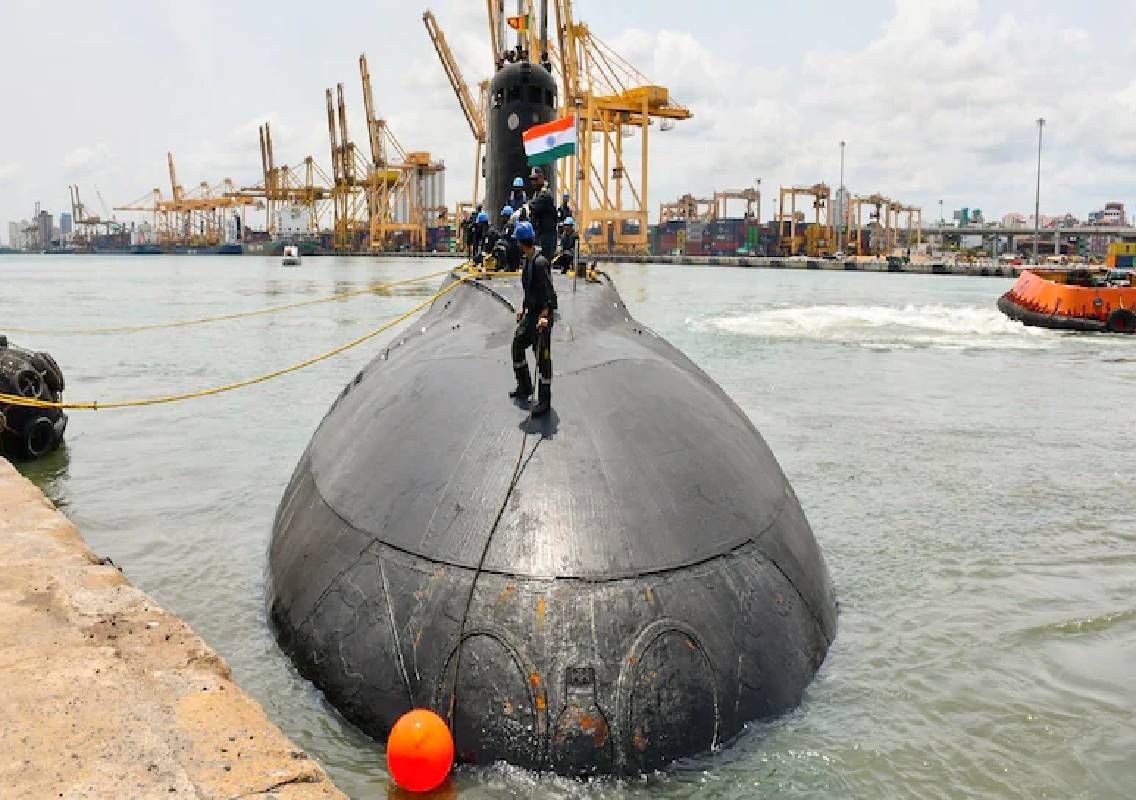


New Delhi: India is moving closer to finalising its long-delayed Project 75(I) submarine programme, with a proposal worth around Rs 70,000 crore expected to come before the Cabinet Committee on Security (CCS). The project involves building six advanced conventional submarines for the Indian Navy in partnership with Germany’s ThyssenKrupp Marine Systems (TKMS).
The proposed programme is expected to strengthen India’s underwater warfare capabilities while giving a major boost to domestic submarine manufacturing and technology transfer.
Six advanced submarines to be built in India
Project 75(I) envisages the construction of six next-generation conventional submarines.
The submarines are expected to be built in India by Mazagon Dock Shipbuilders Limited (MDL) in collaboration with Germany’s TKMS. The programme is designed around a strategic partnership model in which Indian industry will play a significant role in construction and manufacturing.
The project is estimated to cost around Rs 70,000 crore, making it one of India’s biggest conventional submarine acquisition programmes.
The proposal has been delayed for several years because of technical, commercial and procurement-related issues. Its movement towards the CCS now signals a potentially important step towards final approval.
What is Project 75(I)?
Project 75(I) is part of India’s long-term effort to modernise and expand its conventional submarine fleet.
The programme seeks to acquire submarines with improved stealth, endurance and combat capabilities, including air-independent propulsion (AIP) technology.
AIP allows a conventional submarine to remain submerged for considerably longer periods without having to surface or frequently use its diesel engines. This can improve survivability and reduce the chances of detection during underwater operations.
The submarines will complement India’s existing fleet of conventional submarines and are expected to strengthen the Navy’s ability to conduct anti-submarine warfare, surveillance and other maritime missions.
Germany’s TKMS to partner with Mazagon Dock
The German company ThyssenKrupp Marine Systems has emerged as India’s strategic partner for the programme, with Mumbai-based MDL expected to undertake construction in India.
The partnership is significant because Project 75(I) is not simply an overseas purchase of completed submarines.
Instead, the programme is intended to increase India’s ability to design, build, maintain and upgrade advanced submarines domestically. Earlier reporting on the programme has highlighted technology transfer as a key component of the arrangement.
This could help Indian shipyards and defence companies develop expertise that can be used in future submarine programmes.
Why the CCS approval matters
The Cabinet Committee on Security is the key government body that handles major national-security and defence decisions.
The Project 75(I) proposal is expected to be placed before the committee as India moves towards the next stage of the programme.
Approval would clear an important administrative hurdle, although the finalisation of contractual and implementation details would still be required.
The programme has already gone through a lengthy process involving technical evaluations and negotiations, making the expected CCS consideration particularly significant.
A boost for India’s underwater capabilities
India’s submarine fleet has faced long-standing concerns over its size and ageing platforms.
Modern conventional submarines equipped with AIP systems can remain underwater for extended periods, making them difficult to detect. Their stealth characteristics can be particularly valuable in the Indian Ocean, where India is seeking to strengthen its maritime surveillance and deterrence capabilities.
The Project 75(I) submarines are therefore expected to improve India’s ability to monitor important sea routes and respond to potential underwater threats.
Why AIP technology is important
Traditional diesel-electric submarines generally need to periodically surface or use a snorkel to recharge their batteries.
AIP systems reduce this dependence by allowing the submarine to generate power while remaining submerged.
For a navy operating across large maritime areas, longer submerged endurance can provide important tactical advantages.
The Project 75(I) programme’s focus on AIP is therefore one of its most significant technological features.
Major Make in India component
One of the biggest advantages of the project for India could be its domestic manufacturing component.
The submarines are expected to be constructed in India, with technology transfer from the German partner supporting the development of local capabilities.
The programme could create opportunities for Indian defence suppliers involved in areas such as engineering, electronics, weapons integration, maintenance and other submarine systems.
It could also help build a larger industrial ecosystem around submarine construction.
Long-delayed programme finally moves closer
Project 75(I) has been in development for many years and has faced repeated delays.
The government had previously cleared negotiations involving MDL and the German partner, with the project subsequently moving through technical and commercial discussions. Earlier reports indicated that the first submarine would be delivered several years after the contract is signed, followed by subsequent boats at regular intervals.
The latest movement towards CCS consideration could therefore represent a major breakthrough for a programme that has remained pending for an extended period.
Strategic significance amid regional competition
India’s push to strengthen its submarine fleet comes as naval activity increases across the Indian Ocean and Indo-Pacific.
China has significantly expanded its naval capabilities, including its submarine fleet, while Pakistan is also developing its underwater warfare capabilities.
Advanced Indian submarines could strengthen India’s ability to monitor maritime activity and protect strategic sea lanes.
The programme is consequently viewed not only as a procurement exercise but also as part of India’s broader maritime-security strategy.
India-Germany defence ties deepen
The submarine programme also has wider significance for India-Germany relations.
The two countries have been seeking to expand defence-industrial cooperation, with submarine construction emerging as one of the most important areas of collaboration.
German Defence Minister Boris Pistorius and Defence Minister Rajnath Singh have previously discussed strengthening bilateral defence cooperation, while India’s Project 75(I) has been a major element of the relationship.
The programme could consequently provide a foundation for longer-term cooperation in defence manufacturing and technology.
When could the submarines be delivered?
The delivery schedule will ultimately depend on when the final contract is signed and construction begins.
Earlier plans indicated that the first submarine could be delivered around seven years after the contract is signed, with subsequent submarines following at approximately one-year intervals.
This means the project is a long-term capability-building exercise rather than an immediate solution to India’s submarine shortage.
However, the construction programme could establish a sustained production capability in India.
What the deal means for Indian defence manufacturing
The potential Rs 70,000-crore programme could have implications beyond the six submarines themselves.
Technology transfer and domestic construction could help Indian companies gain experience in advanced underwater systems. It could also strengthen India’s ability to undertake future maintenance, modernisation and upgrades without depending entirely on foreign suppliers.
The project therefore fits into India’s broader objective of increasing defence self-reliance and reducing dependence on imported military platforms.
What happens next?
The immediate step is the expected consideration of the proposal by the CCS.
If approved, the government and industry partners would proceed towards final contractual arrangements and implementation.
The programme would then move into the production phase, with MDL and TKMS working together on construction and technology integration.
Given the complexity of submarine construction, the project will require sustained investment and coordination over several years.
Conclusion
India’s Rs 70,000-crore Project 75(I) submarine programme with Germany is moving closer to a major decision, with the proposal expected to come before the Cabinet Committee on Security. The project involves building six advanced conventional submarines in India through a partnership between Mazagon Dock Shipbuilders and Germany’s ThyssenKrupp Marine Systems.
The programme is strategically important because the submarines will feature advanced capabilities, including AIP technology, while the domestic construction model is expected to strengthen India’s defence manufacturing ecosystem.
If the CCS clears the proposal and the contract is subsequently finalised, Project 75(I) could become a major milestone in India’s efforts to modernise its submarine fleet and expand its indigenous defence-production capabilities.