







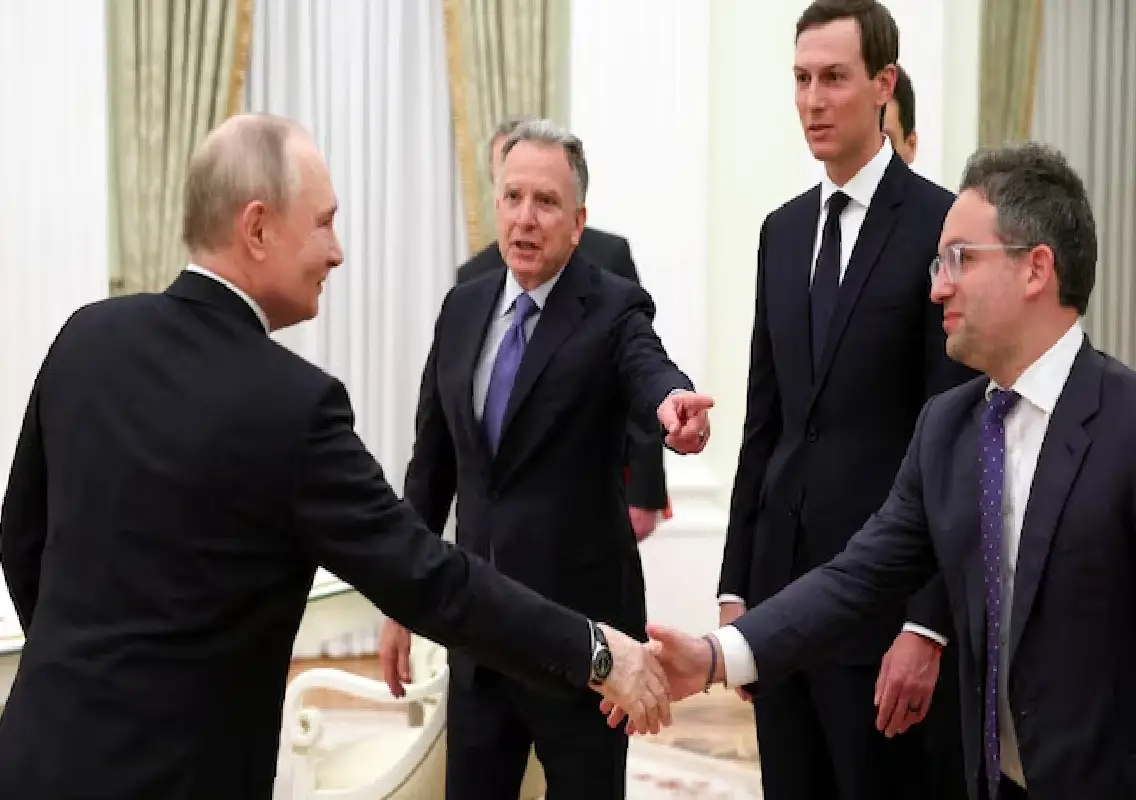


Russian President Vladimir Putin held late-night talks with three senior US envoys at the Kremlin on Thursday, as diplomatic efforts to end the nearly four-year-old war in Ukraine gathered momentum. The meeting, which began shortly before midnight and lasted for more than three and a half hours, came amid renewed signals from Washington that a potential deal could be within reach, even as deep disagreements over territory, security guarantees and Nato’s future role remain unresolved.
The Kremlin confirmed that the discussions concluded in the early hours of Friday. The talks followed comments by US President Donald Trump earlier in the day, in which he said that an agreement to end the conflict was “reasonably close”, raising expectations of a possible breakthrough after months of stalled diplomacy and continued fighting on the ground.
High-level US delegation in Moscow
The US delegation included Steve Witkoff, Trump’s special envoy on the Ukraine conflict, Jared Kushner, the US President’s son-in-law and a key figure in earlier diplomatic initiatives, and Josh Gruenbaum, recently appointed as a senior adviser to Trump’s Board of Peace. The Board of Peace is a new initiative announced by the Trump administration, aimed at resolving major international conflicts through direct negotiations.
A brief video released by the Kremlin showed Putin greeting the American envoys and inviting them to take their seats at a long oval table, a familiar setting for high-level talks with foreign leaders. As in previous engagements with Washington, Putin was accompanied by his long-time foreign policy aide Yuri Ushakov and special envoy Kirill Dmitriev.
Kirill Dmitriev, who also serves as the chief executive officer of the Russian Direct Investment Fund, later posted on social media platform X that a “significant Russia–US discussion” had taken place at the Kremlin, though he did not disclose details of the talks.
Military signalling during talks
According to news agency Reuters, minutes after the discussions began, Russia announced a patrol by its strategic bomber aircraft, a move widely interpreted as a signal of military strength. The Russian defence ministry said Tu-22M3 long-range bombers flew for more than five hours over the Baltic Sea, escorted by fighter jets.
The Tu-22M3 aircraft have been extensively used by Russia during the Ukraine war to strike cities, military installations and energy infrastructure. Analysts said the timing of the patrol, coinciding with the Kremlin talks, underlined Moscow’s intent to negotiate from a position of strength, even as diplomatic channels remained open.
Territory and Nato remain core disputes
President Trump has repeatedly pressed for a swift end to the war, which is the deadliest conflict in Europe since World War II. On Wednesday, he remarked that both Putin and Ukrainian President Volodymyr Zelenskyy would be “stupid” not to reach an agreement, signalling impatience with the prolonged hostilities.
Speaking earlier at the World Economic Forum in Davos, Witkoff said negotiations had narrowed down to “one last issue”, without specifying what it was. However, both Moscow and Kyiv have long acknowledged that territory remains the central obstacle to any settlement.
Russia has demanded that Ukraine formally relinquish control over eastern regions currently occupied by Russian forces. Ukraine, for its part, has firmly rejected any surrender of land, arguing that it has defended its territory at enormous human and economic cost. Moscow has also insisted that Ukraine abandon its long-standing ambition to join Nato and has ruled out any future deployment of Nato troops on Ukrainian soil as part of a peace agreement.
Zelenskyy: Security guarantees ready, land not negotiable
Witkoff and Kushner travelled to Moscow directly from Davos, Switzerland, where they had met Ukrainian officials earlier in the week. Trump also held a meeting with President Zelenskyy on Thursday on the sidelines of the World Economic Forum.
After that meeting, Zelenskyy said that security guarantees for Ukraine had been finalised with the United States, calling the discussions “productive and meaningful”. However, he confirmed that territorial issues remained unresolved.
“Security guarantees are ready,” Zelenskyy said, while reiterating that Ukraine would not compromise on its sovereignty. He added that the question of land remained the most difficult and sensitive aspect of the negotiations.
Trilateral talks planned in Abu Dhabi
In what Zelenskyy described as a positive development, negotiators from Russia, Ukraine and the United States are expected to hold trilateral talks for the first time in Abu Dhabi on Friday and Saturday. These discussions are seen as a critical test of whether the current diplomatic push can translate into concrete progress.
Zelenskyy said peace proposals were “nearly ready” but stressed that compromises would be required from all sides. “Russians have to be ready for compromises, because everybody has to be ready — not only Ukraine,” he said.
War continues amid harsh winter
Despite the flurry of diplomatic activity, fighting continues across the roughly 1,000-kilometre front line. Ukraine is facing one of the harshest winters of the war, with Russian missile and drone attacks repeatedly targeting energy infrastructure. Prolonged power cuts have left hundreds of thousands of people without electricity and heating in sub-zero temperatures.
Russia currently controls about 20 per cent of Ukrainian territory. While its forces have made incremental gains, these advances have come at significant cost. Ukraine, meanwhile, is grappling with shortages of funds and manpower, even as it expands domestic arms production and remains heavily reliant on Western military support.
Conclusion
The late-night Kremlin talks underscore the urgency and complexity of efforts to end the Ukraine war. While signals from Washington suggest that a deal may be closer than before, the fundamental disagreements over territory, security guarantees and Nato’s role continue to cast uncertainty over the outcome. As negotiators prepare for trilateral talks in Abu Dhabi, the coming days may prove decisive in determining whether diplomacy can finally bring an end to a conflict that has reshaped Europe’s security landscape.