







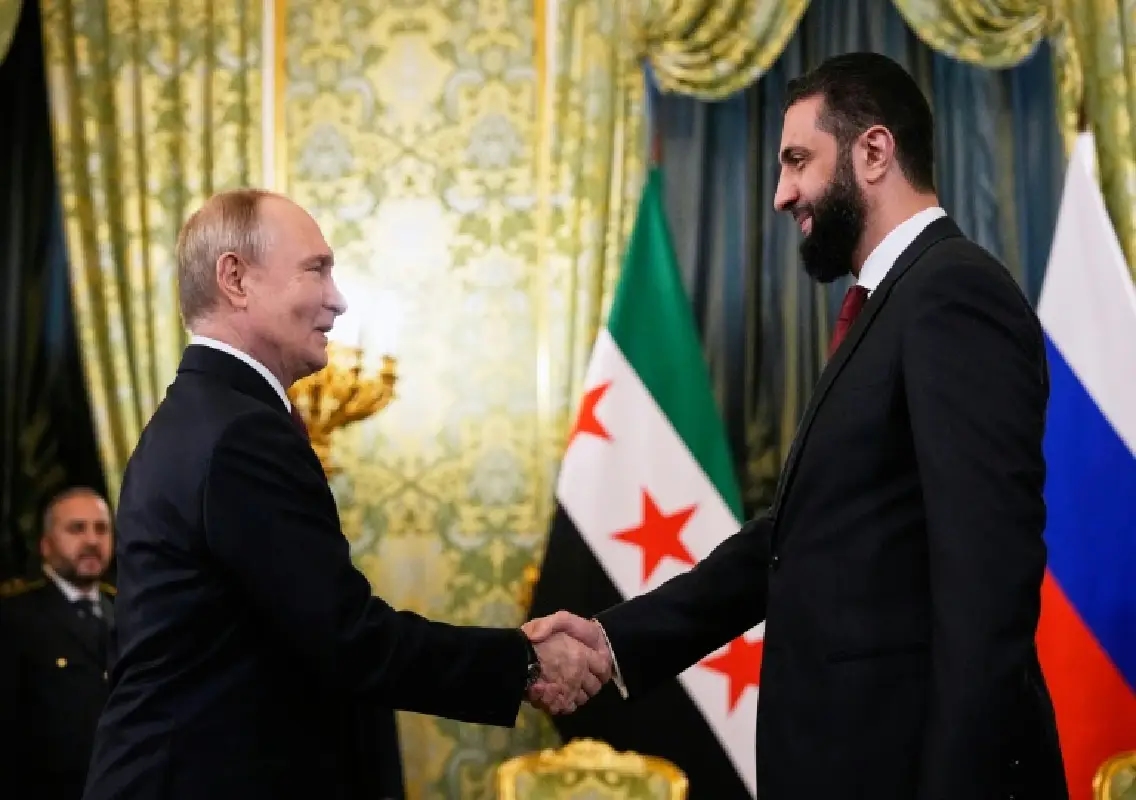


Russian President Vladimir Putin and Syrian leader Ahmed al-Sharaa struck a notably cautious and conciliatory tone during their latest round of talks, as Moscow reassesses its role in a dramatically changed Syria following the fall of long-time ally Bashar al-Assad in 2024. The meeting, closely watched by regional and global powers, comes amid mounting pressure on Russia over its continued sheltering of Assad and his wife, as well as shifting geopolitical equations involving the United States and Kurdish forces.
The discussions mark a significant moment in Russia–Syria relations, which have been fundamentally altered since Sharaa’s rebel forces toppled Assad, ending a 14-year civil war that devastated the country and reshaped West Asian politics. While Putin and Sharaa had previously met in October — their first encounter since the regime change — unresolved issues continue to cast a shadow over bilateral ties.
The unresolved Assad question
At the heart of the tension lies Russia’s decision to grant refuge to Bashar al-Assad and his wife following their ouster. Moscow’s continued protection of the former Syrian strongman remains a deeply sensitive issue for Damascus’s new leadership.
Sharaa has repeatedly demanded Assad’s extradition, framing it as a matter of justice and national reconciliation. For the new Syrian government, holding Assad accountable is seen as crucial to legitimising the post-war political order and addressing the grievances of millions affected by the conflict.
The Kremlin, however, has remained tight-lipped on the matter. Ahead of the latest talks, Kremlin spokesperson Dmitry Peskov declined to comment directly on Assad’s status but confirmed that broader security issues would be discussed.
“I have no doubt that all issues related to the presence of our soldiers in Syria will also be discussed during today’s talks,” Peskov told reporters, signalling that Russia’s military footprint was firmly on the agenda.
Russia scales back its military presence
Just days before the meeting, Russia withdrew its forces from the Qamishli airport in Kurdish-held northeast Syria. The move significantly reduces Moscow’s on-ground presence, leaving it with only two strategic outposts — the Hmeimim airbase and the Tartus naval base on Syria’s Mediterranean coast.
These bases are of immense importance to Russia, representing its only permanent military facilities outside the former Soviet Union. Analysts say the withdrawal from Qamishli reflects both practical constraints and a recalibration of priorities as Russia remains heavily engaged in the Ukraine war.
During the Assad era, Russia had a widespread military presence across Syria, providing decisive air support that helped government forces regain territory from rebel groups, including those now led by Sharaa. The drawdown underscores how Assad’s fall has dealt a major blow to Moscow’s influence in the region.
A shifting balance of power
Russia was Assad’s most powerful international backer throughout the civil war, launching thousands of air strikes against rebel-held areas and positioning itself as a key power broker in West Asia. Assad’s overthrow, however, exposed the limits of Russia’s military reach, particularly as its resources are stretched by the ongoing conflict in Ukraine.
For Sharaa, the new Syrian leadership’s foreign policy appears increasingly pragmatic. Even as talks with Moscow continue, Damascus has moved to strengthen ties with Washington, signalling a dramatic pivot away from Russia’s orbit.
US President Donald Trump has publicly praised Sharaa, describing him as “highly respected” and saying relations with the new Syrian leadership were “working out very well”. Such remarks underline the extent to which the United States sees an opportunity to reshape Syria’s alignment after years of hostility with the Assad regime.
US ties and Kurdish tensions
Despite warming relations with Washington, Sharaa’s government has not shied away from controversial moves. Damascus recently launched an offensive against Kurdish forces in northern Syria — groups that have long enjoyed US and Western backing for their role in the fight against the Islamic State.
This has created a complex dynamic, with the United States attempting to balance its support for Kurdish allies with its engagement with Syria’s new rulers. Russia, for its part, has historically maintained ties with Kurdish factions, further complicating the strategic picture.
Observers note that Sharaa’s outreach to both Moscow and Washington reflects a desire to maximise diplomatic flexibility while consolidating power at home.
What lies ahead for Russia–Syria relations
The latest Putin–Sharaa talks suggest a relationship in transition rather than rupture. While Moscow has lost its dominant position in Syria, it still retains leverage through its military bases and diplomatic channels. For Russia, maintaining access to the Mediterranean via Tartus and Hmeimim remains a strategic priority.
For Syria’s new leadership, engagement with Russia offers a way to manage a difficult legacy without fully alienating a former power broker. However, the unresolved issue of Assad’s extradition and Russia’s reduced influence mean that relations are unlikely to return to their earlier closeness.
Conclusion
As Syria navigates its post-Assad future, the meeting between Putin and Sharaa highlights a broader realignment in West Asia. Russia, once the decisive external force in Syria, is now negotiating its place amid diminished leverage and competing global pressures. Whether Moscow can retain a meaningful role in Damascus will depend on how it balances its strategic interests with the demands of Syria’s new leadership and the growing influence of the United States.