







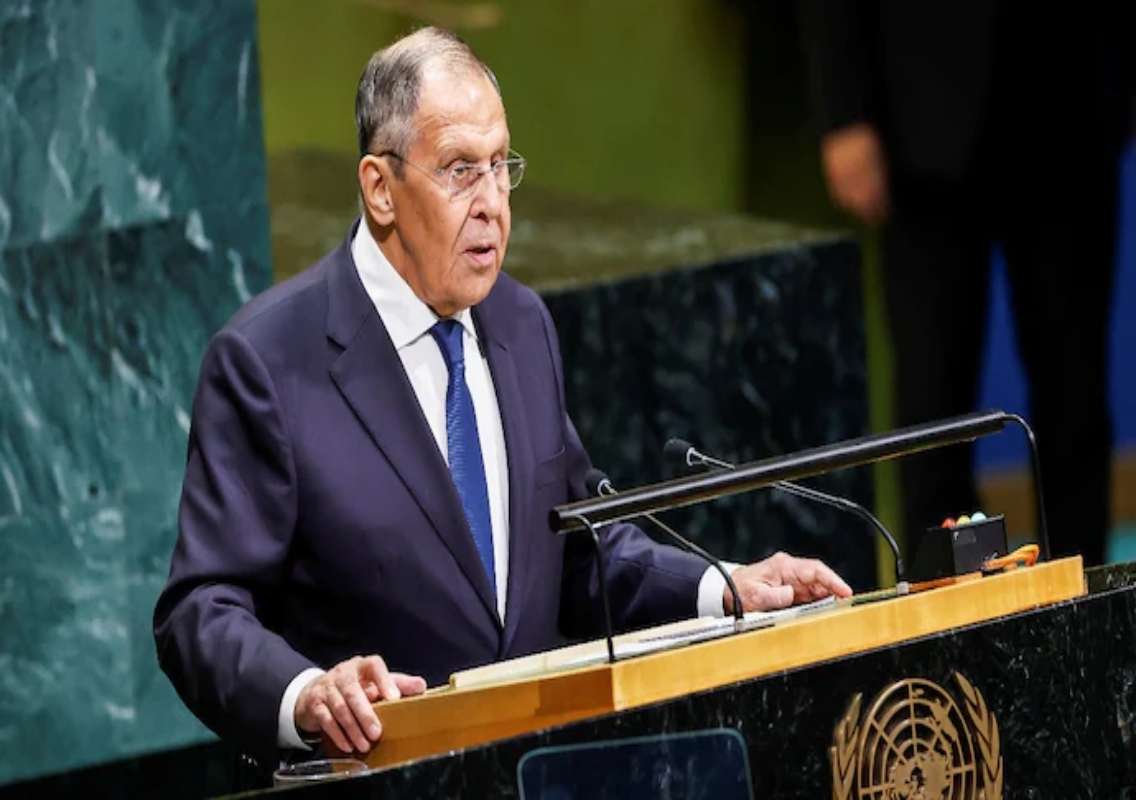


New Delhi: Russia has backed India’s candidature for a permanent seat on the United Nations Security Council (UNSC), while opposing the addition of more Western countries to the Council’s permanent membership.
Russian Foreign Minister Sergey Lavrov made the remarks while addressing the 81st United Nations General Assembly in New York on September 26. He said any reform of the Security Council should increase representation from Asia, Africa and Latin America, and specifically backed the candidatures of India and Brazil.
Lavrov’s position comes as India continues its long-standing campaign for permanent membership of the UNSC. New Delhi is part of the G4 grouping along with Brazil, Germany and Japan, with the four countries supporting each other’s bids for permanent seats.
Russia supports India and Brazil
Addressing the UN General Assembly, Lavrov said Russia supported greater representation for developing regions in the Security Council.
“We are in favour of broadening the representation of Asia, Africa and Latin America. We support Brazil and India’s candidature for a permanent seat,” Lavrov said, according to reports of his address.
Russia has previously supported India’s bid and has argued that the present composition of the Security Council does not adequately reflect current global realities.
Lavrov has also previously identified India and Brazil as candidates that Moscow considers suitable for permanent membership. In September 2026, he reiterated that Asia, Africa and Latin America remain under-represented in the Council.
The latest statement gives fresh backing to India’s campaign at a time when UN Security Council reform has again emerged as a major issue during the General Assembly session.
Moscow opposes additional Western seats
While supporting India and Brazil, Russia has taken a different position on Germany and Japan, which are also members of the G4.
Lavrov said Security Council reform should not involve additional permanent seats for Western countries, specifically naming Germany and Japan. He argued that the West is already adequately represented within the Council.
Russia’s position therefore differs from the broader G4 approach. India, Brazil, Germany and Japan have jointly called for expansion in both the permanent and non-permanent categories of Security Council membership.
The G4 has maintained that the Council’s structure should better reflect contemporary geopolitical realities and provide greater representation to regions that remain under-represented.
Why India wants a permanent UNSC seat
India’s campaign for permanent membership has continued for decades. New Delhi has cited its population, economic significance, contribution to UN peacekeeping and role in international affairs as factors supporting its case.
India has also served multiple terms as an elected, non-permanent member of the Security Council, including its most recent two-year term in 2021 and 2022. Its campaign is part of a wider effort to reform a Council whose permanent membership has remained unchanged since the UN was established in 1945.
The current permanent members are China, France, Russia, the United Kingdom and the United States. They also hold veto power over substantive Security Council resolutions.
The Council additionally has 10 non-permanent members, who are elected by the General Assembly for two-year terms.
G4 pushes for wider reform
India’s position is closely linked to the G4’s broader reform campaign.
The four countries renewed their demand for Security Council reform during the 81st UN General Assembly. They called for negotiations to move towards text-based discussions and supported expansion in both permanent and non-permanent categories.
The grouping has argued that the Council’s present structure does not sufficiently represent the geopolitical realities of the 21st century.
The G4 proposal has also included stronger representation for Africa, Asia-Pacific and Latin America and the Caribbean. India has consistently expressed support for greater African representation as part of a broader reform of the Council.
China remains an important factor
Support from individual countries does not by itself change the composition of the Security Council.
Any amendment to the UN Charter concerning the Council requires approval through the prescribed UN process, including a two-thirds majority in the General Assembly and ratification by two-thirds of UN member states. The five existing permanent members also have to ratify such amendments.
China’s position is therefore significant because Beijing is one of the five permanent members with veto power.
India’s permanent membership bid has received support from several major countries, including Russia, France, the United Kingdom and the United States, while the G4 continues to advocate a common reform framework.
However, international support for reform does not necessarily mean that countries agree on the number of new permanent members, the distribution of seats among regions or whether new permanent members should receive veto rights.
Russia’s position on the changing global order
Lavrov’s latest remarks also reflect Moscow’s broader position that the international system should give greater weight to developing countries.
Russia has repeatedly argued that Asia, Africa and Latin America are under-represented in the current Security Council structure. In September, Lavrov said the West was already over-represented and that Russia would support India and Brazil while also seeking stronger African representation.
The Russian foreign minister’s comments came against the backdrop of wider disagreements between Moscow and Western countries at the UN, including over the war in Ukraine and the future of the international security system.
His criticism of Germany and Japan’s possible permanent membership also highlights one of the major divisions within the debate over Security Council expansion.
India’s UNSC campaign continues
Russia’s latest endorsement provides another statement of support for India’s long-standing demand for permanent membership. At the same time, Moscow’s opposition to Germany and Japan illustrates that support for India’s candidature does not translate into agreement on the entire G4 proposal.
For India, the question remains part of a much wider debate over how the UN Security Council should be restructured and how permanent and non-permanent representation should be distributed.
The reform process continues to involve competing proposals from different regional groups and countries, with disagreements over representation, the number of new seats and the veto remaining central to negotiations.