







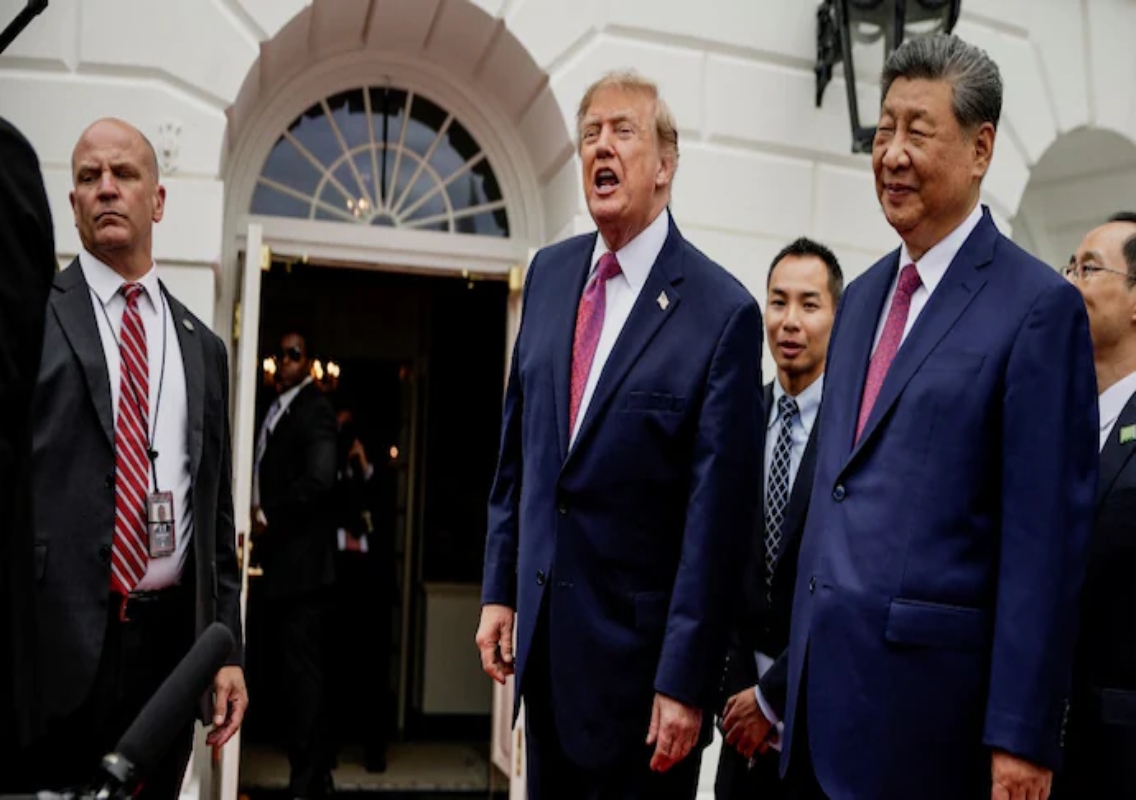


Washington: Major US television networks resumed their shared White House video coverage on Friday, restoring the presidential media pool as Chinese President Xi Jinping’s three-day US visit reached its final day. The development came amid an ongoing legal dispute over President Donald Trump’s decision to bar CNN, MS NOW and Politico from the White House.
The return of the television pool followed a federal court ruling that required the Trump administration to restore access to the three news organisations. The wider dispute, however, remains before the courts, with the administration and the affected media outlets presenting different arguments over White House press access.
The resumption also allowed television networks to provide live pool coverage of events connected with Xi’s visit, including his final engagements in Washington.
Television pool returns after brief suspension
The White House television pool is a shared arrangement involving major US broadcasters. The participating networks take turns sending camera crews to presidential events and distribute the resulting footage among the participating organisations.
The arrangement is particularly important because security and space restrictions mean that every broadcaster cannot send its own crew to every presidential event.
The pool had been suspended earlier in the week after CNN was prevented from carrying out its scheduled assignment. Fox News Media, ABC News, CBS News, CNN and NBC News had jointly decided not to provide the rotating pool coverage following the White House restrictions on CNN, MS NOW and Politico.
The broadcasters said at the time that the public had an interest in receiving independent information about the government and argued that access should not be restricted because an administration disagreed with a news organisation’s reporting.
Xi’s White House visit provides first major test
The pool resumed as Xi Jinping completed his state visit to the United States.
Xi visited Washington from September 23 to 25 at Trump’s invitation. The visit was the second reciprocal meeting between the two leaders within six months, according to China’s Foreign Ministry.
The final day of the visit provided the first major opportunity for the restored pool to cover a high-profile presidential event involving a foreign leader.
Trump and Xi had held talks at the White House covering US-China relations and international issues. Trump described the state of bilateral relations positively, while Xi said the relationship had reached another important stage and described their discussions as sincere and in-depth.
The television pool’s return therefore coincided with one of the most closely watched diplomatic engagements at the White House this year.
Court battle over media access continues
The restoration of access did not end the dispute between the Trump administration and CNN, MS NOW and Politico.
The three organisations filed a federal lawsuit challenging their exclusion from the White House grounds. They argued that the decision violated constitutional protections for freedom of speech and the press and was linked to disagreements over their reporting.
The Trump administration has defended its authority to determine access to the White House. In court filings, administration lawyers argued that access to the White House is a privilege rather than an automatic right and maintained that the administration could impose restrictions.
The legal dispute therefore involves questions about the government’s control over access to presidential facilities as well as constitutional protections for journalists.
Trump administration defends its decision
Trump announced the ban on CNN, MS NOW and Politico on September 19. He accused the organisations of publishing what he called “fake news” and said the restrictions were effective immediately.
The affected organisations disputed the justification and challenged the restrictions in court.
The administration’s position has been that it has authority to regulate access to the White House, while the media organisations contend that government access decisions cannot be used to punish outlets over their reporting.
A federal judge’s ruling requiring access to be restored has allowed reporters from the affected organisations to return, although the broader case remains unresolved.
Pool coverage had earlier come to a standstill
The dispute had an immediate practical effect on presidential coverage.
CNN was scheduled to provide the shared television feed when the White House enforced the restrictions. With CNN unable to fulfil its assignment, the other major broadcasters declined to replace the network and instead suspended the pool.
The absence of the shared feed meant television networks did not have their usual pooled video coverage of Trump’s public appearances. The White House subsequently relied on its own video operation for some events.
The administration also launched a 24-hour streaming service called “Trump TV: The Essentials Station”, providing footage of Trump’s speeches, announcements and other presidential activities directly from the White House.
White House coverage resumes, but access questions remain
Friday’s restoration of the television pool represents a temporary operational return rather than a final resolution of the legal dispute.
The affected organisations have continued to challenge the restrictions, while the administration has maintained its position regarding control over White House access.
The dispute also extends beyond the physical White House grounds. During Trump’s appearance at the United Nations General Assembly earlier in the week, CNN and other affected outlets continued covering the president using UN-issued media credentials. Trump confronted CNN reporter Kaitlan Collins at the UN and questioned why she was there.
The episode demonstrated that the dispute has continued to affect presidential-media interactions outside the White House itself.
CNN access remains a broader issue
The court case has attracted wider attention because CNN has traditionally been an important participant in the White House television pool.
The pool arrangement enables television networks across the United States to receive footage from presidential events without independently deploying crews to every location. Any prolonged disruption therefore has implications for how presidential events are covered by broadcasters.
The return of the pool restores that shared infrastructure, but the underlying disagreement over access and the conditions imposed on journalists remains subject to the court process.
The legal arguments are likely to determine how the administration can regulate access to presidential facilities and whether particular restrictions can be imposed in response to disputes over media coverage.
Conclusion
US television networks have resumed shared White House video coverage after a brief suspension triggered by the administration’s restrictions on CNN, MS NOW and Politico. The return came as Chinese President Xi Jinping completed his state visit to Washington, providing live pool coverage of high-profile presidential events.
However, the broader dispute is not over. The three news organisations continue their legal challenge to the White House restrictions, while the Trump administration maintains that it has authority over access to presidential facilities. The court proceedings will determine the longer-term status of the dispute.