







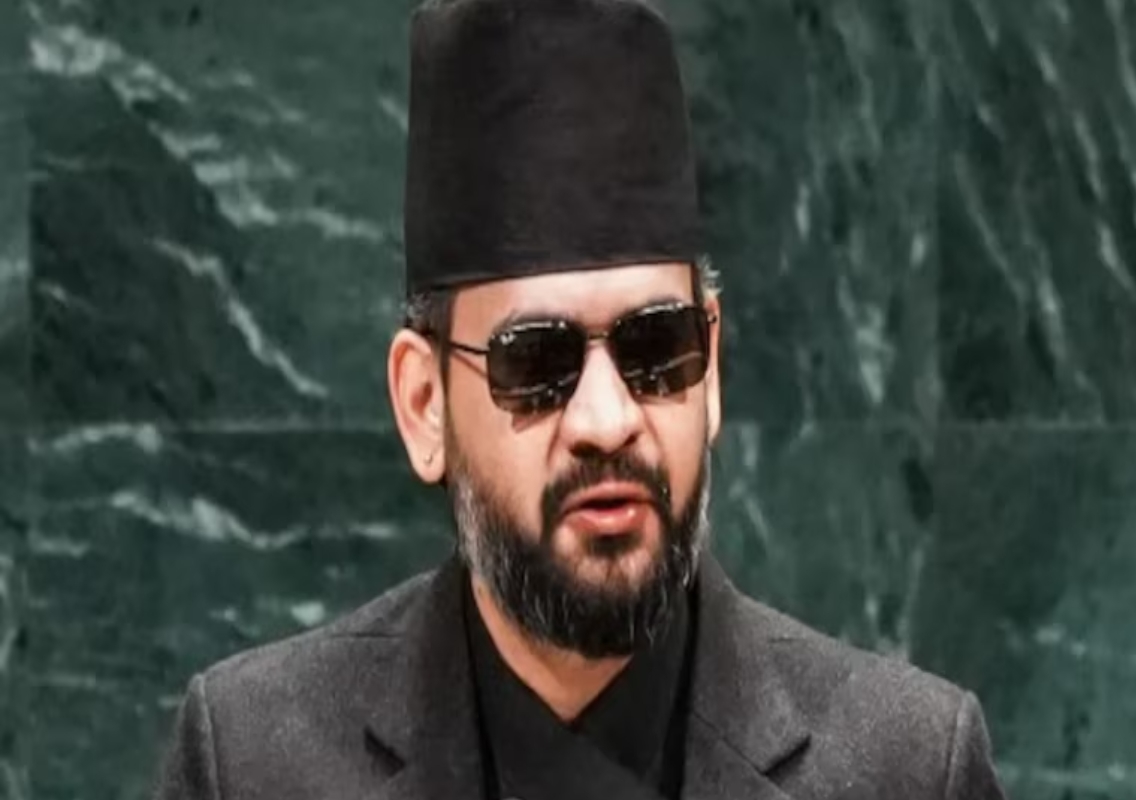


New York: Nepal Prime Minister Balendra “Balen” Shah used his first address to the United Nations General Assembly to criticise what he described as a “broken” global order, arguing that the international system moves weapons and military supplies more efficiently than food, fuel and fertiliser. In his speech, Shah referred to several South Asian countries, including India and Pakistan, saying they were facing the consequences of climate change and conflicts they did not cause.
Speaking at the 81st session of the UN General Assembly in New York on September 24, Shah linked Nepal’s recent natural disaster to wider concerns about climate change, supply chains, geopolitical conflicts and international cooperation. His remarks came weeks after devastating floods struck Nepal on August 26.
Shah argued that the problems faced by Nepal were not isolated and extended his criticism to other countries in South Asia. He specifically named Bangladesh, Bhutan, India, the Maldives, Pakistan and Sri Lanka while discussing the impact of global disruptions on the region.
Shah highlights gap between war and essential supplies
A central theme of Shah’s speech was the contrast between the speed at which military equipment can move across borders and the difficulties faced by ordinary people in obtaining essential goods.
He argued that missiles, rifles and ammunition can reach their destinations quickly, while farmers in developing countries can struggle to obtain fertiliser and fuel when they are needed. Shah used this contrast to question the priorities of the existing international system.
According to Shah, Nepal’s experience demonstrated how global supply disruptions can directly affect households and farmers. He referred to shortages of fertiliser, fuel and construction materials while describing the challenges faced by the country after the recent floods.
The Nepalese Prime Minister said the problem was not simply a domestic issue for Nepal but reflected wider challenges affecting countries across South Asia.
‘Ask India, ask Pakistan’
Shah brought India and Pakistan into his argument while discussing the wider consequences of climate change and geopolitical conflicts.
He said Nepal was not alone in experiencing these pressures and called on the international community to consider the experiences of countries across the region. Bangladesh, Bhutan, India, the Maldives, Pakistan and Sri Lanka were among the countries he named.
His reference to India and Pakistan came in the context of his broader argument about South Asian countries facing external pressures, rather than as a discussion focused specifically on bilateral relations between the two countries.
Shah’s remarks highlighted his view that countries in the region share vulnerabilities linked to climate change, global supply chains and conflicts elsewhere in the world.
Nepal’s devastating floods form backdrop
The Nepal Prime Minister’s UNGA address was delivered against the backdrop of the catastrophic Bhotekoshi-Trishuli floods that struck the country on August 26.
According to reports cited by NDTV and other outlets, Shah said more than 1,400 people had been confirmed dead and thousands remained missing following the disaster. He described the scale of the destruction as a major development and humanitarian challenge for Nepal.
The disaster was central to Shah’s appeal for greater international action on climate change. Nepal contributes a very small share of global greenhouse-gas emissions but faces significant risks from changing weather patterns, melting glaciers, unstable mountain slopes, floods and landslides.
Shah argued that vulnerable countries should receive faster and more accessible international assistance rather than having to navigate lengthy bureaucratic procedures after disasters.
Calls for Himalayan climate mechanism
Shah also proposed greater cooperation among Himalayan countries to deal with climate-related risks.
He called for a Himalayan Climate Resilience Mechanism involving Nepal, India and China. The proposed framework would focus on areas such as sharing satellite data and technical expertise, monitoring dangerous glacial lakes, improving early-warning systems and coordinating disaster response across borders.
The proposal would bring together three countries that share the wider Himalayan ecosystem and face risks from floods, landslides, glacier-related hazards and changing weather patterns.
India and China were therefore mentioned in Shah’s speech not only in the context of the wider global system but also as potential partners in a regional climate-resilience initiative.
Climate change and geopolitical tensions
Shah connected climate-related disasters with broader geopolitical instability.
He argued that developing countries can be affected simultaneously by environmental changes and conflicts occurring elsewhere. His reference to South Asian countries was intended to illustrate how disruptions to energy, food and fertiliser supplies can cross national borders.
The speech also came amid ongoing international conflicts and heightened geopolitical tensions. Other leaders and officials attending the UN General Assembly have similarly called attention to pressure on global cooperation and supply chains.
India’s External Affairs Minister S. Jaishankar, speaking during the UNGA period, has also highlighted what he called the “4F” crisis involving food, fuel, fertiliser and finance, while calling for stronger multilateral cooperation.
The parallel focus on essential commodities and international cooperation reflects a wider concern among countries about the vulnerability of global supply chains.
Shah calls for greater international cooperation
Shah’s broader message was that international institutions need to respond more effectively to countries facing climate disasters and economic disruptions.
He argued that the ability of the international system to move military equipment quickly should be matched by its capacity to deliver essential goods and humanitarian assistance.
The Nepal Prime Minister also called for greater climate financing for vulnerable nations, particularly in the form of grants. He questioned systems that require countries affected by disasters to complete lengthy procedures before receiving assistance.
His address placed Nepal’s recent experience within a larger argument about climate justice and reform of global institutions.
First UNGA address as Nepal Prime Minister
The speech was Shah’s first address to the UN General Assembly since becoming Nepal’s Prime Minister. He used the international platform to highlight Nepal’s vulnerability to climate change and to call for stronger regional cooperation.
Rather than limiting his address to Nepal’s domestic concerns, Shah expanded the discussion to South Asia and the international system. His references to India, Pakistan, Bangladesh, Bhutan, the Maldives and Sri Lanka framed the challenges as regional rather than solely Nepalese.
His proposal for a Himalayan climate mechanism involving Nepal, India and China also placed regional cooperation at the centre of his international agenda.
Conclusion
Nepal Prime Minister Balendra Shah’s first UN General Assembly address focused on climate vulnerability, supply-chain disruptions and what he described as shortcomings in the existing global order. By naming India, Pakistan and other South Asian countries, Shah argued that the region shares many of the pressures created by climate change and geopolitical conflicts. He also proposed a Himalayan climate-resilience mechanism involving Nepal, India and China to strengthen disaster preparedness and regional cooperation.