





Saudi: Unverified social media posts have sparked speculation about the Saudi Arabian execution of two Bangladeshi nationals, Nazrul Islam Abdul Bashir and Sweety Akhtar, accusing an Indian man of involvement in the case. However, the allegations circulating online have not been independently corroborated, and publicly available information does not establish the Indian man’s alleged role.
The two Bangladeshis were executed in Saudi Arabia after being convicted in a case reportedly involving alleged immoral acts in Mecca. Their executions have raised questions about the lack of detailed public information from Saudi authorities and the apparent absence of advance notification to their families and the Bangladeshi government.
As Dhaka seeks further details from Riyadh and the remains of the two individuals have yet to be returned, social media accounts in Pakistan, Bangladesh and other countries have circulated increasingly elaborate versions of the alleged incident.
The online claims describe a supposed romantic relationship, a secretly recorded encounter and the alleged involvement of an Indian man. Yet key elements of this narrative remain unverified, making it important to distinguish the allegations from the limited facts disclosed by officials.
What is known about the executions?
Saudi authorities have said that Nazrul and Sweety were convicted by a court before their executions. However, detailed information about the specific offence, the evidence presented during the proceedings and the circumstances of the alleged incident has not been made publicly available in the accounts cited by reports on the case.
The lack of disclosure has contributed to uncertainty about what happened and why the two received death sentences.
According to a confidential memo from the Bangladesh Consulate General in Jeddah, obtained by Bangladeshi newspaper The Daily Star, both individuals worked as cleaners for Saudi company Al Majal.
A prisoner list received by the consulate on September 30 reportedly showed that Nazrul had been detained on August 1, 2023, under Saudi Arabia’s cybercrime law. Sweety was detained the following day over allegations of adultery.
The information indicates that the two had been in custody for an extended period before their executions. However, the precise relationship between the cases and the legal basis for the death sentences remain unclear from the publicly reported details.
Their families have disputed the accusations and offered separate explanations for the arrests. Neither family’s account has been independently verified.
Families dispute allegations against Nazrul and Sweety
Nazrul’s relatives told Bangladeshi newspaper Prothom Alo that they believed he had been targeted as part of a conspiracy allegedly involving a Pakistani co-worker.
Sweety’s family, meanwhile, claimed that she was arrested after some of her female colleagues allegedly purchased a car illegally.
These accounts differ from the more sensational stories subsequently circulated online. Neither explanation has been independently established, and the available information does not provide enough detail to determine the circumstances that led to the arrests and convictions.
Earlier social media claims suggested that Nazrul and Sweety were married and that the incident involved little more than kissing on the forehead during Umrah, the Islamic pilgrimage to Mecca that can be undertaken outside the Hajj period.
Both families reportedly rejected the suggestion that the two were married, saying they did not know each other.
The absence of a detailed official account has allowed competing narratives to spread. Without access to the court’s findings, the evidence presented during the trial and the precise charges, it remains difficult to assess the claims circulating about the case.
What are the viral posts alleging about an Indian man?
A series of posts that began circulating widely on October 20 has accused an Indian man of playing a role in the events that allegedly led to the executions.
The posts claim that Nazrul and Sweety worked as cleaners at Mecca’s Masjid al-Haram, also known as the Grand Mosque, and developed a romantic relationship. According to this version, the pair allegedly met in a secluded room between gates 85 and 87 of the mosque.
The narrative further alleges that Nazrul asked an Indian friend to stand guard while he and Sweety were together. The Indian man supposedly recorded the encounter and later circulated the video after failing to pursue a relationship with Sweety himself.
The posts claim that Saudi authorities arrested all three individuals. They further allege that the Indian man received a 20-year prison sentence, while Nazrul and Sweety were sentenced to death for allegedly violating the sanctity of the Grand Mosque.
Some versions of the posts also reject the earlier suggestion that the alleged incident involved only a kiss during Umrah, describing that account as fabricated. They claim that Saudi Arabia’s Supreme Court considered capital punishment an appropriate exemplary sentence.
These allegations remain unverified. No publicly available official record cited in the reports substantiates the claim that an Indian man was involved, recorded an encounter or received a 20-year prison sentence. The detailed account of the alleged incident has also not been independently corroborated.
The existence of repeated or identical posts does not establish their accuracy. Until reliable evidence or an official account becomes available, the claims should not be treated as a confirmed explanation for the executions.
How the claims spread across social media
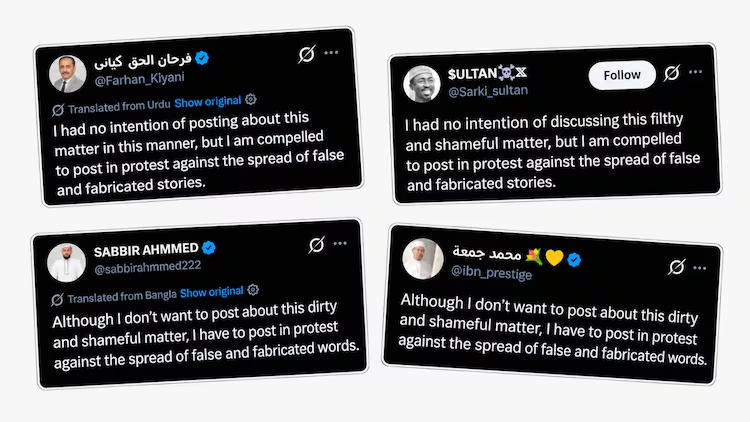
The narrative initially circulated among Pakistani and Bangladeshi accounts on platforms including Facebook and X. One of the accounts identified as sharing the claims belonged to Farhan Kiyani, described in the source report as the president of the Pakistan Muslim League-Nawaz’s youth wing in Riyadh.
The same narrative subsequently appeared on accounts based in other countries, including Nigeria and Afghanistan. The posts reproduced similar details and accusations, helping the claims spread across national and linguistic boundaries.
The repetition has contributed to the appearance of a detailed account of the case despite the lack of independently confirmed evidence supporting its central allegations.
Social media can amplify claims quickly when official information is limited, particularly in cases involving criminal allegations, religious sensitivities and the death penalty. In this instance, the lack of publicly available judicial details has made it more difficult for readers to separate confirmed information from speculation.
The accusation against the unnamed Indian man is particularly serious. Without reliable evidence, attributing responsibility for the deaths to him risks presenting an unproven allegation as fact.
The viral narrative also does not resolve the central questions surrounding the convictions: what evidence the Saudi court considered, how the cases were handled and why the executions took place without advance notification to the families and the Bangladeshi government, as reported.
Questions remain over Saudi Arabia’s lack of disclosure
The executions have prompted scrutiny of the information shared by Saudi authorities and the diplomatic response from Bangladesh.
According to reports, neither the families nor the Bangladeshi government received advance notification of the executions. They reportedly learned about the deaths through media coverage and social media posts.
Dhaka has since sought details from Riyadh, while the remains of the two individuals have yet to be returned, according to the source report.
The reported detention dates suggest that Nazrul and Sweety had been in custody since August 2023. That raises questions about what consular information was available during their imprisonment, what assistance was provided and whether further diplomatic intervention was possible before the sentences were carried out.
The available information does not establish the full extent of the Bangladeshi government’s knowledge of the proceedings or the steps taken throughout the legal process. It would therefore be premature to conclude, without further evidence, precisely why officials were unable to prevent the executions.
Nevertheless, the reported absence of advance notification and the continuing requests for information underline the need for greater clarity from the authorities involved.
A detailed account of the charges, judicial proceedings and grounds for the sentences would help clarify the case more effectively than anonymous accusations circulating online.
Saudi Arabia’s use of the death penalty draws scrutiny
The case has also renewed attention to Saudi Arabia’s use of capital punishment. The source report states that the kingdom executed more than 300 people in 2025, many in cases involving drug-related offences.
The death penalty remains a contentious issue internationally, particularly where information about legal proceedings, access to consular assistance and opportunities for appeals is limited.
In the case of Nazrul and Sweety, the reported lack of detailed public information has made it difficult for families and observers to understand the basis of the convictions and sentences.
The allegations described in the viral posts, even if some elements were eventually substantiated, would not by themselves establish the full circumstances of the court proceedings. Claims about the Indian man’s alleged involvement and sentence also require independent evidence.
The seriousness of the punishment makes transparency particularly important. Information about the charges, the evidence and the legal process is necessary for meaningful scrutiny of the case.
Verified information is needed, not online speculation
The executions of Nazrul Islam Abdul Bashir and Sweety Akhtar have left their families seeking answers and Bangladesh requesting further information from Saudi Arabia. The absence of a detailed public account has created an environment in which unverified allegations can spread rapidly.
The claims accusing an Indian man of recording an encounter and receiving a prison sentence remain unsupported by publicly available evidence cited in the reports. They should not be treated as established facts or used to assign responsibility for the executions.
The most pressing questions concern the legal proceedings, the basis for the death sentences, the reported lack of advance notification and the efforts made to secure information and consular assistance.
Until reliable details emerge, the case requires careful reporting and scrutiny rather than increasingly sensational online narratives. Official clarification from Riyadh and a fuller account of Bangladesh’s diplomatic engagement would help establish what happened and address the questions that remain unanswered.