







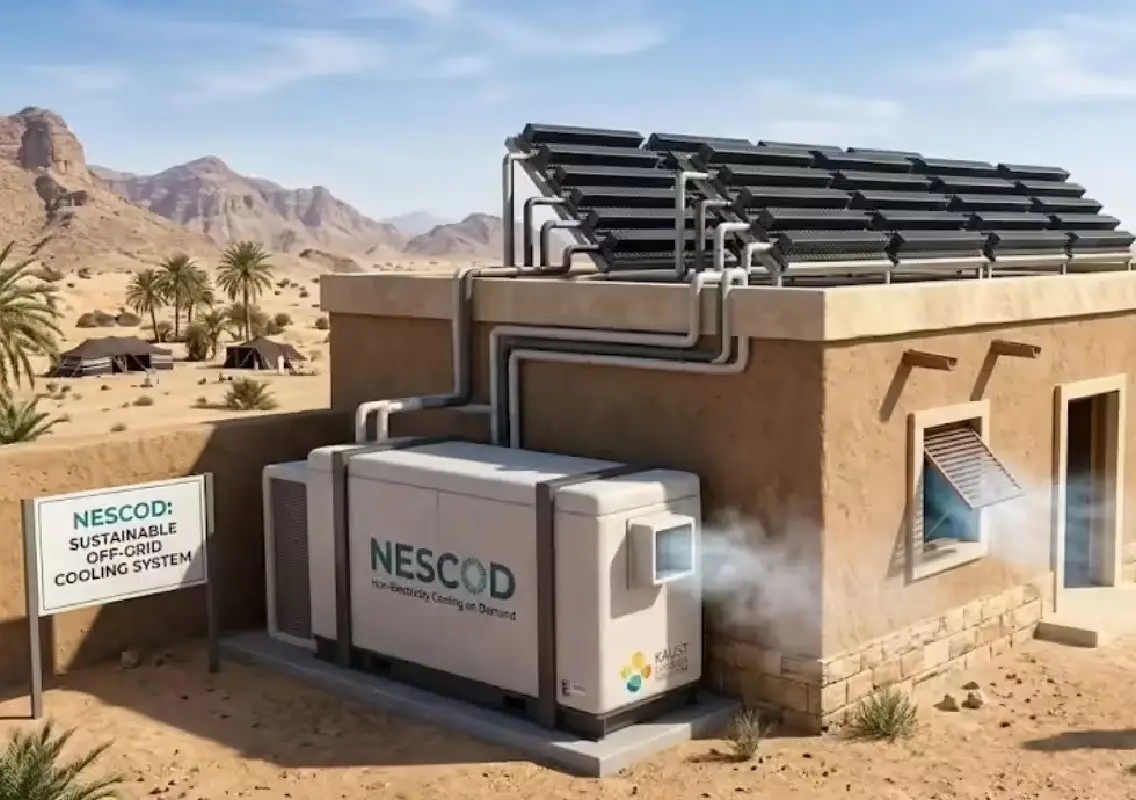


Researchers at King Abdullah University of Science and Technology have developed an innovative cooling technology that operates without electricity, potentially offering a sustainable alternative to traditional air conditioning systems.
The system, called NESCOD, has been designed to tackle rising global temperatures and growing energy demands by using a passive cooling process powered by sunlight.
Cooling powered by chemistry and sunlight
NESCOD works using a two-stage thermodynamic cycle involving dissolution cooling and solar-driven regeneration.
In the first stage, ammonium nitrate salt is dissolved in water. This chemical reaction absorbs heat from the surroundings, causing temperatures to drop rapidly. Laboratory tests reportedly showed cooling power reaching up to 191 watts per square metre.
Researchers said the technology could maintain temperatures between 5°C and 15°C, making it useful for food storage, medicines, and cooling indoor spaces.
System recharges using solar energy
One of the most remarkable features of NESCOD is its ability to recharge itself using sunlight.
Scientists developed a special 3D solar regenerator that evaporates water from the salt solution under sunlight. As the water turns into vapour, the salt crystallises again, allowing the system to be reused repeatedly.
This means cooling energy can be stored and used later, including during nighttime or in different seasons.
Could help remote and heat-affected regions
Researchers believe the system could be especially beneficial in remote areas and developing nations where electricity infrastructure is limited or expensive.
The technology also supports water conservation by capturing and reusing water vapour with extremely low impurity levels, an advantage in arid regions.
Because ammonium nitrate is already widely produced for fertilisers, experts say the materials are relatively affordable and suitable for large-scale use.
As climate change drives temperatures higher worldwide, innovations such as NESCOD may offer a cleaner and more sustainable path for future cooling needs.#Technology #ClimateChange #SaudiArabia #CoolingSystem #Innovation #newskarnataka