







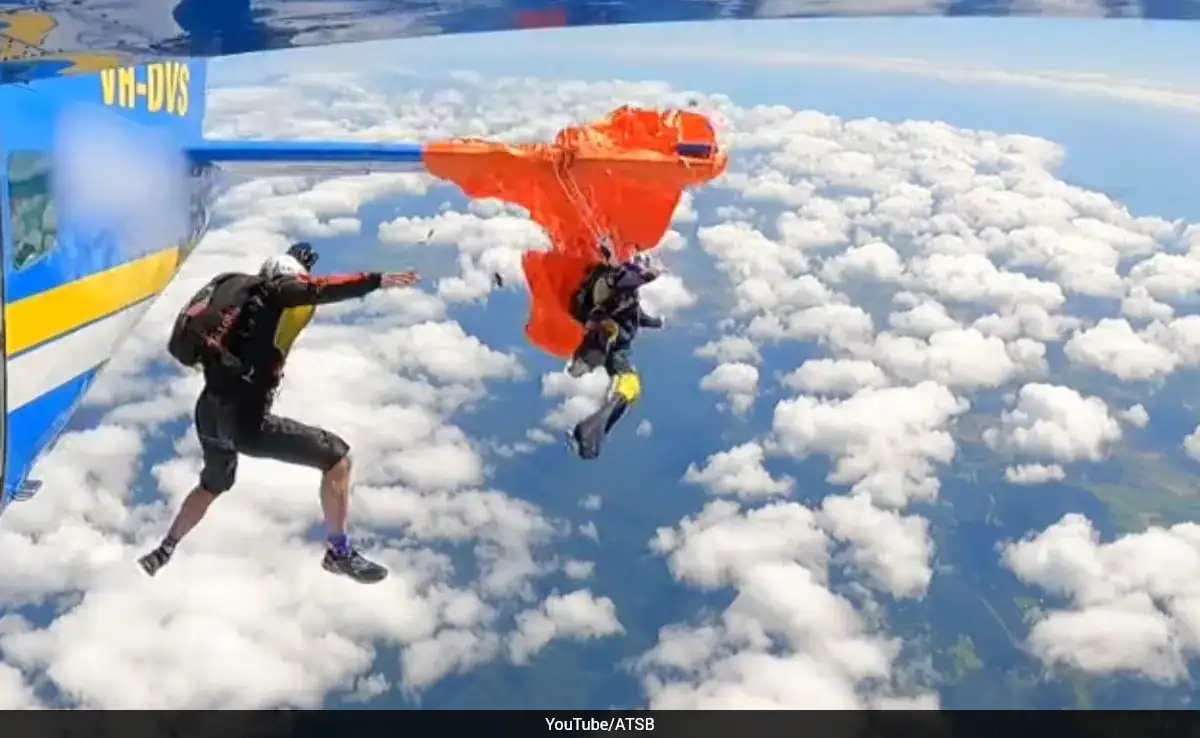


Australia’s transport safety agency has released dramatic footage of a September skydiving accident in which a diver’s reserve parachute deployed prematurely and became tangled around the tail of an aircraft. The Australian Transport Safety Bureau (ATSB) released both the video and a detailed report, revealing how the diver — identified as “P1” — freed themselves mid-air using a hook knife.
The incident occurred at around 15,000 feet over Queensland during a jump involving 17 parachutists. As “P1” prepared to exit the aircraft, their reserve parachute handle snagged on the wing flap, triggering the chute to inflate instantly. The sudden deployment knocked another skydiver into freefall and dragged “P1” backwards, where the parachute became entangled in the plane’s tail.
Suspended beneath the aircraft tail
The ATSB report states that the reserve parachute wrapped tightly around the tailplane, leaving the diver hanging beneath it as the aircraft pitched upward and rapidly lost airspeed.
“The pilot recalled feeling the aircraft suddenly pitch up,” said ATSB Chief Commissioner Angus Mitchell. At first believing the aircraft had stalled, the pilot reduced power before being alerted that a skydiver was trapped on the tail.
Fearing an imminent crash, the crew instructed the remaining parachutists to exit for their own safety. Thirteen jumped immediately, while two stayed behind to watch and support the trapped skydiver.
Cutting free with a hook knife
Realising the situation was deteriorating, “P1” began cutting the tangled reserve parachute lines using a hook knife — a tool not mandated by regulations but commonly carried by seasoned divers.
The report says the diver cut 11 cords in under a minute, later telling investigators the process was “harder” than expected due to tension and wind pressure.
Mitchell emphasised the importance of the tool:
“Carrying a hook knife — although it is not a regulatory requirement — could be lifesaving.”
After the remaining skydivers exited, the pilot assessed the damage. Parachute remnants were wrapped over the tail, and impact from the diver’s legs had caused “substantial damage” to the horizontal stabiliser.
According to the ATSB, the pilot radioed air traffic control and was prepared to bail out if the “tail fell off.” Fortunately, that was not required.
Safe landing despite heavy aircraft damage
Despite the structural damage, the pilot regained control and was able to land safely at Tully Airport. The Far North Freefall Club, which organised the dive, directed questions to the Australian Parachute Federation.
World champion skydiver Dan Brodsky-Chenfeld told CNN that while similar incidents have been reported historically, he had never seen a parachute become entangled with a plane before a jump.
He also explained that reserve parachutes cannot be “cut away” using release systems:
“Your only option is to use your hook knife and cut the lines off.”
Investigator-in-charge Sarah Fien said in an ATSB video that hook knives have repeatedly proven to be lifesaving devices. The Far North Freefall Club has since made them mandatory for all divers and will include footage of the accident in future training seminars.
Incidents involving sudden parachute deployments are rare but documented in aviation and skydiving safety literature. More information can be found on Wikipedia’s entry on parachuting safety.
A dramatic reminder of safety preparedness
The video, now circulating widely, underscores the importance of training, equipment awareness and quick decision-making in extreme sports. For the skydiver and pilot involved, it was decisive action — and a small hook knife — that prevented a disaster