







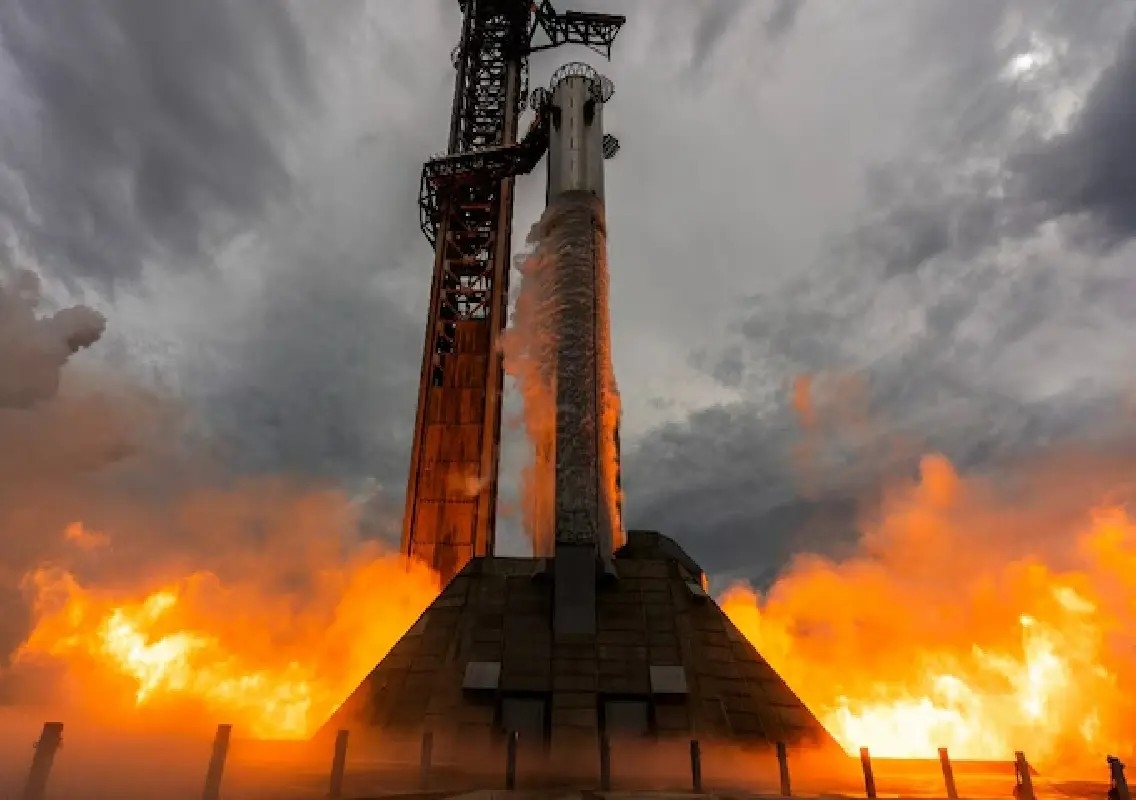


Texas: SpaceX has successfully completed a full-duration static fire test of its next-generation Super Heavy V3 booster at its Starbase facility in Texas, marking a major milestone ahead of the company’s next Starship launch.
The test was conducted on Saturday, July 11, at around 4.37 am IST, during which all 33 Raptor engines ignited simultaneously while the rocket remained securely anchored to the launch pad. The engine firing was completed as planned, with no issues reported.
All 33 Raptor engines fired successfully
Videos released by SpaceX showed towering flames and dense plumes of smoke as Booster 20, the first Version 3 (V3) Super Heavy booster, underwent the full-duration static fire test.
The successful engine firing is one of the final ground-based evaluations before the booster is cleared for flight. During a static fire test, the rocket’s engines are ignited while the vehicle remains fixed to the launch pad, allowing engineers to assess its performance under launch-like conditions.
The test verifies the functioning of the engines, fuel systems, onboard computers and structural components before an actual liftoff.
What is the Super Heavy booster?
Super Heavy is the first-stage booster of SpaceX’s Starship launch system and is designed to propel the Starship spacecraft into space before separating and returning to Earth for reuse.
Standing approximately 70 metres tall and weighing more than 3,000 tonnes when fully fuelled, the booster is powered by 33 Raptor engines, making it the most powerful operational rocket booster ever built.
When combined with the Starship upper stage, the complete launch system measures nearly 120 metres in height, making it the world’s tallest and most powerful reusable rocket.
Key milestone before Flight 13
The successful static fire marks an important step towards Starship Flight 13, the next planned test mission in SpaceX’s ongoing development programme.
The V3 Super Heavy booster features several upgrades over previous versions, including:
- New-generation Raptor 3 engines
- Redesigned control fins
- Structural improvements aimed at enhancing durability
- Faster turnaround for reusability
SpaceX has conducted 12 Starship test flights to date, with each mission contributing to improvements in the launch system.
In recent missions, the company has also demonstrated the ability to recover returning Super Heavy boosters using the launch tower’s mechanical arms, a significant advancement towards rapid rocket reuse.
By successfully completing a full-duration engine firing with all 33 engines, SpaceX has demonstrated that the upgraded booster is capable of withstanding the demanding conditions expected during launch.
Flight 13 could launch next week
SpaceX is expected to pair Booster 20 with Ship 40 ahead of Starship Flight 13, which could lift off as early as July 16, subject to regulatory approvals, final technical assessments and favourable weather conditions.
The upcoming mission is expected to test additional enhancements, including improved thermal protection systems for atmospheric re-entry.
The company ultimately aims to develop Starship into a fully reusable launch system capable of significantly reducing the cost of missions to Earth orbit, the Moon and, eventually, Mars.
The successful completion of the latest static fire test brings SpaceX one step closer to achieving that long-term goal.