







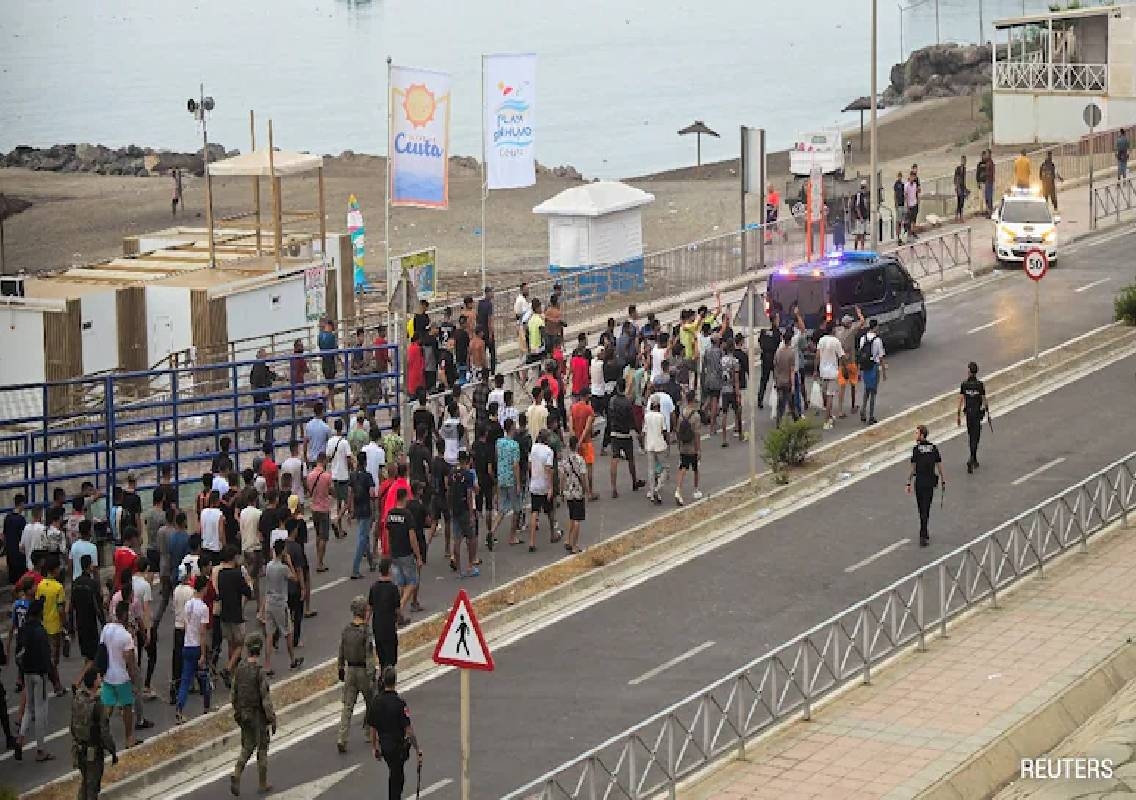


Madrid: Spain has begun installing a 500-metre-long floating sea barrier off the coast of Ceuta, its North African enclave bordering Morocco, after an unprecedented migrant surge that saw around 60,000 people attempt to enter the territory. The move follows one of Europe’s worst recent border crises, in which at least 67 migrants lost their lives during attempts to cross by sea and land.
The barrier is part of Spain’s emergency measures to reinforce border security after the mass influx overwhelmed local authorities and triggered political debate across the European Union over migration policy and border management.
Spain deploys floating sea barrier
Spanish authorities have started installing a 500-metre floating barrier consisting of pneumatic segments and naval buoys along Ceuta’s coastline.
Officials said the structure is designed to discourage migrants from swimming around the existing land border fence while still allowing access for patrol boats and emergency services. Security forces have also increased surveillance along the coastline to prevent further mass crossings.
Around 60,000 migrants entered Ceuta
The latest crisis unfolded after between 50,000 and 60,000 migrants crossed into Ceuta from neighbouring Morocco over a short period, many by swimming around the breakwater while others entered through land routes.
Spanish authorities said the overwhelming majority of migrants returned to Morocco within 48 hours, either voluntarily or through coordinated efforts with Moroccan authorities.
At least 67 people killed
The humanitarian crisis turned deadly, with at least 67 migrants reported dead.
According to officials, several people drowned while attempting the dangerous sea crossing, while others died in a stampede near border checkpoints during the rush into the Spanish enclave. The tragedy has renewed concerns over migrant safety and the activities of human smuggling networks operating in the region.
Spain blames smugglers and misinformation
Spanish Prime Minister Pedro Sánchez said the unprecedented surge was fuelled by misinformation spread by organised trafficking networks, which falsely suggested that migrants would be allowed to enter Ceuta without resistance.
The Spanish government also rejected claims that its earlier migrant regularisation programme had encouraged the crossings, arguing that those measures were unrelated to the latest influx.
EU calls emergency meeting
The border crisis has prompted the European Union to convene an emergency meeting of interior ministers.
Several member states have called for stronger coordination on protecting the EU’s external borders, while the crisis has also reignited debate over migration policies and the future of the Schengen free movement area.
Ceuta’s strategic importance
Ceuta is one of two Spanish territories located on the North African coast and represents one of the European Union’s only land borders with Africa.
For decades, migrants seeking to reach Europe have attempted to enter Ceuta by scaling fences, crossing border checkpoints or swimming around coastal barriers. Spain has repeatedly strengthened security infrastructure in response to such crossings.
Situation remains under control
Spanish officials say order has largely been restored following the deployment of additional security personnel and the installation of the floating barrier.
However, authorities continue monitoring the border closely amid concerns that further attempts could occur if trafficking networks encourage additional crossings. Cooperation with Moroccan authorities remains central to Spain’s border management strategy.
Conclusion
Spain’s decision to install a 500-metre floating sea barrier marks one of its strongest responses to irregular migration in recent years. While the immediate crisis in Ceuta appears to have eased, the deaths of at least 67 migrants and the unprecedented influx have intensified calls across Europe for more coordinated migration and border security policies.