







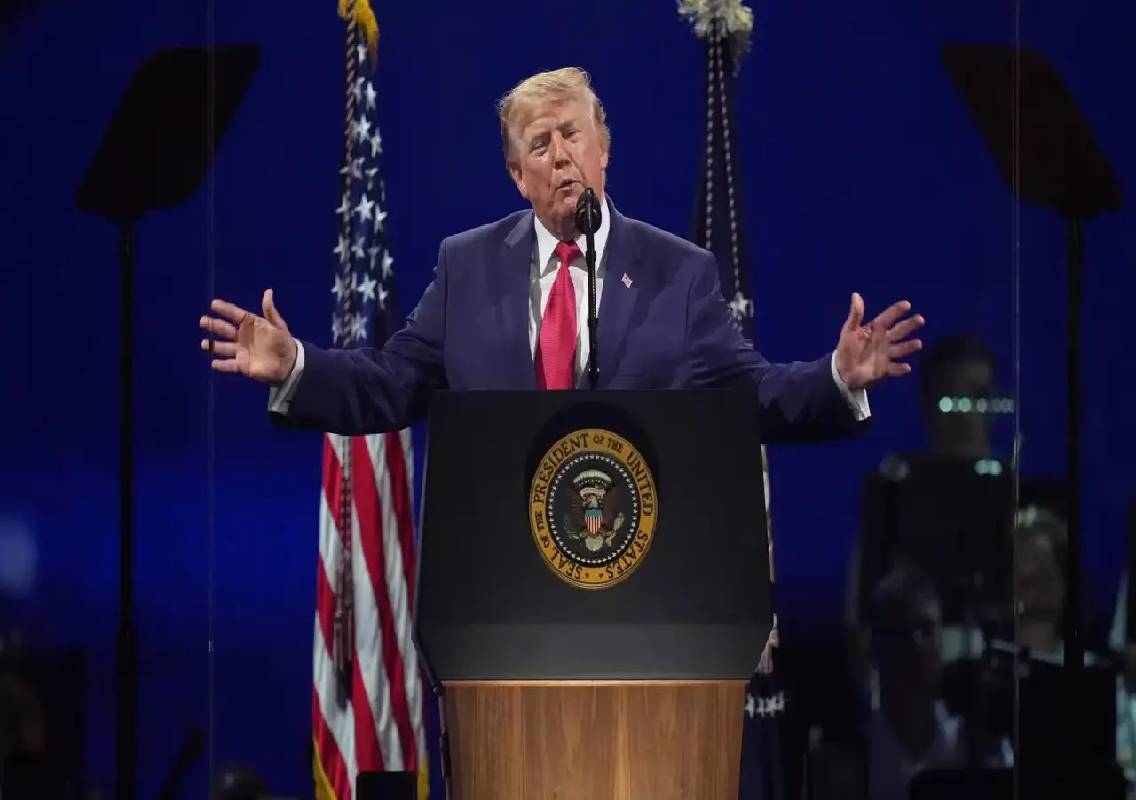


Washington: US President Donald Trump on Monday announced the reinstatement of what he described as the “Iranian blockade”, declaring that the Strait of Hormuz would remain open to all countries except Iran and its customers. He also proposed a 20 per cent charge on cargo passing through the strategic waterway to reimburse the United States for providing maritime security.
The announcement comes amid escalating tensions in the Middle East following renewed exchanges between the United States and Iran.
Trump announces new blockade
In a post on Truth Social, Trump said the Strait of Hormuz would remain open “with or without Iran” and claimed the blockade would apply only to Iranian ships and vessels serving Iranian customers.
“The Hormuz Strait is OPEN, and will remain OPEN, with or without Iran,” Trump wrote.
He added that all other countries would continue to enjoy unrestricted access to one of the world’s busiest energy shipping routes.
US seeks reimbursement for security
Trump also declared that the United States would become the “Guardian of the Hormuz Strait”, arguing that Washington should be compensated for maintaining security in the strategically important waterway.
He proposed imposing a 20 per cent charge on all cargo transiting the Strait of Hormuz to cover the costs of safeguarding maritime traffic.
According to Trump, the process of implementing the proposed reimbursement mechanism would begin immediately.
Strategic importance of the Strait
The Strait of Hormuz is one of the world’s most critical maritime chokepoints, connecting the Persian Gulf with the Gulf of Oman and the Arabian Sea.
A significant share of global crude oil and liquefied natural gas exports passes through the narrow waterway, making any disruption a major concern for international energy markets and global trade.
Iran has historically used its strategic position along the strait as leverage during periods of heightened geopolitical tensions.
Regional tensions continue
Trump’s announcement follows a weekend of military exchanges across the Middle East that have further strained efforts to restore diplomacy between Washington and Tehran.
The latest escalation reportedly began after a container ship was attacked near the coast of Oman, prompting renewed military action in the region.
According to the US Central Command (CENTCOM), American forces targeted multiple sites, including air defence systems, radar installations, missile infrastructure, drone facilities and small boats linked to Iranian military capabilities.
Missile alert sirens were also activated in Bahrain, home to the US Navy’s Fifth Fleet, while Kuwait reported intercepting hostile projectiles.
Questions over implementation
While Trump outlined plans for the blockade and cargo charge, no details have yet been announced regarding the legal framework, international enforcement mechanism or how the proposed 20 per cent fee would be collected.
It also remains unclear how other countries and international shipping companies will respond to the proposal.
Conclusion
Trump’s announcement marks another escalation in US-Iran tensions, combining military posture with economic measures aimed at restricting Iran’s access to the Strait of Hormuz. As regional instability persists, the proposed blockade and cargo fee are likely to draw close attention from global energy markets and international policymakers.