







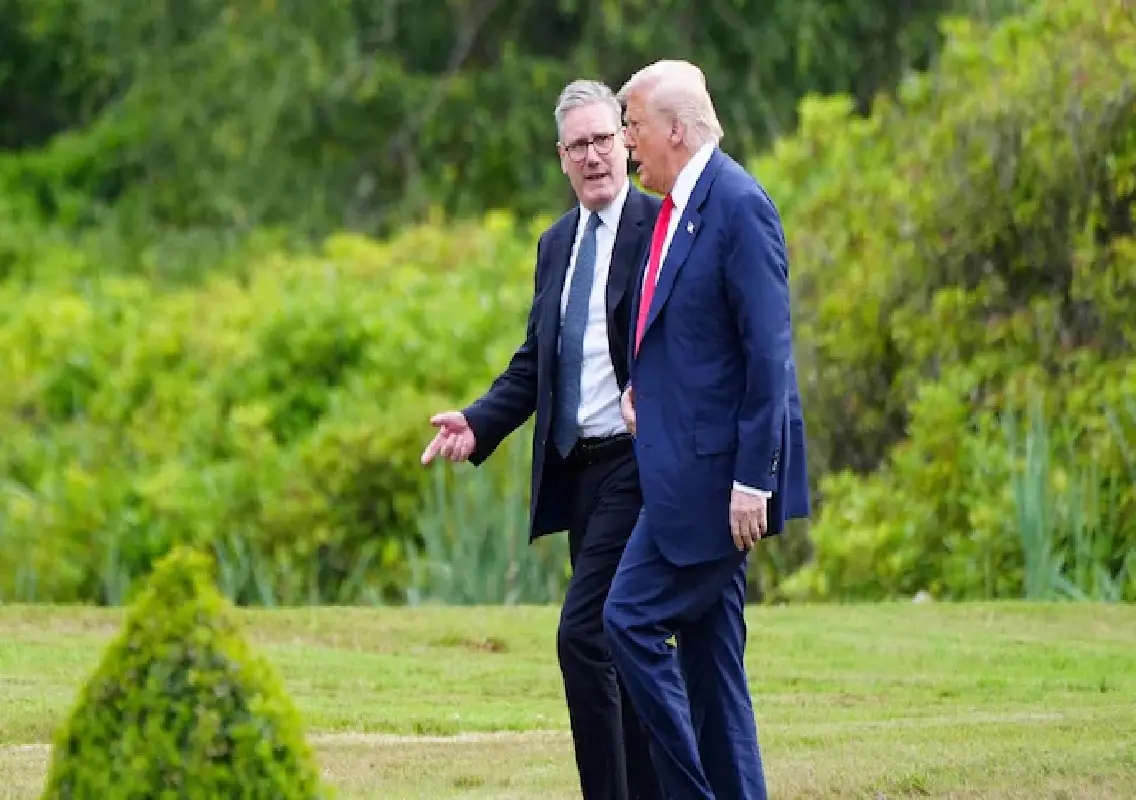


Washington: Donald Trump has escalated his criticism of the United Kingdom’s stance on the ongoing US-Israeli military campaign against Iran, taking aim at British Prime Minister Keir Starmer and accusing London of failing to support Washington during the conflict.
In a post on the social media platform Truth Social, the US President said the UK was “finally giving serious thought” to sending two aircraft carriers to the Middle East but added that American forces no longer needed such support.
Trump’s remarks came amid growing tensions between Washington and London over the UK government’s initial refusal to allow US forces to use British military bases for strikes against Iran.
Trump criticises British response
In his social media post, Trump expressed disappointment with what he described as the lack of British backing during the conflict.
“The United Kingdom, our once great ally, maybe the greatest of them all, is finally giving serious thought to sending two aircraft carriers to the Middle East,” Trump wrote.
He added that the US did not require additional military support now that the situation had progressed.
“That’s ok, Prime Minister Starmer, we don’t need them any longer — but we will remember,” Trump said, suggesting that the US would take note of the UK’s delayed response.
Trump further remarked that the United States did not require support from countries that join wars only after the outcome had already been determined.
Dispute over use of British bases
The disagreement stems from the UK government’s earlier decision to block the initial use of British bases for US operations targeting Iran.
Starmer’s government reportedly withheld permission while seeking clarity on the legal basis and strategic planning behind the proposed military action.
British officials later clarified that the decision was based on the need to ensure that any involvement in military operations complied with international law and national security considerations.
The issue triggered a diplomatic disagreement between the two allies, with Trump suggesting that the decision had damaged the historically close military relationship between the United States and the United Kingdom.
UK considers aircraft carrier deployment
The controversy intensified after Britain’s Defence Ministry indicated that preparations were underway to potentially deploy the aircraft carrier HMS Prince of Wales to the Middle East.
According to British officials, the carrier was being readied for possible deployment as part of contingency planning amid escalating tensions in the region.
However, a government official clarified that no final decision had yet been taken regarding whether the vessel would actually be deployed.
If approved, the deployment would represent a significant step in Britain’s military involvement in the regional conflict.
Starmer defends cautious approach
Prime Minister Keir Starmer has defended his government’s earlier decision to restrict the use of British bases for offensive strikes.
He stated that the UK government needed to be satisfied that any military action was legally justified and carefully planned before granting approval.
Later, Starmer authorised the use of British bases for what he described as defensive operations targeting Iranian missile storage sites and launchers.
According to British officials, these actions were intended to prevent potential attacks and protect regional stability.
Starmer has maintained that his government’s approach prioritised both legal considerations and national security interests.
Personal criticism from Trump
Trump’s criticism of Starmer has also taken on a personal tone in recent days.
During a meeting in the Oval Office with German Chancellor Friedrich Merz earlier this week, the US President made a pointed comparison between the British leader and wartime prime minister Winston Churchill.
“This is not Winston Churchill that we’re dealing with,” Trump reportedly said, suggesting that Starmer lacked the decisive leadership associated with Britain’s wartime history.
The remark further intensified the diplomatic tensions between the two leaders.
Previous disagreements between leaders
Relations between the two governments have also been strained by earlier disagreements on international issues.
Earlier this year, Starmer publicly criticised Trump’s suggestion that the United States could seek to acquire Greenland.
He also condemned remarks by Trump that suggested European troops had avoided frontline combat during the war in Afghanistan.
Starmer described those comments as “frankly appalling,” reflecting differences between the two leaders on security and diplomatic matters.
Strains in a historic alliance
The United States and the United Kingdom have long been regarded as close strategic partners with deep military and intelligence cooperation.
However, the current dispute highlights how policy differences can create friction even between longstanding allies.
Analysts say the disagreement over the Iran conflict reflects broader debates within Western governments about the scale and nature of military involvement in the Middle East.
The situation also underscores the complex balance between maintaining alliances and pursuing independent foreign policy decisions.
As the conflict involving Iran continues to evolve, both governments are likely to remain in close contact despite the political tensions, given the strategic importance of cooperation between the two countries.